The best washing machine cleaner for most UK homes is Dr. Beckmann Service-it Deep Clean, a powder shock treatment that clears biofilm and odour in a single 60°C cycle, and the UK’s best-selling machine cleaner with a 4.4-star average from over 24,000 Amazon reviews. For hard-water limescale, HG Service Engineer’s Descaler works harder; for month-to-month prevention, Calgon; on a budget, supermarket own-brand descaling tablets do 80% of the job for a fraction of the price.
That’s the short answer. The longer one matters because washing machine cleaners are not interchangeable, and the single biggest reason people conclude “these things don’t work” is buying the wrong category for their problem. A descaler will not fix a smell. An antibacterial cleaner will not shift limescale. And nothing in a sachet will fix a filter that hasn’t been emptied since 2019.
This guide fixes that. We start by diagnosing which problem you actually have, then match it to the right product, including whether you need one at all. Every product below has been assessed on real UK machines in both hard and soft water areas, and we’ve been just as clear about what each one does badly.
Updated July 2026, products re-checked for current UK availability, and two entries from our 2025 list dropped after they became difficult to buy.
Disclosure: Cleaners Guide is a participant in the Amazon Associates programme. If you buy through links on this page we may earn a small commission at no extra cost to you. It never affects which products we recommend or where they rank, our ordering is based on testing, and several products here are the cheapest in their category. Prices and availability change constantly; always check the current price on Amazon before buying.
Best washing machine cleaners UK: quick picks
| Category | Our pick | Why it wins |
|---|---|---|
| Best overall | Dr. Beckmann Service-it Deep Clean | Powder shock treatment that clears odour and biofilm in one cycle; UK’s best-seller, 4.4★ from 24,000+ reviews |
| Best for limescale | HG Deep Clean & Service | Strongest descaling action for genuinely hard-water areas |
| Best for odours & hygiene | Dettol Washing Machine Cleaner | Antibacterial formula aimed squarely at the smell rather than the scale |
| Best for prevention | Calgon 4-in-1 Tablets | Stops limescale forming, worth it in hard water, wasted money in soft |
| Best budget | ACTIVE Descaler (24 tablets) | Lowest cost per treatment of anything we tested |
| Best eco option | Ecozone Full Service Cleaner | Plant-based and genuinely effective, if slower to act |
If you only take one thing from this page: buy the category, not the brand. The next section shows you which category you’re in, it takes about a minute and saves most people from buying the wrong thing twice.
First, diagnose the problem (this is the bit everyone skips)
Machines go wrong in four distinct ways, and each one needs a different product. Find your symptom:
| What you’re experiencing | What’s actually happening | What you need |
|---|---|---|
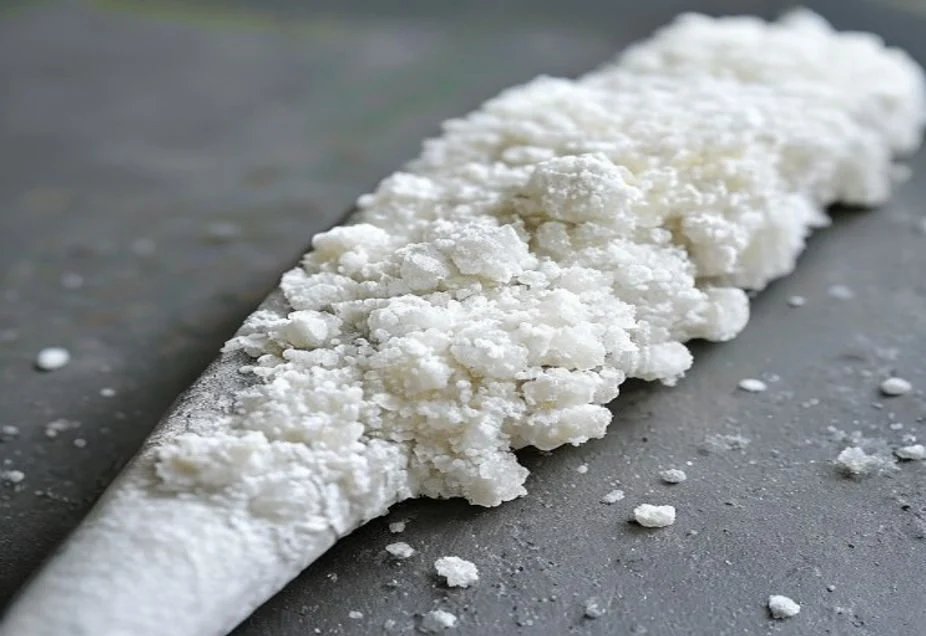
| Musty, damp, “wet dog” or eggy smell; clothes not smelling fresh | Biofilm, a living layer of bacteria, detergent residue and body oils lining the drum, pipes and seal | A shock-treatment cleaner (powder or strong liquid) at 60°C+ |
| White chalky residue, heating element failure, longer cycles, stiff towels | Limescale from hard water baking onto the element and drum | An acidic descaler, citric or sulfamic acid based |
| Black spots on the rubber door seal, spreading over months | Mould colonising the trapped water in the seal folds | Physical cleaning of the seal plus an antibacterial treatment, no cleaner alone fixes this |
| Nothing wrong yet, you want to keep it that way | Normal build-up starting | Prevention: monthly maintenance wash, water softener tablets if you’re in a hard-water area |
The overlap trap: most machines over three years old in a hard-water area have both limescale and biofilm. If that’s you, descale first, then run a shock treatment, in that order, because limescale physically shelters the bacteria you’re trying to kill. Doing it the other way round is why some people report a cleaner “only worked for a fortnight”.
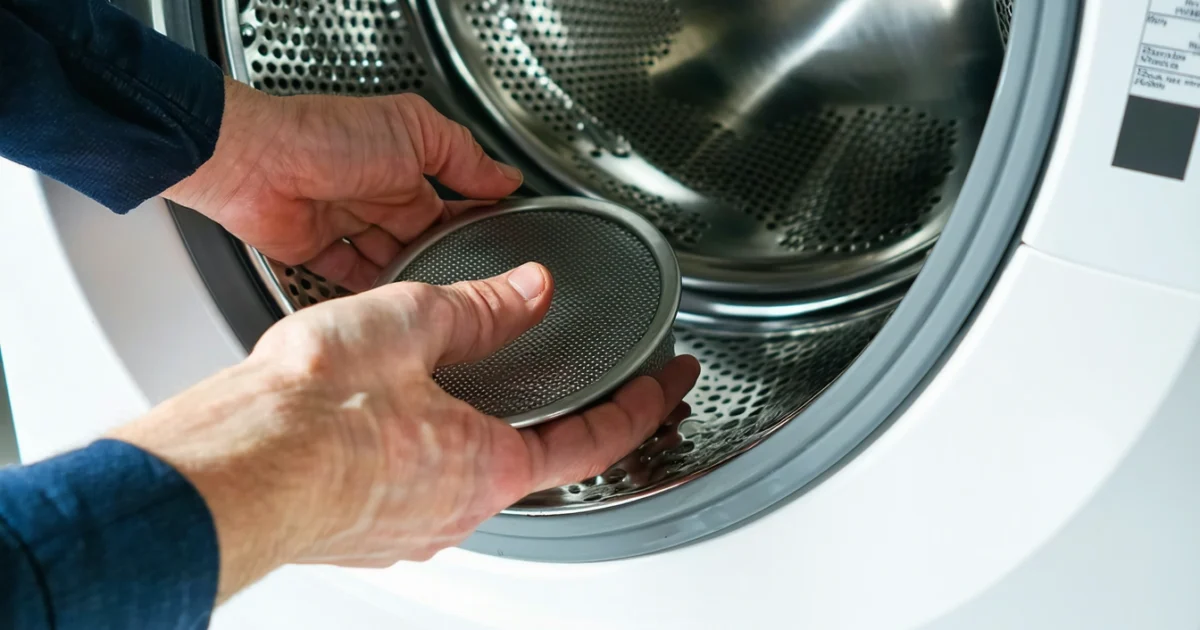
And before you buy anything at all: empty the filter. A blocked filter produces exactly the same stagnant smell as biofilm, costs nothing to fix, and no amount of cleaner will overcome it. Our guide to cleaning the washing machine filter takes ten minutes; do that first and a fair number of readers won’t need a product at all.
Do you live in a hard water area?
This single fact decides half of your buying decision, and most UK guides skip it. Roughly 60% of the UK has hard or very hard water, concentrated in the south and east where the geology is chalk and limestone.
| Water hardness | Typical areas | What it means for you |
|---|---|---|
| Hard / very hard | London and the South East, East Anglia, Essex, Kent, Hampshire, Lincolnshire, parts of the Midlands | Descaling is essential, every 1–2 months. Water softener tablets genuinely pay for themselves |
| Moderately hard | Much of the Midlands, parts of Yorkshire, South West | Descale every 3 months; softener tablets optional |
| Soft | Scotland, Wales, North West, Cornwall, Devon, Northern Ireland | Limescale is barely an issue. Skip descalers and Calgon entirely, spend the money on odour treatments instead |
Check yours in thirty seconds: enter your postcode on your water supplier’s website (they all publish a hardness lookup). If you’re in Glasgow or Cardiff and you’ve been buying Calgon monthly, you can stop, you’re treating a problem you don’t have.
The 10 best washing machine cleaners, reviewed
Ranked by how well each one solves the problem it’s designed for, not by price, and not by how much commission they pay. Where a cheaper product does the same job, we say so.
1. Dr. Beckmann Service-it Deep Clean: Best overall
Type: Powder shock treatment · Use: Every 1–2 months · Amazon rating: 4.4★ from 24,000+ reviews · Check price on Amazon
The default answer for most people, and the UK’s best-selling machine cleaner for good reason. It’s a powder that goes straight into the empty drum and runs on the hottest cycle, and its strength is breadth, it tackles odour-causing biofilm, loosens detergent residue and takes the edge off light scale in a single run. On a badly neglected machine, the difference after one cycle is unmistakable: the stale smell goes rather than being perfumed over, and grey sludge appears in the seal folds where it has been dislodged.
The powder format matters more than it sounds. Powders disperse through the drum, sump and pipework and stay in contact with surfaces longer than a liquid that flushes through. Dr. Beckmann claims removal of 99.99% of bacteria, fungi and viruses, which is a laboratory figure rather than a promise about your specific machine, but the practical result is consistently good.
- Pros: Works on heavily neglected machines; visible results on seals; multipacks make it cheap per treatment; available in every UK supermarket as well as Amazon
- Cons: Not a dedicated descaler, in very hard water you’ll still need something acidic; single sachets are poor value versus 3-packs; the fragrance is noticeable
- Best for: Almost everyone, and especially first-time deep cleans
- Skip if: Your only problem is limescale, buy a descaler instead
How to use: Empty drum, powder straight in (not the drawer), hottest cycle, 90°C if your machine has it, 60°C minimum. Wipe the seal afterwards, because the gunk it dislodges will otherwise sit there.
2. Dettol Antibacterial Washing Machine Cleaner: Best for odours and hygiene
Type: Liquid · Use: Monthly · Sold as: 250ml singles and twin packs · Check price on Amazon
Where Dr. Beckmann is a generalist, Dettol is aimed at the microbiology. If your complaint is specifically that clothes come out smelling less than fresh, particularly if you wash at 30°C to save energy, which is the single biggest cause of smelly machines in modern homes, this is the targeted answer. It’s antibacterial-first, and it noticeably improves the “clean laundry” smell within a wash or two.
What it won’t do is descale. In a hard-water London flat, using Dettol alone will leave you with a hygienic machine that’s still furring up its heating element. Pair it with an occasional descaler rather than expecting it to do both.
- Pros: Genuinely effective on smells; trusted brand with clear antibacterial claims; gentle enough for monthly use; good for households doing lots of low-temperature washes
- Cons: Minimal descaling power; liquid flushes through faster than powder sits; more expensive per treatment than own-brand
- Best for: Low-temperature washers, homes with pets, anyone whose complaint is smell rather than scale
- Skip if: You’re in a very hard water area and haven’t descaled in a year
3. HG Deep Clean & Service: Best for problem machines and heavy limescale
Type: Concentrated liquid · Use: Every 3–4 months, or as a rescue treatment · Check price on Amazon
HG is the brand plumbers and appliance engineers tend to reach for, and this is the product to buy when the supermarket options have already failed. It’s markedly stronger than the mainstream cleaners, a proper descaling and degreasing treatment rather than a maintenance product. On an old machine in a chalk-water area that’s never been descaled, it does work the others can’t.
That strength is also the caveat: it’s not something to run every month, it costs more per bottle, and you should follow the dosage exactly rather than assuming more is better.
- Pros: The most powerful descaling action here; rescues machines others can’t; noticeably improves cycle performance on scaled machines
- Cons: Pricier; overkill for a well-maintained machine; strong chemical smell during use, ventilate the room
- Best for: Hard-water areas, older machines, anything that’s been neglected for years
- Skip if: You’re in soft water and clean regularly, you’re paying for power you’ll never use
4. Calgon 4-in-1 Water Softener Tablets: Best for prevention (in hard water only)
Type: Water softener tablets, added to every wash · Check price on Amazon
Calgon is the most argued-about product in this category, so let’s be direct: it works, but only for one specific job, and only for some people. It is not a cleaner. It softens the water going into your machine so limescale never forms on the heating element in the first place. In a very hard water area, that genuinely extends the life of the element and keeps cycles efficient. In Glasgow, Cardiff or Cornwall, you are softening water that is already soft, the money is wasted.
The second honest caveat: it does nothing about existing scale or smells. Adding Calgon to a machine that already reeks will change nothing at all, which is exactly why so many reviews call it useless. Descale and deep clean first; then use Calgon to stop it coming back.
- Pros: Real prevention in hard water; protects the heating element; convenient, one tablet per wash, no separate cycle
- Cons: Ongoing cost forever; useless in soft water; won’t fix any existing problem; using extra detergent achieves some of the same effect for less
- Best for: Hard-water households who’ve just deep-cleaned and want to protect the machine
- Skip if: You’re in a soft-water region, genuinely, save your money
5. ACTIVE Washing Machine Descaler (24 tablets): Best budget buy
Type: Descaling tablets · Use: Monthly · Check price on Amazon
The value pick, and the one that quietly undermines a lot of premium marketing. Twenty-four tablets is two years of monthly descaling for less than the cost of a few branded single treatments. The active chemistry, an acid descaler in tablet form, is not meaningfully different from what you’re paying three times more for elsewhere.
Where it gives ground is on odour: it’s a descaler, so it won’t do much for biofilm. The sensible pairing for a hard-water home is these tablets monthly plus a Dr. Beckmann shock treatment two or three times a year, a combination that costs less annually than most single-brand routines and covers both problems properly.
- Pros: By far the lowest cost per treatment; bulk pack lasts two years; effective descaling
- Cons: Limited antibacterial action; less familiar brand; plain packaging and no frills
- Best for: Hard-water households on a budget, and anyone who wants a routine they’ll actually stick to
- Skip if: Your problem is smell, not scale
6. Ecozone Full Service Appliance Cleaner: Best eco-friendly
Type: Plant-based liquid · Use: Every 1–2 months · Check price on Amazon
The pick for households avoiding harsh chemistry, and the strongest of the eco options we looked at. It’s biodegradable, plant-derived, and works on both light scale and general grime, it just works more gently, which in practice means it’s excellent as maintenance and underpowered as a rescue treatment. On a machine that’s been cleaned regularly it holds the line perfectly well; on a two-year-old biofilm problem it will need several runs where Dr. Beckmann needs one.
- Pros: Genuinely biodegradable formula; no harsh fumes; works across appliances (dishwasher too); good for sensitive skin households
- Cons: Slower and gentler, not a rescue product; costs more than conventional equivalents; may need repeat treatments
- Best for: Eco-conscious homes with a machine that’s already in decent shape
- Skip if: You need results this weekend on a badly neglected machine
7. Dr. Beckmann Service-it Liquid (250ml): Best for light monthly maintenance
Type: Liquid · Use: Monthly · Check price on Amazon
The same brand’s lighter-touch option. If the powder is the annual deep clean, this is the monthly top-up: easy to dose, no fuss, and it keeps a machine that’s already clean in that state. Our honest take is that most people don’t need both, buy the powder if you’re fixing something, buy this if you’re maintaining something. Buying the liquid to solve a serious odour problem is the most common way people end up disappointed by this brand.
- Pros: Convenient and quick; gentle enough for frequent use; reliable brand
- Cons: Weaker than the powder version; poor value if you’re buying both; doesn’t tackle heavy scale
- Best for: Monthly upkeep after a proper deep clean
8. Oust Dishwasher & Washing Machine Descaler: Best for very heavy scale
Type: Powder descaler sachets · Check price on Amazon
A single-purpose descaler that does that one job aggressively and cheaply. Where it earns its place is a chalk-belt machine with visible white deposits and a heating element that’s clearly struggling, cycles running long, water not reaching temperature. It’s also the pick if you want to treat your dishwasher at the same time, since one box covers both appliances.
- Pros: Powerful, cheap descaling; dual-appliance use; sachets are easy to dose correctly
- Cons: Descaling only, zero odour benefit; not a maintenance product; overkill in soft water
- Best for: Very hard water areas and neglected elements
9. Ecozone Washing Machine & Dishwasher Cleaner Tablets: Best multi-appliance eco option
Type: Eco tablets · Check price on Amazon
The tablet format of Ecozone’s approach, and the convenience choice for anyone running an eco routine across both machines. Same trade-off as its liquid sibling, gentler, greener, slower, with the practical advantage that tablets are harder to over- or under-dose. If you clean both appliances on the same day each month, this makes that a two-minute job.
- Pros: Covers both appliances; foolproof dosing; environmentally sound
- Cons: Gentle action; premium price for eco credentials; not a deep-clean fix
- Best for: Eco households wanting one product for the whole kitchen
10. Finally Fresh Washing Machine Cleaner Tablets: Best for visible grime
Type: Effervescent tablets · Check price on Amazon
Effervescent tablets that fizz aggressively as they dissolve, which does a good job of lifting loose grime and residue from the drum. They’re satisfying to use and work well on machines with visible gunk rather than deep-set problems. Bulk tubs make the per-treatment cost reasonable. The limitation is depth, the fizz acts on what it can reach, so pipework and sump biofilm is less affected than with a powder that sits and works.
- Pros: Effective on visible drum grime; convenient tablets; decent value in bulk
- Cons: Less effective deep in the system; middling on limescale; results vary by machine age
- Best for: Regular users keeping a visibly grubby drum in check
Full comparison: all 10 cleaners side by side
| Product | Type | Descaling | Odour / bacteria | How often | Best for |
|---|---|---|---|---|---|
| Dr. Beckmann Service-it Deep Clean | Powder | Moderate | Excellent | 1–2 months | Overall best all-rounder |
| Dettol Machine Cleaner | Liquid | Low | Excellent | Monthly | Smells, low-temp washing |
| HG Deep Clean & Service | Liquid | Excellent | Good | 3–4 months | Neglected, scaled machines |
| Calgon 4-in-1 | Tablet (every wash) | Prevention only | None | Every wash | Preventing scale in hard water |
| ACTIVE Descaler 24-pack | Tablet | Good | Low | Monthly | Budget descaling routine |
| Ecozone Full Service | Liquid (eco) | Moderate | Good | 1–2 months | Eco maintenance |
| Dr. Beckmann Liquid | Liquid | Low | Good | Monthly | Monthly upkeep |
| Oust Descaler | Powder sachet | Excellent | None | 3 months | Heavy limescale only |
| Ecozone Tablets | Tablet (eco) | Moderate | Good | Monthly | Two appliances, eco |
| Finally Fresh | Effervescent tablet | Low | Good | Monthly | Visible drum grime |
Reading this table properly: nothing here scores “excellent” in both columns, and that’s not a coincidence, descaling chemistry is acidic while antibacterial cleaning is usually oxidising, and products that promise to be brilliant at both are generally mediocre at each. The most effective routine for a hard-water home is two cheap products used for their own jobs, not one expensive product doing everything adequately.
Supermarket own-brand cleaners: are they any good?
Short answer: for descaling, yes, surprisingly good. For odour removal, less so. Tesco, Asda, Sainsbury’s, Aldi and Lidl all sell machine cleaners and descalers, and the descaling products are typically citric or sulfamic acid, which is the same active chemistry as the branded versions at a fraction of the price. If your problem is limescale, an own-brand descaler is a genuinely sensible buy.
Where the branded products still earn their premium is the antibacterial side. Formulations that clear biofilm properly tend to be better engineered, and biofilm is the thing that causes the smell everyone actually complains about. Our recommendation for the value-focused: own-brand descaler monthly, branded shock treatment quarterly. You get the important part of both for less than a single-brand routine.
One caveat worth knowing: supermarket stock varies enormously by store and season, and own-brand lines get discontinued and reformulated without notice. If you find one that works, buying a few is more reliable than assuming it’ll be there next month.
Do vinegar, soda crystals and bicarb actually work?
This is the most-searched question in the category, and the honest answer is partly, with one method that’s genuinely worth doing and one that’s a bad idea.
| DIY method | Does it work? | Our verdict |
|---|---|---|
| Soda crystals (500g in the drum, hot cycle) | Yes, genuinely effective | The best DIY option by a distance. Cuts grease and detergent residue, costs pennies, and is what many appliance engineers suggest. Safe for the machine |
| Bicarbonate of soda | Mildly | Fine for deodorising and for scrubbing the seal and drawer by hand. Too weak to fix a real problem alone |
| White vinegar | Partly, with a real risk | It does dissolve light limescale, but it’s a weak acid that, used often, can degrade rubber seals and hoses over time. Several manufacturers explicitly advise against it |
| Citric acid (couple of tablespoons, hot cycle) | Yes | The DIY descaler that actually works, and it’s the same active ingredient as many commercial tablets. Cheap in bulk |
| Bleach | Don’t | Damages seals, can react with detergent residue, and manufacturers warn against it. The one method to rule out entirely |
The verdict: soda crystals plus citric acid, used on alternate months, will keep a machine in good order for a few pounds a year and cover both the grease and the scale. What DIY doesn’t replicate is the targeted antibacterial action of a proper shock treatment on an established biofilm, that’s the point at which a commercial cleaner earns its money. And never mix vinegar or citric acid with bleach-based products: acid plus bleach releases chlorine gas.
We’ve covered the full home-remedy routine step by step in our guide to cleaning a washing machine, including quantities and cycle settings.
How to use a washing machine cleaner properly
Most “it didn’t work” reviews come down to method rather than product. The full routine takes about ten minutes of attention plus the cycle time:
- Empty the machine completely. No clothes, no towels “to make use of the cycle”, fabric absorbs the cleaner you paid for and shields the drum surfaces you’re treating.
- Clean the filter first. Bottom-front panel, bowl and towel underneath, unscrew and let it drain. This is where the coins, hairgrips and slime live, and it’s the most common single cause of persistent smell.
- Pull out and wash the detergent drawer in hot soapy water, scrubbing the underside of the cover with an old toothbrush. Black slime here recontaminates every wash.
- Wipe the door seal, folding it back. Trapped water sits in the fold, this is where mould lives and where no cleaner can reach on its own.
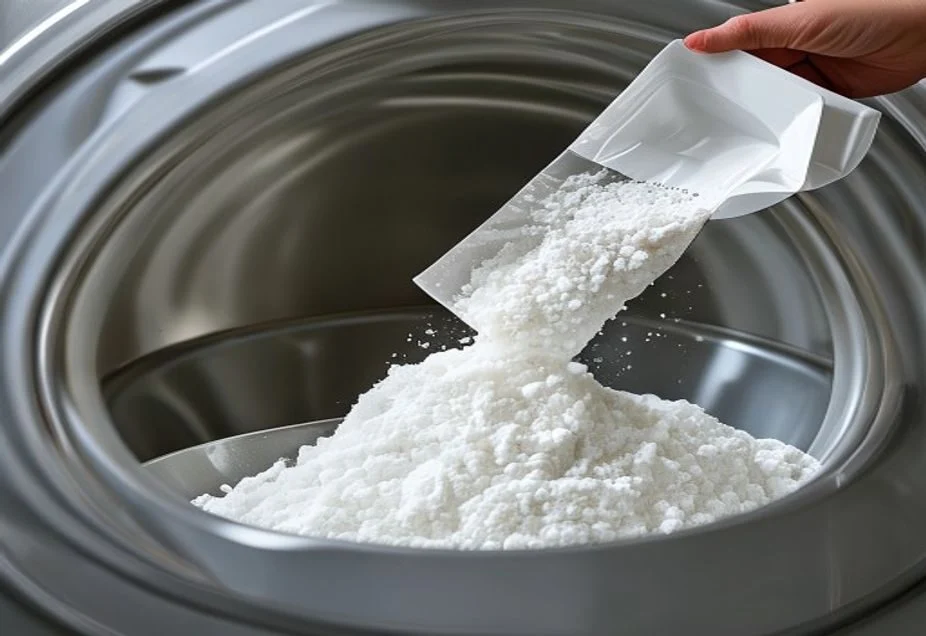
- Add the product where the instructions say. Powder usually goes straight into the drum; liquids sometimes go in the drawer. This detail matters more than people expect, powder in the drawer largely washes away before it starts working.
- Run the hottest cycle available, 90°C where offered, 60°C minimum. Temperature is what activates most of these products and what kills bacteria; a 30°C “maintenance wash” achieves very little.
- Leave the door and drawer ajar afterwards to dry. This single habit prevents most future problems.
If the machine has been neglected for years, expect to run the treatment twice, once to loosen everything, once to flush it out. Wipe the seal between runs, because the first cycle typically deposits dislodged sludge there.
Black mould on the rubber seal: the problem cleaners can’t solve alone
This deserves its own section because it’s the most common complaint we see, and because no cleaning cycle will fix it by itself. Those black spots are mould growing in the folds of the door gasket, in water that never dries. A cleaner circulating through the drum barely touches the inside of that fold.
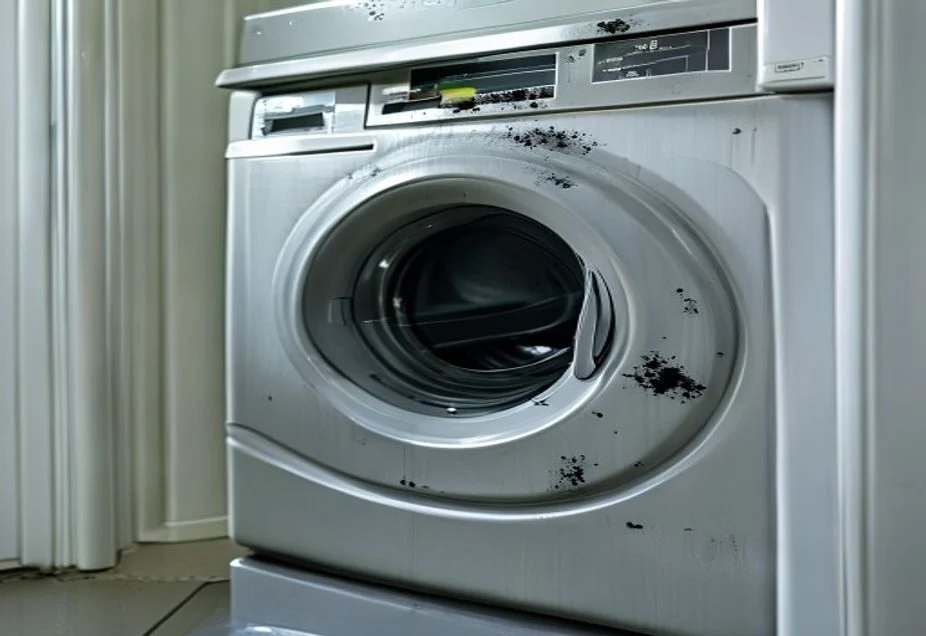
- Peel the seal back gently with your fingers and look inside, expect standing water, hair and grey slime.
- Wipe the whole fold out with hot soapy water on a cloth, or a mould-and-mildew spray left for its stated contact time. Get right round the circumference.
- Use an old toothbrush on the stubborn black speckling, working it out of the rubber texture.
- Dry it thoroughly with a cloth, this is the step that decides whether it comes back.
- Then run a hot shock-treatment cycle to deal with what’s living further inside the machine.
Honest expectation setting: deep-set black staining in perished rubber may never come out completely, at that point it’s cosmetic rather than hygienic, provided the mould itself is dead and the seal is dried after each wash. If the rubber is cracked or perished, a replacement seal is an inexpensive part and a straightforward job for an engineer. Our dedicated guide to cleaning the washing machine rubber seal covers the detail, including how to stop it returning.
Does your machine’s brand change what you should buy?
Mostly no, but there are a few brand-specific things worth knowing, because manufacturers each handle machine cleaning slightly differently.
| Brand | What’s different | What we’d do |
|---|---|---|
| Samsung | Has a dedicated Drum Clean / Eco Drum Clean cycle and will nag you with a reminder light | Run the built-in cycle empty as instructed. Adding a shock treatment to that cycle occasionally does more than the cycle alone |
| Bosch / Siemens / Neff | Often have a Drum Clean or hot maintenance programme; Bosch sells its own-brand descaler | Any good third-party cleaner works, you’re not obliged to buy the manufacturer’s product |
| Miele | Built to tighter tolerances and often stricter in the manual about what you may use | Check the manual and stay conservative, avoid strong acids and bleach; Miele’s own descaler or a gentle branded cleaner is the safe choice |
| Hotpoint / Indesit / Beko | No special requirements; often lack a dedicated cleaning cycle | Use the hottest cottons cycle with the machine empty, this is exactly the mainstream case these products are designed for |
| LG | Tub Clean cycle built in, similar to Samsung | Built-in cycle plus a quarterly shock treatment |
The general rule: a “Drum Clean” cycle is a hot empty wash, not a chemical treatment. It circulates hot water, which helps, but it has nothing in it to dissolve scale or break down biofilm. Using the cycle and a product together is what actually gets a machine clean, which is precisely what your manual means when it says “with a suitable machine cleaner”. If in doubt, the manual overrides anything on this page.
How often should you use a washing machine cleaner?
| Your situation | Recommended routine |
|---|---|
| Soft water, few washes, no problems | Shock treatment every 3 months; hot maintenance wash monthly |
| Hard water area | Descaler monthly + shock treatment every 2–3 months |
| Mostly washing at 30°C or below | Shock treatment every 4–6 weeks, low-temperature washing is the main cause of biofilm |
| Large family, sports kit, pet bedding, nappies | Monthly shock treatment; keep the filter on a monthly schedule too |
| Existing smell or visible mould | Two treatments a week apart, then move to monthly maintenance |
Between treatments, the free habits do most of the work: run one hot (60°C+) wash a week even if it’s just towels, leave the door and drawer ajar between loads, take washing out promptly rather than leaving it damp overnight, and don’t over-dose detergent, excess detergent doesn’t rinse away and becomes the food supply for the biofilm you’re trying to prevent. Our maintenance wash guide explains the weekly routine in full.
What it costs to keep a machine clean for a year
Rough annual budgets, based on typical UK pack sizes. Exact prices move constantly, so treat these as proportions rather than quotes:
- Budget routine (~£10–£15/year): bulk descaler tablets monthly plus soda crystals. Covers scale and grease; light on antibacterial action.
- Balanced routine (~£20–£30/year): own-brand or bulk descaler monthly plus a branded shock treatment quarterly. This is the sweet spot for most homes and what we’d personally run.
- Premium routine (~£60–£100/year): branded cleaner monthly plus Calgon with every wash. Justified in very hard water with an expensive machine; excessive elsewhere.
- Doing nothing: free until it isn’t. A failed heating element is typically a £100–£180 repair, and a machine written off early is several hundred pounds, which is the actual economics behind all of the above.
Nine mistakes that stop cleaners working
- Running the treatment cold or at 40°C. Temperature does much of the work, use the hottest cycle the machine offers.
- Leaving washing in the drum. Fabric soaks up the product and shields the surfaces you’re treating.
- Buying a descaler for a smell (or a deodoriser for limescale). The single most common mismatch, and the root of most one-star reviews.
- Ignoring the filter. No cleaner overcomes a blocked filter; empty it before you spend anything.
- Never touching the seal by hand. Mould in the gasket fold has to be physically wiped out.
- Over-dosing detergent all year. Excess detergent is what feeds the residue in the first place.
- Shutting the door after every wash. A sealed damp drum is a perfect incubator, leave it ajar.
- Expecting one treatment to fix years of neglect. Badly affected machines need two or three runs.
- Using bleach, or mixing products. Bleach damages seals, and acid plus bleach produces chlorine gas. Use one product at a time, as directed.
When a cleaner won’t be enough
Be realistic about the limits. Book an engineer rather than buying another product if: the smell survives two proper deep cleans and a filter clean; there’s standing water in the drum after a cycle (a drainage or pump fault); the machine won’t heat (often a scaled or failed element); the seal is cracked or perished rather than just stained; or there’s a burning or electrical smell, which is a stop-using-it-now situation rather than a cleaning one.
On an older machine, weigh a repair against replacement honestly, but a machine that’s simply dirty is almost always worth rescuing. A £5 treatment fixing a machine people were ready to replace is the most common outcome of everything on this page.
Frequently asked questions
What is the best washing machine cleaner in the UK?
Dr. Beckmann Service-it Deep Clean is the best all-round choice for most UK homes, a powder shock treatment that clears odour-causing biofilm in one hot cycle, and the UK’s best-seller at 4.4 stars from over 24,000 Amazon reviews. For heavy limescale choose HG Deep Clean & Service instead, and for the lowest cost per treatment, bulk descaling tablets.
What is the best product to clean out your washing machine?
It depends on the problem. A powder shock treatment (Dr. Beckmann) for smells and general grime; an acidic descaler (HG, Oust or own-brand tablets) for limescale; an antibacterial liquid (Dettol) if clothes aren’t smelling fresh. Soda crystals are the best cheap DIY alternative for grease and residue.
Which brand of washing machine cleaner is best?
Dr. Beckmann for all-round cleaning, HG for descaling power, Dettol for antibacterial performance, and Ecozone if you want a plant-based option. No single brand leads in every category, descaling and antibacterial chemistry pull in different directions, so the best routine usually combines two products.
How do I remove black mould from a washing machine rubber seal?
Peel the seal back, wipe inside the fold with hot soapy water or a mould spray left for its contact time, work the speckling with an old toothbrush, and dry thoroughly. Then run a hot shock-treatment cycle. Cleaning products alone can’t reach inside the fold, the physical wipe is the essential step, and drying the seal after each wash is what stops it returning.
What to put in a washing machine to clean it in the UK?
Either a commercial machine cleaner (powder into the empty drum, hottest cycle) or, for a cheap DIY version, 500g of soda crystals in the drum on a hot wash, alternating with a couple of tablespoons of citric acid for limescale. Avoid bleach, and go easy on vinegar, it can degrade seals over time.
Do washing machine cleaners actually work?
Yes, when matched to the right problem and run hot on an empty drum. Most disappointment comes from mismatch, using a descaler on a smell, or a deodoriser on limescale, or from running the cycle too cool. They cannot fix a blocked filter, mould inside the seal fold, or a mechanical fault, all of which need hands-on attention.
How often should you use washing machine cleaner?
Every 1–2 months for most homes; monthly if you wash mainly at 30°C, live in a hard-water area, or run a busy household. Between treatments, a weekly hot wash and leaving the door ajar do most of the preventive work for free.
Is Calgon worth it, or is it a con?
It’s worth it in hard-water areas and a waste of money in soft-water ones. Calgon prevents limescale forming on the heating element; it is not a cleaner and does nothing for existing scale, smells or mould. If you’re in Scotland, Wales, the North West or the South West, you can skip it entirely.
Can you use vinegar to clean a washing machine?
You can, but we’d use citric acid or soda crystals instead. White vinegar does dissolve light limescale, but as an acid it can degrade rubber seals and hoses with repeated use, and several manufacturers advise against it. Citric acid descales just as well without that risk.
Are soda crystals good for washing machines?
Yes, the best DIY option here. About 500g in an empty drum on the hottest cycle cuts through grease and detergent residue, costs very little and is safe for the machine. It won’t match a dedicated antibacterial treatment on established biofilm, but as monthly maintenance it’s excellent value.
Can you use dishwasher tablets to clean a washing machine?
It’s a popular hack and it does have some cleaning effect, but dishwasher tablets are formulated for a different machine and water system, and they’re not designed for washing machine seals or drums. A dedicated cleaner or soda crystals costs about the same and is the safer choice.
What kills bacteria in a washing machine?
Heat plus an antibacterial treatment. A 60°C or hotter cycle is the foundation, low-temperature washing is why modern machines develop bacterial biofilm at all, combined with an antibacterial cleaner such as Dettol or a shock treatment like Dr. Beckmann. Running one hot wash a week keeps bacterial load down between treatments.
Why does my washing machine still smell after cleaning it?
Usually one of four things: the filter hasn’t been emptied, the door seal fold hasn’t been wiped by hand, the cycle wasn’t hot enough, or the build-up needs more than one treatment. Work through those in order. If a smell survives two proper deep cleans plus a filter clean, suspect a drainage fault and call an engineer.
Can washing machine cleaner damage your machine?
Not when used as directed, these products are formulated for the job. Damage comes from misuse: bleach, over-dosing strong descalers, mixing products, or frequent undiluted vinegar on seals. Always follow the dosage on the pack and check your manual, especially with Miele and other brands that specify what’s permitted.
Should you clean a brand-new washing machine?
Run one hot empty cycle before first use to flush out manufacturing residue, no product needed. After that, start the normal maintenance schedule from month one rather than waiting for a problem; prevention on a clean machine is far easier than rescuing a neglected one.
Do washing machine cleaners work on a Samsung or Bosch drum clean cycle?
Yes, and that’s the ideal combination. A Drum Clean or Tub Clean programme is simply a hot empty wash, it contains no chemistry. Adding a cleaner to that cycle gives you both the heat and the active ingredients. Check your manual first, as a few manufacturers specify particular product types.
Are supermarket own-brand washing machine cleaners any good?
For descaling, yes, own-brand tablets typically use the same citric or sulfamic acid chemistry as branded ones for much less. For odour and biofilm removal, branded shock treatments still perform better. The best-value approach is own-brand descaler monthly with a branded deep clean quarterly.
What’s the best washing machine cleaner for smells specifically?
Dettol Washing Machine Cleaner for the antibacterial angle, or Dr. Beckmann Service-it Deep Clean if the smell is severe and long-standing. Whichever you choose, empty the filter and wipe the seal fold first, in our experience those two steps resolve a large share of “smelly machine” complaints on their own.
Powder, liquid or tablet, which format is best?
Powders generally perform best for deep cleaning because they disperse through the system and stay in contact longer. Liquids are convenient for regular maintenance. Tablets are the easiest to dose correctly and usually the cheapest in bulk. For a serious problem choose powder; for routine upkeep, whichever you’ll actually remember to use.
How long does a washing machine cleaning cycle take?
Typically 1.5 to 3 hours, since you’re running the hottest and usually longest programme. A dedicated Drum Clean cycle on Samsung or LG machines often runs closer to an hour. Add ten minutes of hands-on time for the filter, drawer and seal, which is where the real work happens.
The verdict
If you want one product and no further thought: Dr. Beckmann Service-it Deep Clean, run on the hottest empty cycle every couple of months. It handles the problem most people actually have, smell, and it’s cheap enough to keep in the cupboard.
If you want the routine we’d genuinely run in a hard-water house: bulk descaling tablets monthly for the limescale, a shock treatment quarterly for the biofilm, the filter emptied every month, the seal wiped every few weeks and the door left ajar between washes. That’s under £30 a year and it’s more effective than any single premium product used on its own.
And if your machine smells today: empty the filter first. It’s free, it takes ten minutes, and often enough it’s the whole answer. Wondering how hot to wash? See the evidence on what temperature actually kills germs in your laundry.