Cleaning a washing machine with white vinegar and bicarbonate of soda is cheap, popular and mostly harmless, but it is not risk-free, and not every machine maker approves of it. Before the how-to, here is what can go wrong, what to check first and where the limits of the method are.
As an Amazon Associate we earn from qualifying purchases.
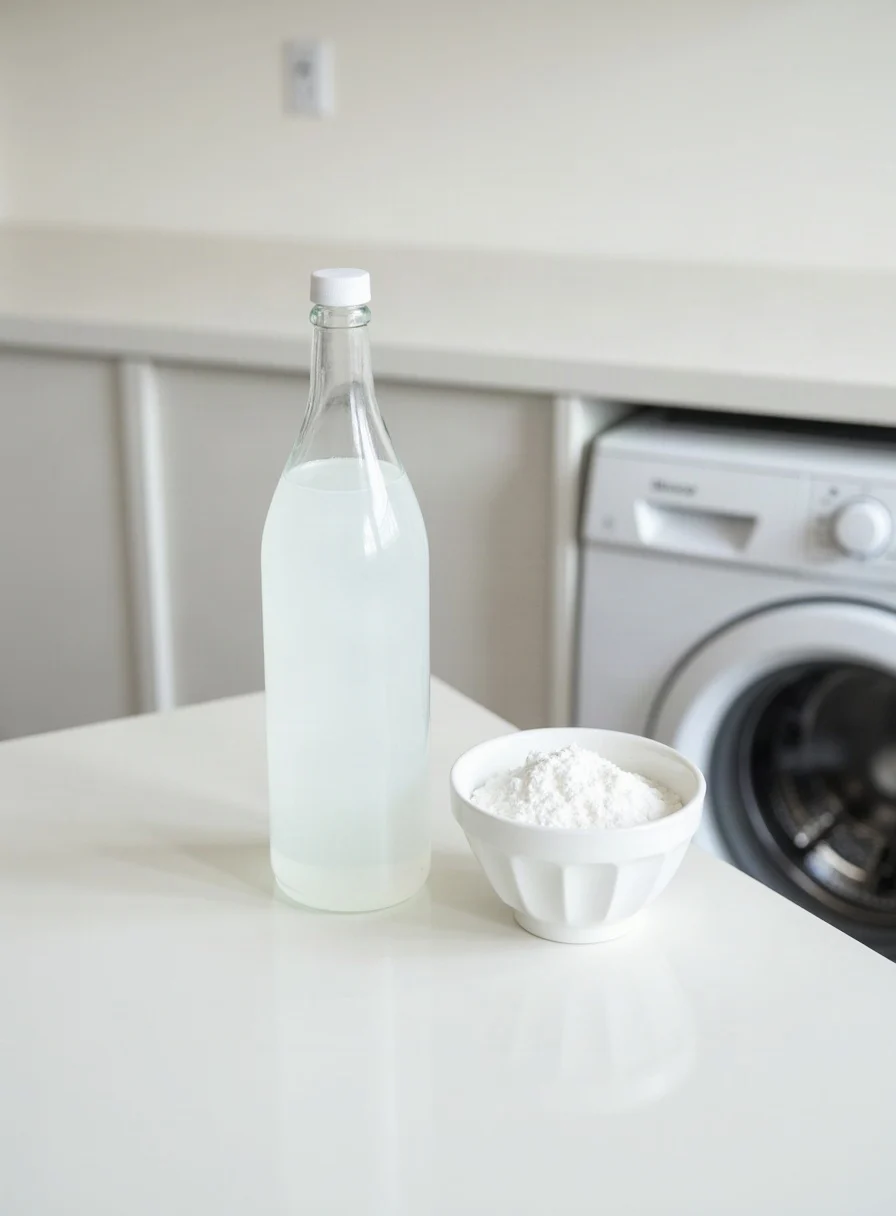
What can go wrong when you clean a washing machine at home
Most of the risks come from a handful of choices, and all are avoidable.
- Acid on rubber. Vinegar is a mild acid. Used now and then it is generally fine, but using it every week, leaving it sitting on door seals or using stronger “cleaning vinegar” can wear rubber over time. Some manufacturers advise against vinegar altogether.
- The wrong vinegar. Malt and wine vinegar carry colourings and sugars that can leave sticky residues, so use distilled white vinegar only.
- Mixing products. Vinegar and bleach together release chlorine gas, which is dangerous to breathe. Vinegar with bicarbonate of soda in the same cycle just fizzes and cancels out most of what each does. Use one product per cycle.
- Water and electricity. You will be wiping controls and opening a filter that holds water. Unplug the machine or switch it off at the socket first, spray cloths and not the machine, and never remove the back or a panel on a plugged-in appliance.
- Forcing parts. A stuck filter or drawer can crack or cross-thread if you force it, and a cracked housing leaks.
- Voiding advice or warranty. If your machine is under warranty, using something the manual warns against may cause trouble if a fault arises later.
Check the manual and the label first
Look for these things:
- Does the maker mention vinegar? Some premium or coated-drum machines carry a warning against it, so check before you assume it suits yours. If it does, use the maker’s own cleaning tablets instead.
- Is there a Drum Clean, Tub Clean or Maintenance Wash programme? Many machines have one. It is designed for the job, so use it with your chosen product.
- What temperature does your machine offer? Many have a 60 degree cycle, and some go higher. You do not need the maximum.
- Where is the filter and does the manual say how to open it? Some machines have a small drain hose by the filter.
- Is it a front-loader, top-loader, integrated machine or washer-dryer? The method suits all of them in principle, but washer-dryers and integrated machines may have extra advice in the manual.
If you do not have your manual, search the model number on the maker’s website. The model number is on a label inside the door or on the back.
What vinegar and bicarbonate can and cannot do
Both are mild, which is exactly why they are popular and why they have limits. White vinegar contains acetic acid, which dissolves mineral deposits and soap scum and helps lift light limescale and film. It also deodorises. It is not a disinfectant you can rely on to sterilise a drum, and a hot cycle is doing a lot of the work. Bicarbonate of soda is mildly alkaline and slightly gritty, so it helps with smells and gently scrubs residue. Its fizz when it meets vinegar looks dramatic but cleans very little, and the two largely cancel each other out.
| Situation | Vinegar and bicarbonate | Shop-bought cleaner or descaler |
|---|---|---|
| Monthly upkeep, light smell | Usually enough | Not needed |
| Light limescale | Helps | Better for thicker scale |
| Machine ignored for many months | May need several rounds | A better first move |
| Visible black mould on the seal | Try first, with scrubbing | Mould remover if it will not shift |
| Sewage-like smell that returns | Unlikely to be enough, check filter and hoses | Cleaner may help, but look for a drainage fault |
| Maker warns against vinegar | Do not use | Use the approved product |
A sensible plan for most households is vinegar and bicarbonate for upkeep, and a washing machine cleaner or descaler every few months or when a problem appears. It costs little to start with the gentle method, and if a smell has not gone after two proper cleans a month apart, step up rather than repeating the same thing.
The gentlest method: two hot cycles, one after the other
This takes about 20 minutes of actual work and three to four hours of machine time, so start it when you do not need the washer. The vinegar cycle descales lightly and deodorises, and the bicarbonate one follows to freshen the drum and soften the vinegar smell. Our guide on whether vinegar actually disinfects explains what it can and cannot do, and it is a reminder that vinegar cleans better than it sanitises.
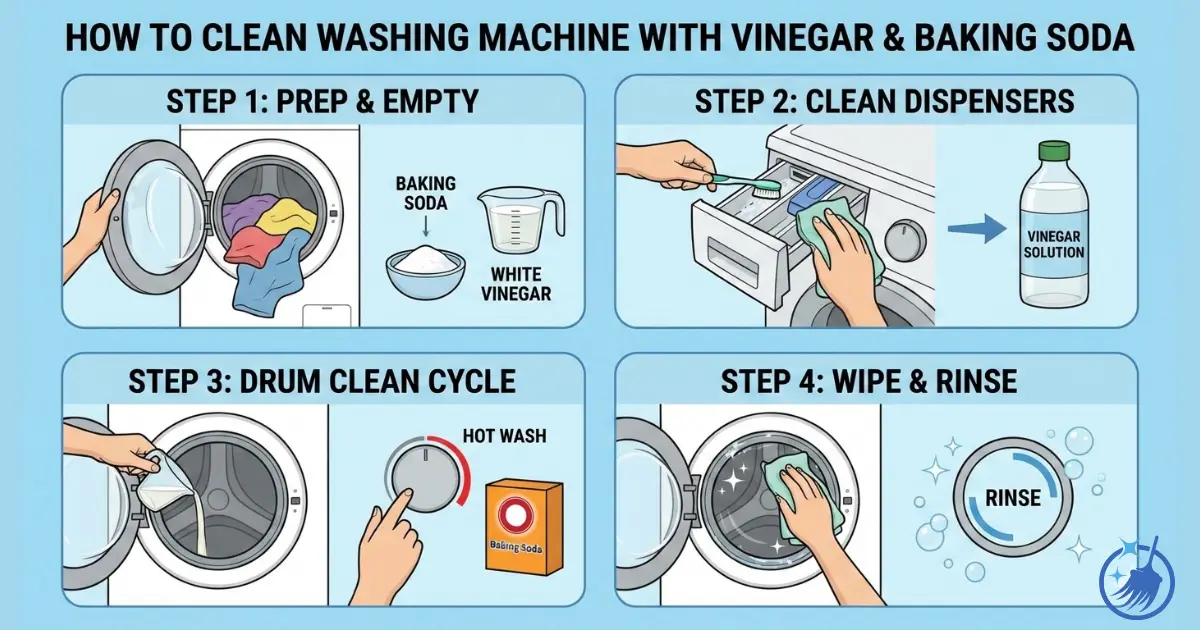
Step 1. Unplug, then clean the detergent drawer and its slot
Pull the drawer out as far as it goes and press the release button or tab, usually in the middle, while you pull. Soak it in warm water with about 250ml of white vinegar for 10 to 15 minutes, scrub each compartment with an old toothbrush and rinse it. Spray the empty slot with equal parts vinegar and water, scrub, wipe and let it dry. Solid lumps of detergent can sit in the cavity and affect drainage.
Step 2. Wipe the door seal
On a front-loader fold the rubber seal back and spray the folds with equal parts white vinegar and warm water. Remove hair, lint, coins and slime with a cloth, and give black mould spots about five minutes before wiping. On a top-loader, wipe the rim where the lid closes. A dedicated cloth, kept for this job and washed hot afterwards, is a good idea. Our complete washing machine cleaning guide covers the seal and drum in further detail.
Step 3. Hot vinegar cycle
Pour about 500ml of distilled white vinegar straight into the empty drum, not the drawer. Pick the hottest cycle you are comfortable using, ideally 60 degrees where available, avoid eco and quick programmes, and add no detergent or softener. It typically takes up to two hours. Foamy or cloudy water is normal.
Step 4. Bicarbonate of soda cycle
Straight afterwards, sprinkle about 100g of bicarbonate of soda into the drum and run a shorter hot cycle of 40 to 60 degrees with no other additives. It helps neutralise the vinegar smell and freshens the drum. A fresh rinse cycle also does this if you would rather skip the bicarbonate.
Step 5. Clean the filter, safely
A dirty filter is the most common reason smells survive vinegar cycles. On a front-loader it sits behind a small panel at the bottom front, and some top-loaders have it inside the drum or in the pump area. Lay old towels down with a shallow tray, as the filter holds a few hundred millilitres of water. Open the panel, drain through the small hose if there is one, then turn the cap slowly anticlockwise. Remove hair, coins, lint and other items, rinse the filter, wipe the housing and refit it firmly, turning clockwise until it is tight.
If the filter will not turn easily, stop. It may be cross-threaded or jammed, and forcing it can crack the housing and cause leaks. An engineer can free it.
Step 6. Final wipe, inside and out
Wipe the inside of the drum, the glass and the door seal with one part vinegar to three parts warm water, paying attention to the back wall and the drum holes. Then wipe the door frame, hinges and the machine body, spraying onto a cloth and not directly onto the controls, and dry with a soft cloth. A paste of bicarbonate of soda and a little water removes stubborn detergent marks on textured plastic.
While the machine is open, check the drum holes with a torch for grey residue and brush them with the toothbrush, and wipe the area behind the lip of the drum. A small amount of loosened residue in the first rinse of the next wash is normal.
Step 7. Let it dry
Leave the door and drawer open for a few hours. Damp is what allows the smell back.
Between deep cleans
Every few weeks you can run a lighter maintenance wash, with about 250ml of white vinegar in the empty drum on a 60 degree cycle. Skip it if your manual advises against vinegar, and do not use it as a substitute for the monthly clean and filter check. Choose a larger bottle of plain white vinegar if you use it regularly, which is usually cheaper per clean than small bottles.
Stronger options, and the cautions that go with them
Vinegar and bicarbonate suit routine upkeep and light smells. They are weaker than a dedicated cleaner, so move on when one of these applies:
- the machine has not been cleaned in many months
- a smell is still there after two monthly cleans, including the filter
- you can see black mould that vinegar does not shift
- heavy limescale in a hard water area, or the machine is slow to heat
- you want an antibacterial product, for example after illness or for baby clothes
Shop-bought washing machine cleaner or descaler
Use one that says it is for washing machines, with the dose and temperature on the pack, and run it empty. A powder such as Dr Beckmann Service-it Deep Clean goes straight into the drum, and a liquid such as Dettol Washing Machine Cleaner goes in the drawer. Do not combine it with vinegar or other products in the same cycle, and wear gloves if the label asks for them. A descaler is for scale, and a cleaner is for film and odours, so check which job each does. For comparisons, see our best washing machine cleaner UK guide.
Mould on the door seal
If vinegar will not shift it, use a mould remover made for the job, following the label. Bleach is a last resort. Check the manual, apply a weak solution with a cloth, ventilate, rinse very well, and never mix it with vinegar, descalers or other cleaners. Frequent bleach exposure can harden rubber.
Hard water
Hard water produces limescale on the heating element and drum. It may need a descaler every few months, and a water-softening product used as directed in washes can help. Scale on the element can shorten its life and affect heating, so it is worth acting early.
What to buy, and what each is for
You can do the gentlest method with two supermarket staples. The table covers the extras, and the links go to Amazon UK searches so you can compare sizes and current prices.
| Product | Best for | What to look for | Caution |
|---|---|---|---|
| White vinegar | The hot cycle and wiping seals and drawers | Distilled white, 5% or similar, in a large bottle | Not malt, wine or strong cleaning vinegar. Do not mix with bleach |
| Bicarbonate of soda | The freshening cycle and scrubbing stained plastic | Food-grade bicarbonate from the baking aisle | Not baking powder, which has other ingredients |
| Dr Beckmann Service-it Deep Clean | Persistent smells and neglected machines. Our default pick if you want one answer | A powder (250g) that Expert Reviews says contains activated carbon, poured into the drum for an empty cycle at 60°C or higher | Which? says to use no detergent or laundry with it. Do not combine with other cleaners |
| Calgon Antibacterial Water Softening Gel | Scale in hard water areas | A gel (750ml) added to the drawer with normal detergent, with the dose set by water hardness (Expert Reviews) | It works alongside normal washes, so it does not replace a hot cleaning cycle |
| Dettol Washing Machine Cleaner | An antibacterial liquid for the detergent drawer | A 250ml liquid that Expert Reviews rated its best overall cleaner, run through an empty 60°C cycle | The bottle is small, so a deep clean may use all of it |
In the UK, bicarbonate of soda and baking soda are the same product, so buy whichever is sold near the baking items. Baking powder is a different thing and does not work the same way.
How often, and what keeps it clean
| Household | Cleaning frequency | Why |
|---|---|---|
| Light use, 1 to 3 washes a week | About every 2 months | Little build-up |
| Average use, 4 to 7 washes | Monthly | Prevents odours forming |
| Daily washing or a big family | About every 3 weeks | High detergent and dirt load |
| Very hard water | About every 3 weeks | Limescale builds faster |
| Pet bedding or sports kit often | About every 3 weeks | Soiled items leave more residue |
Between deep cleans, the habits matter more than any product. Remove laundry promptly, leave the door and drawer open for a few hours, wipe the bottom fold of the seal, use the detergent dose on the pack, run a hotter wash such as 60 degrees now and then, and avoid overloading. If you mostly wash cool, a monthly hot cycle prevents biofilm building up. If you use vinegar, once a month is plenty, and do not rely on weekly vinegar cycles.
Keeping a note of the last clean date inside the detergent drawer helps, because it is easy to forget. For more on the machine’s other parts, see other household guides.
If it still smells after cleaning
| What you see | Try | If that fails |
|---|---|---|
| Musty smell remains | Clean the filter, check the drain hose for standing water, repeat the cycle in a month | Engineer to check the sump hose and pipework |
| Black marks on the seal | Undiluted vinegar for up to 30 minutes, scrub, then mould remover | Replace the seal if it is torn or stained through |
| Clothes smell damp | Check drainage, do not overload, take washing out promptly | Look for a blocked filter or hose |
| Machine not heating well | Descaler, then monthly maintenance | Heating element may be damaged, so call an engineer |
| Vinegar smell lingers | One extra empty rinse cycle | It should fade as the drum dries |
If the smell is still there after two thorough cleans, a month apart, the cause is likely not simple dirt. Standing water in hoses, a damaged seal or a drainage fault needs professional attention.
Five quick answers
Can I put vinegar and bicarbonate in at the same time? It is better not to. They neutralise each other in a fizz, so you lose most of the cleaning effect of both. Run vinegar first, then bicarbonate in a second cycle.
Is vinegar safe for the rubber seals? Occasional use, around once a month, is generally considered fine, but frequent use or leaving it sitting can wear rubber over time. Rinse well and follow the manual.
Can I add vinegar to a load of washing? Some people put a little white vinegar in the softener compartment to cut residue, though check your manual. For cleaning the machine, run the drum empty so the vinegar reaches every surface.
Does vinegar remove limescale from the washer? It helps with light to moderate scale, because the acid dissolves calcium carbonate. Heavy deposits in hard water areas need a dedicated descaler.
Will it work on every washing machine? The method suits front-loaders, top-loaders, integrated machines and washer-dryers in principle, but the manufacturer’s advice comes first, particularly for coated drums.