You kneel in front of the headstone and the name is hard to read. Green growth has settled into the letters, a grey film dulls the face, and the lower edge is streaked where rain has run off the grass for years. Somewhere you have read that shaving cream will sort it out, a can of foam is in the bathroom, and it feels like a gentle thing to try on something that matters.
It is worth slowing down at this point. Shaving cream is a popular internet trick for grave cleaning, but it is not a method conservation bodies endorse, and the real risk to an old stone is rarely dirt. It is the wrong product, too much force, or cleaning without permission. This guide covers what shaving cream does and does not do, how to find out what your stone is made of, a careful step-by-step method, and what to try if it does not work. Our general guide to cleaning headstones covers the wider picture, and the sections below stay with the shaving cream question.
Disclosure: Cleaners Guide is a participant in the Amazon Associates programme, so if you buy through links on this page we may earn a small commission at no extra cost to you. It never changes our recommendations, we suggest products because they work and we point out cheaper options where they do the same job. Prices and availability change, so always check the current price before buying.
First: whose stone is it, and are you allowed?
Before any foam comes out, check you are allowed to clean it. In the UK a grave and its memorial belong to the family who hold the rights to the burial, and the land belongs to the cemetery or churchyard. Local authority and private cemeteries have rules on memorial maintenance, and a churchyard is generally controlled by the church, so work usually needs permission from the cemetery office, the burial authority or the parish before you touch anything. Listed, historic or protected memorials may need specialist consent. Our guide to whether it is legal to clean gravestones in the UK goes into the detail.
A short call or email to the office also gets you practical answers: whether they allow any products at all, whether there are hours or access rules, and who to contact if you find damage. Some cemeteries prefer only water and a soft brush. If it is a relative’s stone, ask the family first, because some people like a weathered look. If the stone is unstable, leaning or cracked, do not clean it. Report it to the cemetery instead, since a moving stone is a safety issue and can be dangerous to work on.
What shaving cream actually does to stone
Shaving foam is mostly water, with soap-like cleaning agents, oils and fatty ingredients, a propellant gas and usually fragrance. Labels vary by brand and by product line, and some contain menthol, colour, moisturisers or alcohol. The foam clings to vertical surfaces, which is why it appeals: it holds moisture on the stone and gives the mild cleaning agents time to loosen loose soiling.
That is also its limit. A foam like this can lift loose surface dirt and may make carved letters easier to read for a photo. It does not kill algae or lichen, and it can leave a film that holds dirt, particularly if it is not rinsed completely. Because formulas differ and are not designed for stone, you cannot assume they are safe on porous, soft or old stones. The claim that conservators recommend it, which circulates online, is not supported. Conservation guidance for memorials usually starts with plain clean water and soft natural-bristle brushes, and for biological growth uses a purpose-made biological cleaner such as D/2 Biological Solution (compare options with a search for a D/2 style biological stone cleaner), applied by the label.
Which shaving cream, if you go ahead?
If you decide to try it on a small test area, choose a plain white foam, unscented, with no menthol, no added colour, no moisturising or aloe additives and no gel. Anything tinted or perfumed risks staining porous stone. Read the ingredients and, if in doubt, do not use it. Never use shaving cream on painted lettering, gilding, bronze or metal plaques, composite or resin memorials, or crumbling stone. A rule that is worth repeating is that the test patch comes first, and a quiet back corner is better than the front.
Does it harm historic stones?
It can, and for anything older than a century or that is visibly decaying the safest answer is not to use it. Old limestone, sandstone and marble can be soft, porous or flaking, with a surface patina that gives the stone its character. Residues sink into that surface and are hard to remove. Memorials that old are best left to water and a very soft brush, or to a professional conservator.
Find out what the stone is before you choose a method
Different stones react differently, so identification matters more than the choice of foam. Look, but do not scratch, as coin scratch tests leave permanent marks.
| Stone | What it tends to look like | Take care because |
|---|---|---|
| Granite | Hard, often polished, speckled in grey, pink, black or red. Lettering is crisp and often gilded or filled | Dense and durable, but polished faces show smears and residue easily |
| Marble | White, cream or grey, often with fine veining or a sugary crystal sparkle | Reacts with acids, so never use acidic cleaners. Soft, and can sugar or flake |
| Limestone | Pale grey or buff, fine texture, sometimes small shell fragments | Soft and porous. Acid dissolves it, and residues soak in |
| Sandstone | Gritty feel, buff, red or grey, sometimes layered | Surface can crumble and flake. Pressure and water can lift layers |
| Slate | Dark grey or blue-grey, thin layers, smooth cleaved face | Can flake along layers. Use minimum water and gentle handling |
| Composite, resin or metal | Moulded look, unusually uniform, or visible metal | Different chemistry entirely. Clean with plain water or take specialist advice |
Cemetery staff and monumental masons can often identify the stone from the age, style and type of memorial. Dates help too: granite memorials became far more common in the later nineteenth and twentieth centuries, while earlier stones are more often limestone, sandstone, slate or marble. Surface condition matters as well. If the surface is sugary, powdery, laminating or flaking, stop and ask for advice.
Lichen, moss and algae: leave, treat or remove?
The green, grey, orange or black growth on old stone is living. Algae and moss are surface growth that wash off easily. Lichen is a slow-growing organism that attaches itself to the stone, and some conservators prefer to leave it alone where it is not hiding an inscription, since removing it by force can pull off the stone surface with it. If growth is covering lettering or holding moisture against the stone, treat it with a biological cleaner as directed on the label, give it the time stated, and expect results over weeks, not minutes. Gentle brushing afterwards removes the dead growth. Never scrape it off dry.
Why acids and harsh cleaners hurt some stones
Marble and limestone are made mostly of calcium carbonate, which reacts with acids and slowly dissolves. That is why acidic cleaners, including many bathroom and limescale products and even vinegar, leave dull, etched patches on these stones. Strong alkalis such as oven cleaner and bleach can leave salts in the stone that later crystallise and break up the surface. Granite is harder, but polished faces can still mark. Plain water, a soft brush and patience avoid all of these problems.
Reading faint lettering without cleaning
If the real aim is to read an inscription for family research, you often do not need to clean at all. Shine a torch or the low sun across the face at a shallow angle, which throws the carved letters into shadow, or hold a mirror to bounce light across the surface. Photograph the stone in this light from several angles and zoom in on the picture. Avoid rubbings and leaving products in the letters, as both can mark fragile stone, and never use chalk, paint or flour to highlight letters. If an old inscription matters to a family history project, a local history or gravestone photography group may already have recorded it.
The method, one careful step at a time
- Photograph the stone from several angles, front, sides and base, before touching it. These show the starting condition and any damage that was already there.
- Check stability. Gently test that the stone is firm. Walk away if it moves, if there are cracks, loose pieces or crumbling mortar.
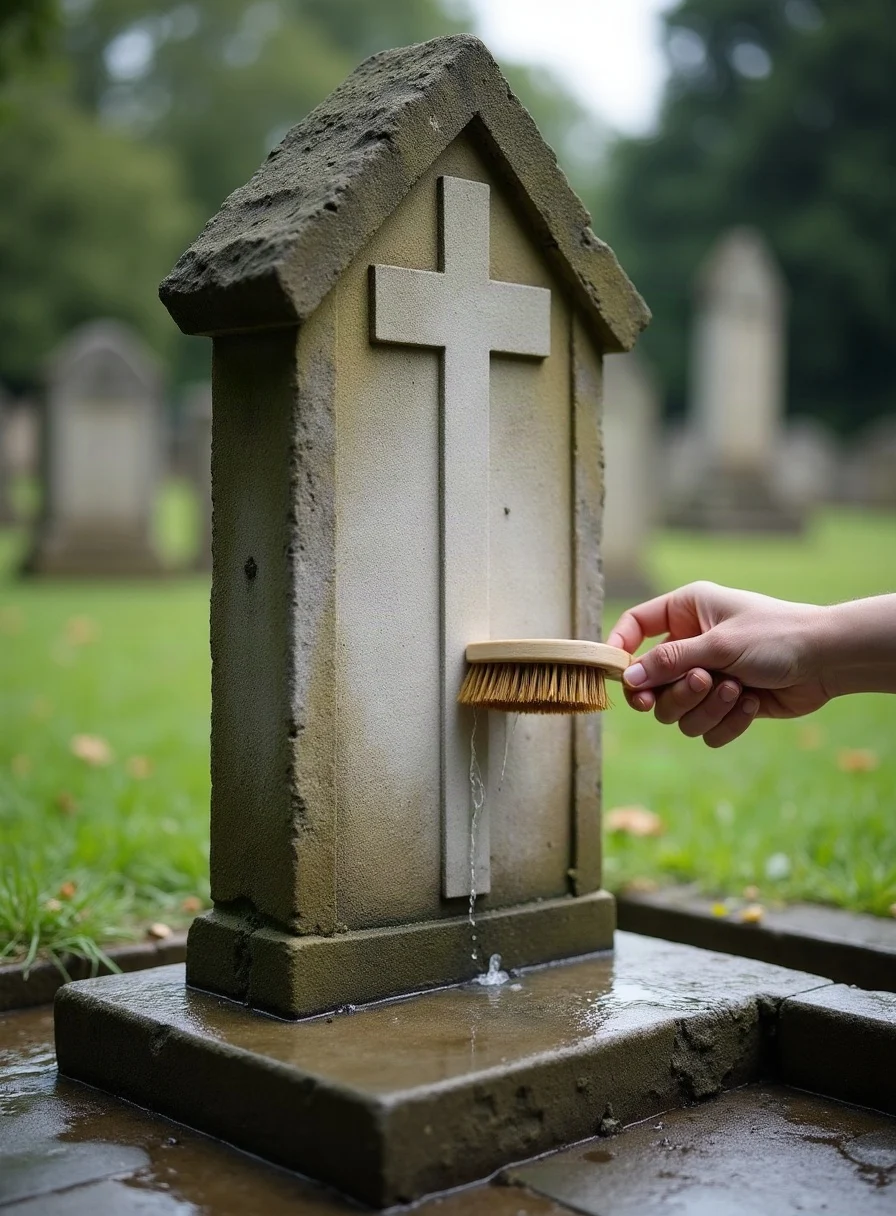
- Dry brush first. Use a soft natural-bristle brush to remove loose soil, moss and leaves, working gently from the top down.
- Choose a hidden test patch low on the back or side. Apply the cream, wait 10 minutes, rinse and let it dry fully to see the result in daylight.
- Wet the stone with clean water from a hand sprayer, starting at the bottom and working up so dirty runoff does not stain clean stone. Wetting the surface stops the stone absorbing the cream.
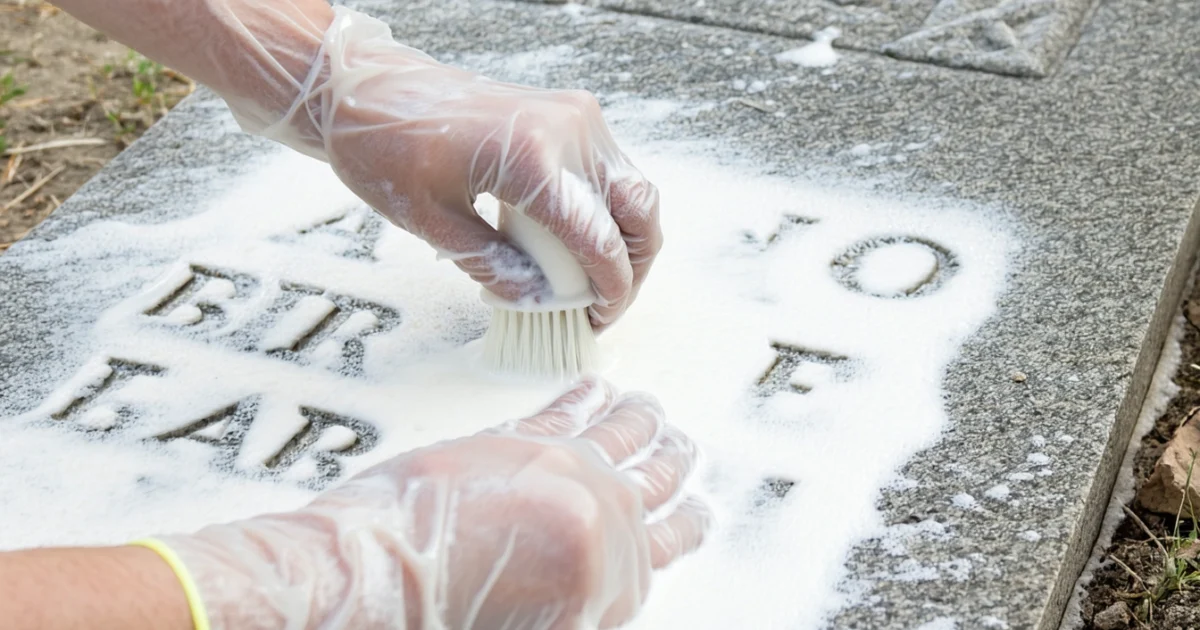
- Apply a thin layer of foam over the area you are working on, one section at a time, and work it gently into any carved lettering with a soft brush.
- Leave it for no more than 10 to 15 minutes, keeping the surface damp. If it starts to dry, mist it with water.
- Agitate lightly with a soft brush or clean cloth in small circles, with the lightest pressure that works. Do not scrub at stubborn marks.
- Rinse thoroughly from the top down with plenty of clean water, until no foam, slipperiness or film is left. Rinse crevices and lettering again.
- Let it dry in the open air, then look at it from several angles and in different light before deciding if more is needed.
Work in mild, dry, overcast weather, avoiding hard frost or the days after it, bright sun that dries products quickly, and rain. Water that freezes in a damp porous stone can split it. If your tap water is hard, you may see white spots as it dries on dark stone, which is mineral scale and not leftover foam, and our piece on dealing with limescale explains why it happens. Collecting your rinse water in a bucket for the final pass avoids most spotting, and wearing waterproof gloves and kneeling on a mat makes the work easier.
If it did not work, or made things worse
| What you see | What to do |
|---|---|
| Dirt moved but the stone looks hazy or filmy | Rinse again with plenty of clean water and leave it to dry. A film usually means leftover cream, not damage |
| Green or black growth still in the lettering | Algae and lichen need a biological cleaner used strictly by its label, not more foam. Never scrape lichen off |
| Orange-brown streaks | Often iron or rust from fixings or vases. Do not use acids. Ask a monumental mason for advice |
| White crusty patches or powdery surface | The stone is breaking down or salts are present. Stop cleaning and take advice |
| Lettering looks less clear | Cleaning may have removed a dark patina that gave contrast. Do not paint or fill it. Photograph in raking light or at an angle |
| A stain or colour change after the foam | Rinse at once with plenty of water, stop, photograph it, and take professional advice |
What not to reach for next is just as important as what to try. Do not use bleach, household limescale or bathroom cleaners, acid products, wire brushes, metal scrapers, abrasive pads, sandpaper or a pressure washer. These etch, scratch and drive water into the stone. They are the usual causes of permanent damage to memorials. For help beyond basic cleaning, a qualified stone conservator is the right person, and the Building Conservation Directory is one place to look for specialists. If the cleaning product is not on the list the cemetery has approved, tell them what you used. More general stain advice is in our cleaning products and other cleaning guides sections.
Working safely at the graveside
Cemeteries are uneven places. Wear sturdy shoes with grip, because wet grass and algae-covered paths are slippery, and take care not to step on neighbouring plots or kneel on other graves. Be considerate of funerals and other visitors, and check with the office on the days when a service is likely. Tell someone where you are if you are working alone, take water and sun protection in warm weather, and bring a bag for rubbish. Never climb on a stone or lean heavily on it, because many older memorials are only loosely bedded and can topple. If a stone moves under a light touch, step back and report it.
Keeping a record
A small notebook or note on your phone helps: the date, the weather, what you used, how long it stayed on, and what the stone looked like before and after. The photographs and notes tell you, and any cemetery officer or conservator you speak to later, exactly what was done. If a second family member takes over the upkeep, it saves them repeating a mistake.
When a professional is the better call
A monumental mason or stone conservator will identify the stone, check the fixings and foundations, and clean with methods suited to it. It costs more than a can of foam, but it makes sense for listed or very old memorials, for stones with gilded or painted lettering, for anything leaning or cracked, and for deep-set staining. Ask what they plan to use, ask whether they are happy to follow the cemetery’s rules, and ask for the work to be recorded with before and after photographs.
A gentle memorial cleaning kit
You do not need much, and all of it is cheap. The five items below are the ones people reach for most. The links go to Amazon UK searches so you can compare options.
Also worth bringing: a bucket of clean water, a few clean microfibre cloths, a camera, and rubbish bags to take away anything you bring or collect. Nothing should be left on the grave.
Looking after the stone afterwards
Less is better. Cleaning removes a little of the surface every time, and the stone often looks best when it is only cleaned when growth is hiding the lettering. For most memorials, a gentle brush and water once a year at most is plenty. Between cleans, remove leaves and debris from the base, keep soil and turf from piling up against the stone, and check that the drainage around it is clear, because standing damp encourages algae and frost damage.
Avoid sealers, waterproofing treatments and wax unless a conservator advises them, as non-breathable coatings can trap moisture and speed up decay. Look after the surroundings too: pick up what you bring, keep products away from nearby plants, and respect the plantings on other graves. If you do spot damage, such as a leaning stone, a crack, or a loose inscription, report it rather than trying to repair it yourself.
If you tend the grave regularly, a simple routine is enough: lift fallen leaves and flowers that have gone over, trim grass back from the base by hand shears rather than a strimmer, which can chip stone, and check the stone for movement each visit. Small habits like these slow the return of growth and mean the stone needs far less intervention.
Three quick questions
Can I use shaving cream on any gravestone?
No. Avoid it on painted or gilded lettering, metal plaques, composite materials, flaking or crumbling stone, and on anything historic without advice. Even on sound granite, test a hidden spot first and rinse thoroughly. Plain water and a soft brush is the safer first step.
How long should I leave it on?
Ten to fifteen minutes at most, kept damp, then brush gently and rinse thoroughly. Longer contact does not help and makes residue harder to rinse. If a stain remains, stop and try a different approach instead of repeating.
How often is it safe to clean a gravestone?
As rarely as you can. Clean when growth or dirt is hiding the inscription, and not on a fixed schedule. Once a year at most is a sensible ceiling, and many stones need less. Regular light brushing of loose debris is gentler than repeated washing.