Most people read the front of a cleaning bottle and ignore the small print, yet the small print is where the safety information lives. In Great Britain, a hazardous cleaner has to carry a standard set of warnings, and once you know the three layers (symbol, signal word, hazard statement) you can read any label in under a minute. The second half of this guide is a checker for the question people actually search: can I mix these two things?
This is a research-and-synthesis piece. Every claim below comes from a regulator, health service, poison centre or chemistry reference that I read for this article, and each is linked in the Sources section. If you only want the quick list of bad pairings, our shorter post on cleaning products you should never mix is the place to start. This page goes further: it explains the label, then lets you test a specific pair.
What a UK cleaner label has to tell you
HSE explains that a hazard label is built from a few standard parts. A signal word tells you how severe the hazard is: the GB CLP Regulation uses two, Danger for more severe hazards and Warning for less severe ones. A hazard statement is a phrase describing the nature of the hazard, with HSE’s examples being "causes serious eye damage" and "toxic if swallowed". A precautionary statement is a recommended measure to minimise or prevent harm, such as "wear eye protection", and HSE says suppliers usually use no more than six, chosen to match the hazard statements.
The pictograms sit alongside these. HSE describes them as diamond-shaped with a distinctive red border and a white background, and says one or more can appear on a single chemical. ECHA, the EU regulator, adds that the label must also carry the supplier’s name, address and telephone number (ECHA labelling page), which is useful: HSE’s cleaning-products guidance says that if you are unsure about a product’s hazards, you contact the supplier using the details on the label.
One thing worth knowing is that more cleaners now look alarming than a decade ago. HSE says that since 1 June 2015 mixtures such as cleaning products have been classified under CLP, whose stricter methods for corrosive and irritant substances mean "a higher number of cleaning products being classified and labelled as hazardous". HSE stresses this does not necessarily make a product more or less hazardous, and that in most cases you can continue to use it as before. The label is a prompt to read on, not a verdict.
The nine hazard pictograms, and where they show up in the cupboard
The table below uses the pictogram names from HSE and the symbol descriptions from HSENI, plus HSE’s own statements about what the corrosive and exclamation mark pictograms cover on cleaners. The last column is my own cross-reference, matched by pictogram name: it shows which common cleaning ingredients carry that kind of classification in the NIH PubChem listings. Those listings are for the concentrated ingredient as notified to the ECHA inventory, so a diluted consumer product can be classified differently, which is exactly the point HSE makes about concentration thresholds.
| Pictogram (HSE) | Symbol (HSENI) | What HSE says about it on cleaners | Cleaning ingredients with a matching classification (PubChem) |
|---|---|---|---|
| Explosive | Exploding bomb | Nothing specific for household cleaners | None of the ingredient listings checked for this guide |
| Flammable | Flame | Nothing specific for household cleaners | Isopropanol and ethanol (H225, highly flammable liquid and vapour). UK surgical spirit’s product information says to keep it from naked flames. |
| Oxidising | Flame over circle | Nothing specific for household cleaners | Hydrogen peroxide (H271, strong oxidiser), listed for the concentrated chemical |
| Corrosive | Corrosion | Covers skin corrosion and serious eye damage, with H318 (Category 1, irreversible effects) | Sodium hypochlorite, sodium hydroxide, hydrochloric acid (H314, H318) |
| Acute toxicity | Skull and crossbones | Nothing specific for household cleaners | Ammonia and hydrochloric acid (H331, toxic if inhaled) |
| Exclamation mark (HSE heads it Health hazard / hazardous to the ozone layer) | Exclamation mark | Covers skin and eye irritation, with H319 (Category 2, reversible effects) | Isopropanol and ethanol (H319) |
| Serious health hazard | Health hazard | Nothing specific for household cleaners | Not mapped in this guide |
| Hazardous to the environment | Dead tree and fish | Nothing specific for household cleaners | Sodium hypochlorite and ammonia (H400), sodium hypochlorite (H410) |
| Gas under pressure | Gas cylinder | Nothing specific for household cleaners | Ammonia (H280, in some notifications, as the gas) |
Two practical points follow. First, HSE says the corrosive pictogram goes with H318 "Causes serious eye damage" (Category 1, irreversible effects), while the exclamation mark goes with H319 "Causes serious eye irritation" (Category 2, reversible effects). The same page admits this can be confusing, which is why reading the words matters. Second, if you still see an orange square symbol on an older bottle, the University of Dundee notes that the current pictograms replaced the old orange and black EU symbols.
Hazard statements decoded
Hazard statements carry a code, but the code is for reference. The University of Edinburgh’s guidance notes that the code may not be used instead of the written hazard statement. The table shows the statements most often attached to cleaning ingredients in the PubChem data, with the signal word that sits beside each in those listings.
| Code | Wording on the label | Signal word listed | Ingredients carrying it (PubChem) |
|---|---|---|---|
| H225 | Highly flammable liquid and vapour | Danger | Isopropanol, ethanol |
| H271 | May cause fire or explosion; strong oxidiser | Danger | Hydrogen peroxide (concentrated) |
| H290 | May be corrosive to metals | Warning | Sodium hydroxide, hydrochloric acid |
| H302 | Harmful if swallowed | Warning | Hydrogen peroxide |
| H314 | Causes severe skin burns and eye damage | Danger | Sodium hypochlorite, sodium hydroxide, hydrochloric acid, acetic acid, hydrogen peroxide, ammonia |
| H318 | Causes serious eye damage | Danger | Sodium hypochlorite, sodium hydroxide |
| H319 | Causes serious eye irritation | Warning | Isopropanol, ethanol |
| H331 | Toxic if inhaled | Danger | Ammonia, hydrochloric acid |
| H335 | May cause respiratory irritation | Warning | Hydrochloric acid, sodium hypochlorite |
| H400 | Very toxic to aquatic life | Warning | Sodium hypochlorite, ammonia |
| H410 | Very toxic to aquatic life with long lasting effects | Warning | Sodium hypochlorite |
A pattern worth noticing: in these listings the Danger signal word accompanies the burn, serious-eye-damage, toxic-if-inhaled and highly flammable statements, while Warning accompanies the irritation, corrosive-to-metals and aquatic ones. That fits HSE’s definition that Danger marks the more severe hazards, and it gives you a quick way to rank two products on the shelf.
A sixty-second label routine
- Find the pictograms and note which hazard families they signal (burn, flammable, toxic, environment).
- Read the signal word. Danger is more severe than Warning.
- Read every hazard statement, because the same symbol can cover different hazards (HSE’s corrosive versus exclamation mark point).
- Read the precautionary statements, which tell you what protection to use, such as eye protection.
- If anything is unclear, use the supplier contact details printed on the label.
Can I mix these? The checker
Choose two products and the checker shows one of four results. Never mix means a source I read documents a dangerous reaction. Avoid means an authoritative source says not to combine them, but I could not verify the specific hazard. Safe means a chemistry reference supports combining them. Anything else shows No verified guidance: do not combine, because the absence of a warning is not the same as a green light.
Choose two products
Choose a product in each box to see the result.
Do not mix products even when the checker shows Safe unless the label of each allows it. If you have already mixed something and feel unwell, skip to the emergency box below.
Every pair I could verify
This is the same data the checker uses, laid out so it works without JavaScript. Bleach sits in nine of the thirteen verified pairs, which is why the sources keep repeating the same advice: keep it on its own.
| Pair | Result | Reason and what the source says | Sources |
|---|---|---|---|
| Alcohol or surgical spirit + Bleach (sodium hypochlorite) | Never mix | New Jersey Department of Health says bleach with rubbing alcohol (isopropyl) forms chloroform, which can cause dizziness, nausea, headaches and loss of consciousness. UK surgical spirit is ethanol based, which that source does not name, so treat the two the same way and keep them apart. | New Jersey Department of Health; electronic medicines compendium; Missouri Poison Center |
| Ammonia-based cleaner + Bleach (sodium hypochlorite) | Never mix | UKHSA says mixing sodium hypochlorite with ammonia-based cleaners forms chloramines, which are highly irritating to the respiratory tract. CDC says never to mix bleach with ammonia or any other cleaner. | UKHSA; CDC; CDC MMWR |
| Bleach (sodium hypochlorite) + Drain cleaner | Never mix | New Jersey Department of Health lists bleach with drain cleaner as able to create toxic chlorine gas and lead to long-term health issues. | New Jersey Department of Health |
| Bleach (sodium hypochlorite) + Oven cleaner (caustic type) | Never mix | New Jersey Department of Health lists bleach with oven cleaner as able to produce chlorine gas and irritate the eyes, nose and respiratory system. | New Jersey Department of Health |
| Bleach (sodium hypochlorite) + Toilet cleaner (acid type) | Never mix | UKHSA says bleach mixed with acidic products releases chlorine gas, and New Jersey Department of Health says bleach with toilet bowl cleaner may give off toxic fumes that can burn the throat and lungs. If your toilet cleaner is acid based, the acid rule applies. | UKHSA; New Jersey Department of Health |
| Bleach (sodium hypochlorite) + White vinegar | Never mix | CDC’s MMWR report says mixing bleach with vinegar or ammonia can generate chlorine and chloramine gases that might cause severe lung tissue damage. UKHSA says bleach mixed with acidic products releases chlorine gas. | CDC MMWR; UKHSA; Missouri Poison Center |
| Hydrogen peroxide + White vinegar | Never mix | Missouri Poison Center, New Jersey Department of Health and a North Texas Poison Center educator all say vinegar and hydrogen peroxide together make peracetic acid, which can irritate or burn the skin, eyes and airways. Use them separately and rinse in between. | Missouri Poison Center; New Jersey Department of Health; KERA News (North Texas Poison Center educator interview) |
| Ammonia-based cleaner + Toilet cleaner (acid type) | Avoid | CDC’s ammonia fact sheet says ammonia reacts with acids and that household cleaners should not be mixed. An acid-type toilet cleaner is an acid product. | CDC |
| Ammonia-based cleaner + White vinegar | Avoid | CDC’s ammonia fact sheet says household ammonia can release gas if mixed with certain other cleaning products, that it reacts with acids and chlorine bleach, and says do not mix household cleaners. Vinegar is an acid. | CDC |
| Bicarbonate of soda + Bleach (sodium hypochlorite) | Avoid | CDC says never to mix bleach with ammonia or any other cleaner. The sources read for this guide do not describe a specific hazard for this pair, so the general rule applies. | CDC |
| Bleach (sodium hypochlorite) + Hydrogen peroxide | Avoid | New Jersey Department of Health’s fact sheet on sodium hypochlorite warns against mixing it with hydrogen peroxide, and Missouri Poison Center says not to mix them. The sources read for this guide do not name the exact hazard, so treat it as a firm no. | New Jersey Department of Health; Missouri Poison Center |
| Bleach (sodium hypochlorite) + Washing-up liquid | Avoid | CDC says never to mix bleach with ammonia or any other cleaner. The sources read for this guide do not describe a specific hazard for this pair, so the general rule applies. Use one product, rinse, then the next. | CDC; KERA News (North Texas Poison Center educator interview) |
| Bicarbonate of soda + White vinegar | Safe | The Royal Society of Chemistry says vinegar (ethanoic acid) reacts with sodium hydrogencarbonate to give sodium acetate, water and carbon dioxide, and rates both ingredients as low hazard at shop strength. That is a statement about hazard, not about cleaning power: the fizz largely uses the two up. | Royal Society of Chemistry |
Three things stand out when the pairs are laid side by side. The gas-producing pairs are almost all bleach plus an acid or ammonia, which UKHSA describes as chlorine and chloramines respectively. The one non-bleach pair that sources agree on, vinegar with hydrogen peroxide, is a case where two products people regard as gentle make something corrosive. And the only Safe result is a reaction that mostly cancels out the cleaning value, a point covered in our post on whether baking soda and vinegar actually clean.
If you want to know whether a single product does the job rather than whether it mixes, the existing guides on whether bleach expires, whether vinegar disinfects, hydrogen peroxide, bicarbonate of soda and what kills mould compare them side by side, and they are a better route than blending products to get a stronger one.
Why one-at-a-time beats clever blends
The poison-centre advice reported by KERA News is blunt: a North Texas Poison Center educator says to use one product, let the surface dry, wipe with water, then use the next, and that there are no recommendations for mixing products. CDC makes the same point for bleach, with its instruction never to mix it with ammonia or any other cleaner, and to wear rubber or other non-porous gloves and eye protection and open windows and doors when using it indoors. NHS adds that liquid cleaning products should stay in their original containers so they are not mistaken for drinks, that chemicals belong out of children’s reach, ideally in a locked cupboard, and that gloves, goggles or a mask are sensible when handling harmful chemicals.
That advice is dull and it works, because it removes the need to remember a table of 45 pairings at all.
If something goes wrong
Emergency box: harmful chemical swallowed, on skin, in eyes or breathed in
- Call 999 or go to A&E if you think you or someone else may have swallowed, touched or breathed in something harmful, or if someone has lost consciousness, stopped breathing, has severe difficulty breathing or has a seizure (NHS: Poisoning). NHS says not to drive to A&E: ask someone to drive you or call 999.
- Call NHS 111 if you are not sure whether something you swallowed, touched or breathed in is harmful (NHS: Poisoning).
- Do not try to make someone sick and do not give them anything to eat or drink. Take the packaging or container with you if you can (NHS: Poisoning).
- Chemical on skin: NHS says call 999, wear gloves if you can, carefully remove contaminated clothing, brush off any dry chemical, rinse under cool or lukewarm running water for about 1 hour, and put nothing on the burn (NHS: Acid and chemical burns).
- Chemical in the eye: hold the eye open and run clean water over it gently for at least 20 minutes, keep rinsing while you wait for help, and take the container. For a strong chemical such as oven cleaner or bleach, NHS says go to A&E or call 999 right away (NHS: Eye injuries).
- Fumes from mixed products: CDC advises opening windows and doors and leaving the area until the gas dissipates (CDC: Ammonia fact sheet). Do not assume you are fine because you feel better: UKHSA says respiratory irritation from bleach exposure usually occurs immediately, followed by a latent period of 5 minutes to 15 hours (UKHSA: toxicological overview), so get medical advice.
- National Poisons Information Service (NPIS): NPIS states that it does not provide poisons information to members of the public. Its page for the public directs people to their GP or to NHS 111 in England, Scotland and Wales, and to a local GP in Northern Ireland, while healthcare professionals use its TOXBASE service (NPIS: Contact, NPIS: Member of public). In an emergency where someone has collapsed or is not breathing properly, it says to call 999.
Basic protective kit, if you want it
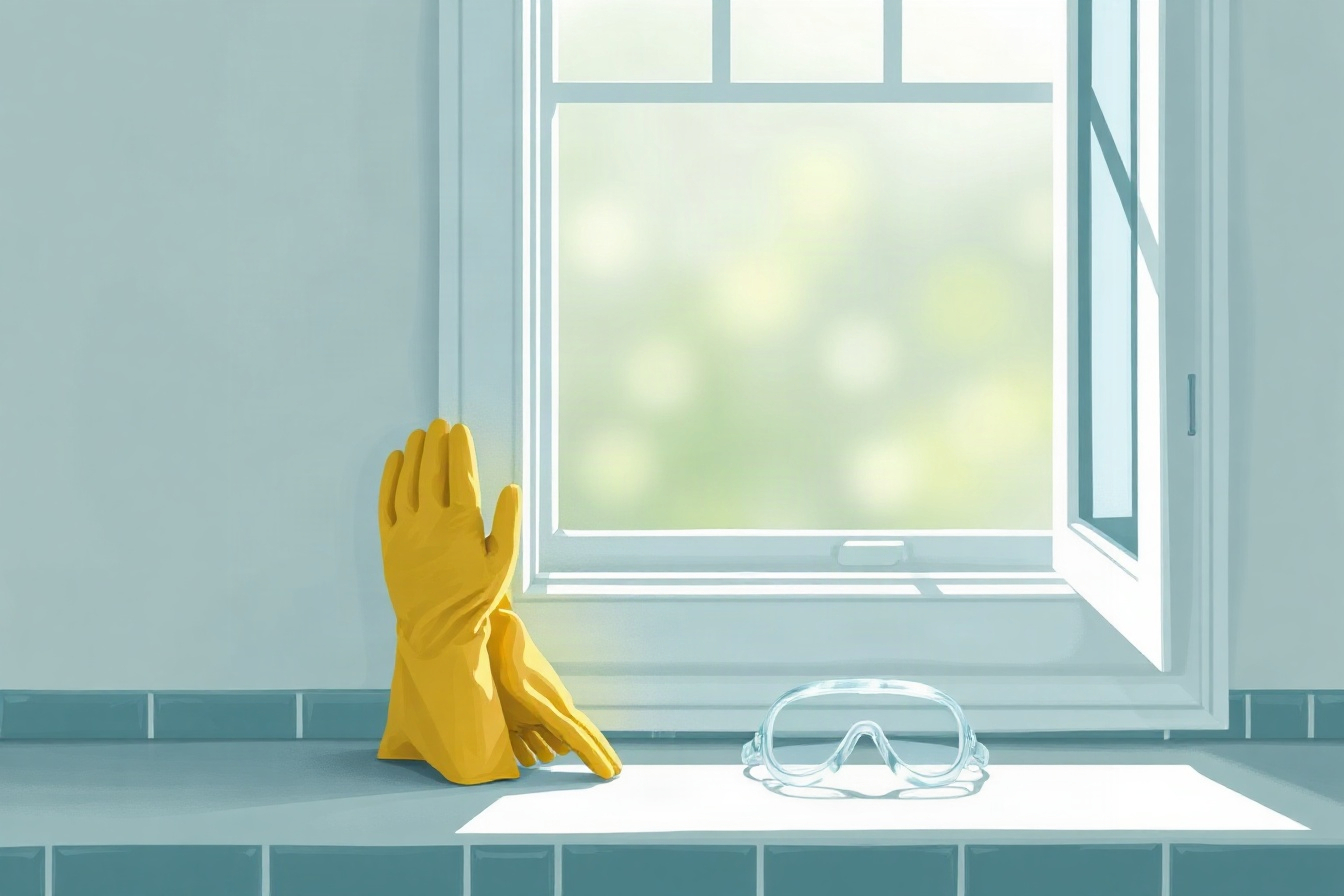
These are the practical items the sources above point to (gloves, eye protection and ventilation), not a requirement to buy anything. Look for what suits the job, and always follow the precautionary statements on your own product.
- Reusable rubber gloves: CDC specifically mentions rubber or non-porous gloves when using bleach, so look for a waterproof pair with a long cuff and one that fits without sliding.
- Splash safety goggles: NHS lists goggles among sensible protection, so look for a fully enclosed, clear pair that sits over your own glasses if you wear them.
- Child-resistant cupboard lock: NHS advises a locked cupboard for chemicals, so look for one that fits your cupboard and cannot be opened easily by a small child.
As an Amazon Associate we earn from qualifying purchases.
Questions people ask
What do the hazard symbols on cleaning products mean?
They are red-bordered diamonds on a white background that show the type of hazard, such as corrosive, flammable, toxic or harmful to the environment. HSE says one or more can appear on a single product. The symbol is only part of the warning, so read the signal word and hazard statements too.
What is the difference between Danger and Warning on a label?
HSE says GB CLP labels use two signal words: Danger for more severe hazards and Warning for less severe ones. A Danger label deserves more care, such as gloves and eye protection, but neither word replaces reading the hazard statements to see exactly what the product can do.
Why does my cleaner have a corrosive symbol when it feels mild?
HSE says stricter classification methods introduced under CLP mean more cleaning products are now labelled hazardous, and that this does not necessarily make a product more or less hazardous. The corrosive symbol on a cleaner often reflects serious eye damage (H318). Read the hazard and precautionary statements and keep it away from your eyes.
Can I mix bleach and vinegar?
No. UKHSA says bleach mixed with acidic products releases chlorine gas, and CDC’s MMWR report says mixing bleach with vinegar or ammonia can generate chlorine and chloramine gases that might cause severe lung damage when inhaled. Use them separately, rinsing the surface well in between, or choose one product.
What should I do if I mix bleach and ammonia by accident?
Get out of the area and into fresh air, opening windows and doors if you can do so safely, as CDC advises for household ammonia releases. NHS says to call 999 or go to A&E if you think someone has breathed in something harmful, and to call 111 if you are unsure.
Can I call the National Poisons Information Service myself?
Not as a member of the public. NPIS says it does not provide poisons information to the public. It directs people to their GP or NHS 111 in England, Scotland and Wales, and to a local GP in Northern Ireland. In an emergency where someone has collapsed or is not breathing properly, call 999.
Is it safe to mix bicarbonate of soda and vinegar?
Hazard-wise, yes. The Royal Society of Chemistry says ethanoic acid (vinegar) reacts with sodium hydrogencarbonate to give sodium acetate, water and carbon dioxide, and rates both low hazard at shop strength. The fizz mostly uses the two up, so it is not a stronger cleaner.
Is hydrogen peroxide safe to mix with vinegar?
No. Missouri Poison Center, New Jersey Department of Health and a North Texas Poison Center educator all say the two make peracetic acid, which can irritate or burn the skin, eyes and airways. Use them one after the other with a water rinse in between, never together in one bottle.
Sources
Every source below was fetched and read for this article. "Last checked: 25 October 2026". Regulations, product formulations and public guidance change, so check the label on your own product and the current NHS and HSE pages.
- HSE, Hazard pictograms (symbols): used for pictogram names and the red border and white background description.
- HSE, Hazard statements, precautionary statements and signal words: used for definitions of signal words, hazard statements and precautionary statements.
- HSE, Cleaning products and GB CLP: used for corrosive versus exclamation mark pictogram on cleaners, H318 and H319, why more products are now labelled hazardous.
- HSENI, CLP hazard pictograms: used for symbol description for each of the nine pictograms.
- University of Dundee, GHS hazard warning symbols: used for statement that the pictograms replace the old orange and black EU symbols.
- University of Edinburgh, UK CLP: used for signal word meanings and the rule that an H-code cannot replace the written statement.
- ECHA, CLP labelling: used for what the EU version of the CLP label must contain, including supplier details.
- NIH PubChem, GHS classification sections (sodium hypochlorite, sodium hydroxide, hydrochloric acid, hydrogen peroxide, ammonia, isopropanol, ethanol, acetic acid): used for hazard statement wording and signal words as notified to the ECHA classification inventory.
- NHS, Poisoning: used for when to call 999 or 111, what not to do, storage advice.
- NHS, Acid and chemical burns: used for first aid for chemicals on skin or in eyes.
- NHS, Eye injuries: used for rinsing a chemical out of the eye and when to go to A&E.
- NPIS, Member of public: used for who the public should contact for poisons advice.
- NPIS, Contact us: used for NPIS does not take calls from the public; TOXBASE is for healthcare professionals.
- UKHSA, Sodium hypochlorite: general information: used for bleach with acids gives chlorine gas, with ammonia gives chloramines; typical bleach strength.
- UKHSA, Sodium hypochlorite: toxicological overview: used for symptoms of inhaling mixtures and the delayed onset of respiratory effects.
- UKHSA, Ammonia: general information: used for ammonia in cleaning products, hazard from mixing with sodium hypochlorite.
- UKHSA, Hydrogen peroxide: general information: used for domestic uses at about 3 to 6 per cent, hazards at high concentration.
- UKHSA, Sodium hydroxide: general information: used for sodium hydroxide in drain cleaners and de-scalers, burns on contact.
- CDC, How to safely clean and sanitize with bleach: used for never mix bleach with ammonia or any other cleaner; gloves, eye protection, ventilation.
- CDC MMWR, Knowledge and practices regarding safe household cleaning and disinfection, May 2020: used for bleach with vinegar or ammonia can generate chlorine and chloramine gases.
- CDC, Ammonia chemical fact sheet: used for household ammonia reacts with acids and chlorine bleach; ventilate and leave the area.
- New Jersey Department of Health, Hazard Alert: Mixing Cleaners (PDF): used for pair-by-pair list of bleach mixtures and hydrogen peroxide with vinegar.
- New Jersey Department of Health, Hazardous Substance Fact Sheet: Sodium hypochlorite (PDF): used for incompatibilities of sodium hypochlorite, including acids, ammonia compounds and hydrogen peroxide.
- Missouri Poison Center, Some things just don’t mix: used for bleach with acidic cleaners, bleach with urine, vinegar with hydrogen peroxide.
- KERA News (North Texas Poison Center educator interview), When is it safe to mix household cleaning products? Never: used for poison centre advice to use one product at a time and wipe between.
- Royal Society of Chemistry, Bubble volcanoes: used for reaction of ethanoic acid with sodium hydrogencarbonate and hazard ratings.
- electronic medicines compendium, Surgical Spirit BP SmPC: used for composition and flammability of UK surgical spirit.
Last checked: 25 October 2026
What I could not verify and left out: hazard data for washing-up liquid, how any specific commercial brand is classified, whether the old orange symbols map one for one to the new pictograms, and any combination not listed in the verified-pairs table. The New Jersey Department of Health and Missouri Poison Center are US sources, used for chemistry that does not depend on the country, and the PubChem data reflects the EU classification inventory rather than GB CLP specifically.