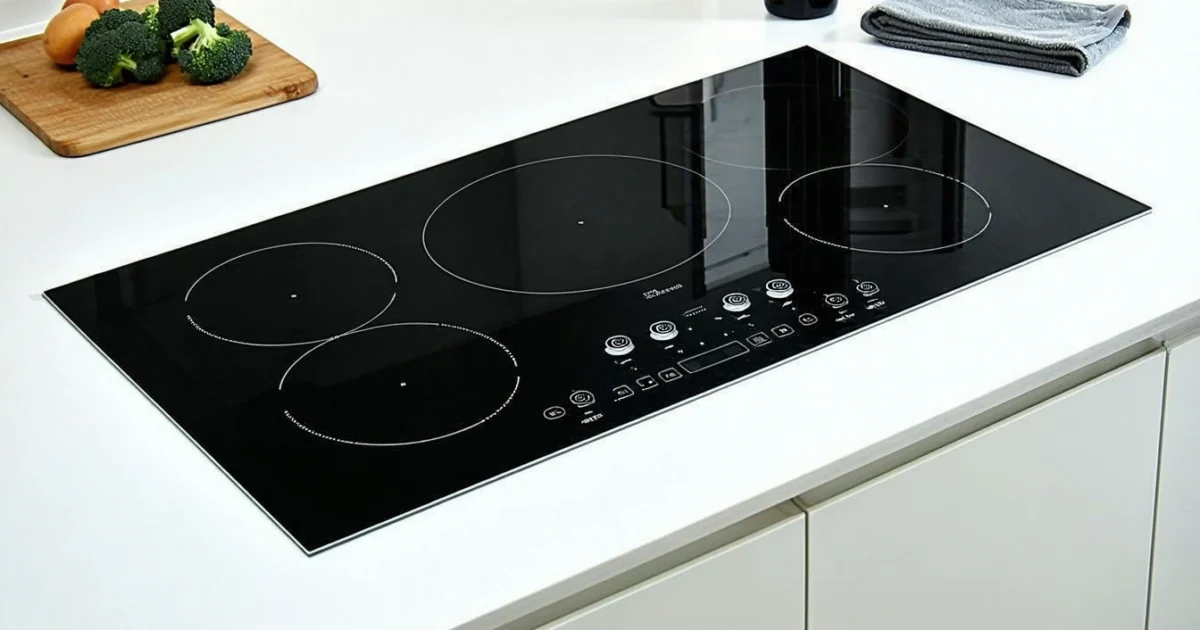
Is a special cleaner really needed for an induction hob? Not for most days. The glass-ceramic top is smooth, sealed and does not get hot enough to bake spills the way an old radiant hob does, so a damp cloth with a drop of washing-up liquid handles nearly everything. What the surface does need is the right tools: nothing abrasive, nothing that leaves a film, and a method that keeps liquid away from the touch controls.
This guide is organised like a short buyer’s guide. It begins with what to look for, then covers four items worth owning and the ones to avoid, and finishes with how to use them for daily wipes, deep cleans and awkward marks. If you want the same advice for a ceramic hob, our glass stovetop guide overlaps heavily, and many hob-care principles also appear in our wider cleaning product guides.
Disclosure: Cleaners Guide is a participant in the Amazon Associates programme, so if you buy through links on this page we may earn a small commission at no extra cost to you. It never changes our recommendations, we suggest products because they work and we point out cheaper options where they do the same job. Prices and availability change, so always check the current price before buying.
What an induction hob needs from a cleaning routine
Induction works by creating a magnetic field that heats the pan directly. The glass itself warms only from the hot base of the pan, so spills tend to be lukewarm and sticky rather than welded on, with the exception of sugar and anything that has boiled dry. That is why the right routine looks different from the one for a coil or radiant hob.
Why induction cleans differently from other hobs
A gas hob has grates, burners and crevices. A radiant electric hob has glowing elements under the glass that can bake a spill onto the surface within seconds. An induction hob has neither. Because the glass is heated only by the pan, a spill beside the pan is rarely much warmer than a cup of tea, and it stays soft for longer. That is good news for cleaning, with two catches. Spills directly under the pan still bake, and a film that is never wiped away slowly builds into a dull, sticky layer that is harder to shift than any one spill would have been.
The glass itself is glass-ceramic, a tough material that handles heat and everyday knocks well but not point impacts, such as a dropped heavy pan, or abrasives. Black glass shows every smear and fingerprint, while white and light-coloured tops show burnt marks more clearly. Neither needs a different method, though dark glass rewards a final dry buff.
Five criteria that matter
- Gentle on glass. The surface scratches from grit, steel wool and abrasive pads. Whatever you buy should say it is safe on glass-ceramic, ceramic or induction hobs.
- Low residue. Cleaners that leave a film cause smears and can cook on the next time the pan heats. Look for products that buff off cleanly and ask to be wiped with a damp cloth.
- Safe near the controls. Touch controls are sensitive to liquid. Choose products you apply to a cloth rather than spraying across the surface, and avoid anything that drips.
- Matched to the job. Daily marks, burnt-on food and limescale are different problems. One product rarely does all three well.
- Agrees with your manual. Manufacturers sometimes name products they approve, or rule some out. A short check of the instruction book saves trouble and any warranty argument.
Where specialist products help, and where they do not
Hob creams and cleaners are mildly abrasive or contain polishing agents, and they are good at lifting grey pan marks and leaving a shine. They are not essential for daily cleaning, where warm soapy water is just as safe. A scraper is the one tool that does something nothing else can: lift a burnt-on sugar or food deposit without scrubbing. Microfibre cloths do the rest. A few very basic items cover almost every situation, so the price of a full kit is worth weighing against what you actually need.
Four things worth buying, and what to look for
None of these is complicated, but small differences matter. The links open Amazon UK searches so you can compare current options. As an Amazon Associate we earn from qualifying purchases.
- Hob cream or cleaner for ceramic and induction glass (browse hob creams). Look for a label that names ceramic, glass-ceramic or induction hobs, a cream or liquid rather than a powder, and instructions to apply with a cloth and buff off. Good for shine and light marks. Avoid anything labelled for ovens or grills. Shake the bottle and use a small amount, as more cream means more buffing. The two products named in the table later, Hob Brite and Cerapol, are examples of this type.
- Ceramic hob scraper with replaceable blades (browse hob scrapers). Look for a safety cover or retractable blade, a comfortable handle and spare blades included. This is the most effective tool for burnt-on sugar and carbonised spills. Use it flat, replace blades when they dull or nick, and store it where children cannot reach it. Not suitable if you are unsure about using blades, in which case a plastic scraper works for lighter deposits.
- Microfibre cloths (browse microfibre cloths). Look for a pack of soft, lint-free cloths with a tight weave, at least one for washing and one for buffing. Keep these just for the hob, wash them without fabric softener, and replace any that feel stiff or gritty. Paper towels can streak, and rough cloths can mark.
- A complete hob cleaning kit (browse hob cleaning kits). Kits usually bundle a cream, a scraper and a cloth or pad. They suit someone starting from nothing or a new hob. Check that any included pad is labelled non-scratch, and that the scraper has spare blades. If you already own a good cloth and a bottle of cream, buy the pieces separately.
That is the whole shopping list. A soft sponge with no abrasive side, a spray bottle for water and a bottle of white vinegar are worth keeping in the cupboard but need no special purchase.
Using the scraper without regret
A hob scraper is a small razor blade in a holder, and it deserves respect. Hold it at a shallow angle, nearly flat to the glass, with the blade corner lifted clear. Always wet the spot first, so the blade glides instead of catching, and push in one direction with light pressure. Stop if you hear grinding, because that is grit under the blade. Wipe the blade clean between passes, replace it when it dulls or nicks, and cover or retract it after use. A nicked blade can scratch glass, and it takes only one pass.
If you do not want to use a blade, a plastic scraper or an old plastic card is a gentler tool for softened deposits. It takes more passes, but there is no risk of cutting your hand or the glass.
A sensible budget
If money is tight, the essentials cost very little. A pack of microfibre cloths and a bottle of washing-up liquid cover daily cleaning. A scraper is the one worthwhile purchase for burnt-on food, since nothing else removes carbon safely. A hob cream is the nice-to-have: it adds shine and handles pan marks, but you can manage without it for a long time. A full kit is only better value if you need all three pieces at once. Look at your manual before buying a brand-specific product, because some makers sell their own cream or accept any non-abrasive cleaner.
What to keep away from the glass
| Avoid | Why it causes trouble | Use instead |
|---|---|---|
| Steel wool, scourers, abrasive pads | Fine scratches that gather grease and cloud the glass | Microfibre cloth, non-scratch pad |
| Metal scrapers or knives | They can gouge or chip glass | A ceramic hob scraper held flat, or a plastic scraper |
| Oven cleaner or bleach | Strong alkali or chlorine can mark glass and printed markings, and the fumes are unpleasant | Hob cream or soapy water |
| Ammonia-based glass sprays | They can leave a film and attack decorative printing or controls | A damp cloth, then a dry polish |
| Paper towel and rough cloths | They leave lint and can drag grit across the surface | Soft microfibre |
| Cold water on a hot hob | A sudden temperature change stresses the glass | Wait for it to cool, or wipe with a cloth that is only damp |
| Sliding rough pans, or cooking on the surface | Pan bases pick up grit that scratches | Lift pans and check the base is clean and smooth |
Vinegar sits in a middle position. A diluted spray is a sound way to take off limescale and water marks on glass, but keep it off any frame, seals and printed markings, wipe it away promptly and finish with clean water. Bicarbonate of soda in a paste is also workable if it is fully dissolved and kept wet, since it is softer than the glass. Our piece on homemade cleaners discusses the same low-cost ingredients. Check your manual first, as some makers prefer you to stay with their own products.
Everyday care in two minutes
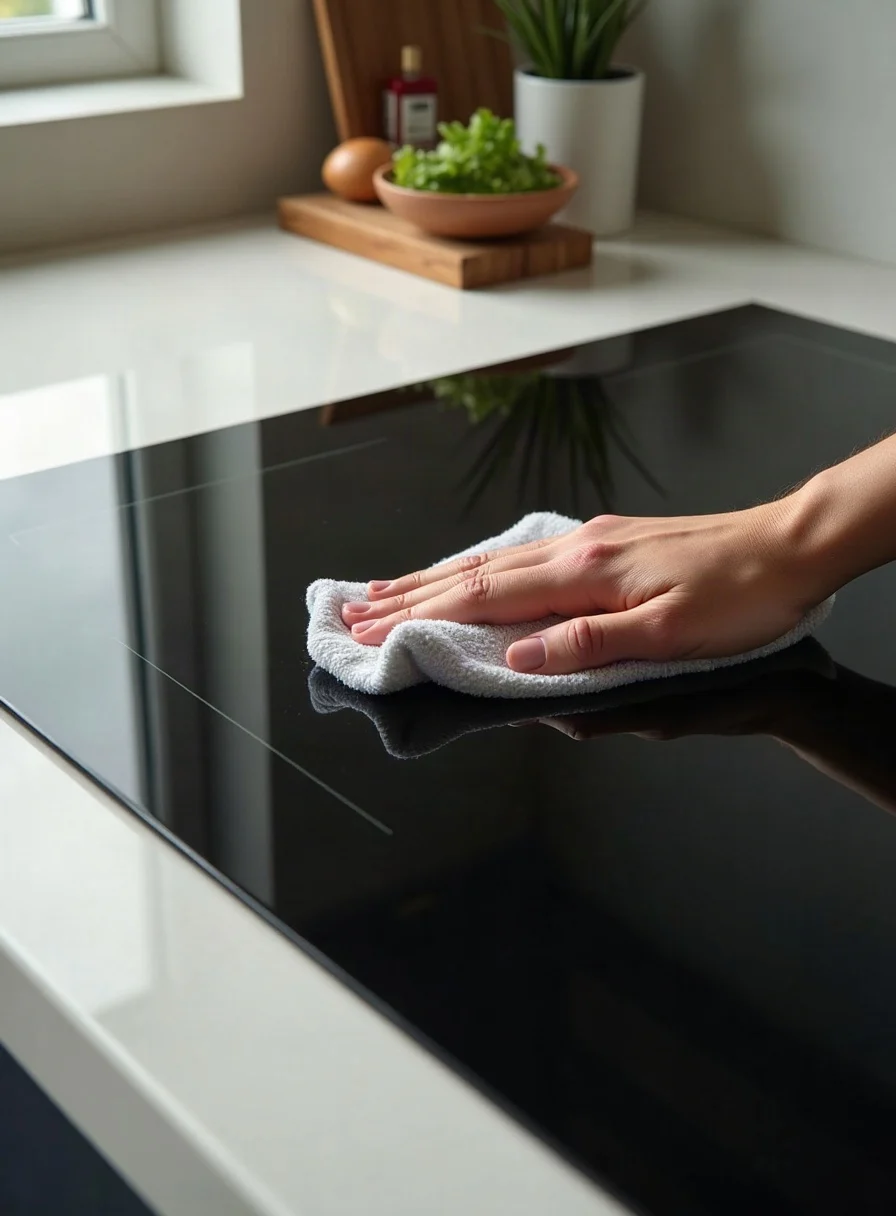
Daily cleaning is where an induction hob pays you back, because a quick wipe stops the film that makes deep cleaning necessary.
- Switch the hob off and let it cool. The residual heat indicator, often an H, shows when a zone is still hot. Use the control lock or cleaning mode if your hob has one, so wiping does not switch it on by accident.
- Wipe up spills as they happen. Once the zone is off, a damp cloth removes fresh liquid easily. Be careful of hot pan bases and steam.
- Use a damp cloth, not a wet one. Wring a cloth out and add a drop of washing-up liquid for greasy patches. Keep liquid away from the edges of the controls.
- Rinse and dry. Wipe again with a cloth wrung out in clean water, then buff with a dry microfibre cloth to prevent smears.
- Clean under the pan, too. Wipe the base of your pans so they do not carry a burnt ring onto the glass.
The sugar rule
Sugar is the exception to the cool-down rule. Sugary spills, jam and melted plastic or foil can pit ceramic glass as they cool and harden. Hob makers generally advise removing them straight away: switch the zone off, protect your hand with an oven glove, and push the spill off the hot glass with a scraper held flat, then wipe once it has cooled. If you find a hardened sugar spill later, soften it with a hot damp cloth, then scrape carefully.
Cookware and the glass
Induction only works with pans that are magnetic. A fridge magnet that sticks firmly to the base of a pan is a quick test. Cast iron, enamelled steel and most stainless steel pans work, while aluminium, copper and glass do not unless the base has a magnetic plate. The pan base is also the part that touches your hob, so its condition matters. Rough cast iron, damaged enamel and a pan with a warped base can scratch glass, and a base with burnt-on food will leave a ring. Wash the bottom of pans as well as the inside.
Habits that keep it looking new
- Check pan bases. They must be flat, clean and free of burrs. Cast iron and rough-based pans should be lifted, never slid.
- Match the pan to the zone. A pan that overhangs the zone or boils over leaves more to clean up.
- Avoid using the hob as a worktop. A chopping board or heavy tin dropped on the glass is a common cause of chips.
- Do not cook empty. A pan that boils dry can leave a burnt ring and can overheat the glass.
- Use a lid when frying. Splashes that never land on the glass never need removing. Grease that drifts into the air ends up on the extractor too, so it is worth reading our guide to cleaning extractor fan filters as well.
A proper deep clean, step by step
Do this when daily wiping no longer shifts the film, or when the glass looks dull, perhaps once a month or whenever it needs it. Set aside twenty minutes, most of which is waiting.
- Make sure the hob is off and completely cool, and lock the controls if it has that function.
- Brush off crumbs with a soft brush or dry cloth so no grit gets dragged across the glass.
- Wipe the surface with a cloth wrung out in warm soapy water to lift loose grease, and leave a damp, warm cloth on any dried-on patches for 10 to 15 minutes to soften them.
- Scrape stubborn deposits with the scraper held at a shallow angle, flat to the glass, pushing in one direction and wiping the blade as you go.
- Squeeze a small amount of hob cream onto a damp cloth, not onto the hob, and work it over the glass in light circles. Leave it to dry to a haze if the label says so.
- Buff off the residue with a clean, dry microfibre cloth until the glass squeaks slightly under it.
- Wipe once more with a cloth wrung out in clean water to remove any film, then dry.
A paste of bicarbonate of soda and water, spread thinly and left for 15 to 20 minutes, is a workable alternative to cream if you have it in the cupboard. Keep it wet, wipe it off with a damp cloth, and rinse. Persistent greasy build-up responds to the cleaning approach in our guide on using lemon, as long as you rinse well afterwards. If the whole kitchen is due for attention, the complete kitchen deep clean fits the hob in alongside everything else.
Marks that need a different approach
Not every mark is the same, so match the product to the problem. The table below summarises the options, and the notes underneath give the detail.
| Method | Best for | Caution |
|---|---|---|
| Hob cream, such as Hob Brite or Cerapol | Daily shine and light marks | Buff off fully or it hazes |
| Ceramic hob scraper, held flat | Burnt on sugar and food | Keep the blade flat, never gouge |
| White vinegar spray | Water spots and limescale | Follow with cream for shine |
| Abrasive pads and scourers | Nothing, they scratch glass | Never use on an induction hob |
Grease and oil
Fat leaves a film that smears. Warm water with a few drops of washing-up liquid on a damp cloth removes it, followed by a rinse wipe and a dry buff. A little cream finishes the job. Avoid stacking up cleaner, because the residue itself causes streaks.
Burnt-on food and carbon
Soften with a hot damp cloth laid on the spot for 15 to 20 minutes, then use a scraper held flat. Wipe the loosened material away rather than scraping it across the glass, and finish with cream. Never scrape dry, never use the corner of the blade, and replace blades when they dull.
Limescale and water marks
White rings around where a pan boiled over are mineral deposits. Spray or wipe with diluted white vinegar, leave for a few minutes, wipe and rinse. Dry afterwards so new marks do not form. In hard water areas, drying the hob after wiping is the cheapest way to stop the film returning.
Greyish pan marks and metal streaks
The grey smudges that look like pencil are traces of metal from the base of a pan. A little hob cream on a damp cloth lifts them. If they come back quickly, the pan base is rough or dirty, so check it.
Streaks after cleaning
Too much product, too little rinsing, or a worn cloth. Wipe with a cloth wrung out in clean water, then dry buff with a fresh microfibre cloth. In hard water areas a last wipe with distilled water gives the cleanest finish.
Edges, frames and controls: the awkward bits
The glass is not the only part of the hob. The places where dirt collects are the edge, the control area and the joint with the worktop, and they are more delicate than the main surface.
Touch controls
Touch controls respond to a change in electrical charge on the glass, which means a film of water or grease can trigger them. Wipe the control area with a barely damp cloth and dry it straight away. Do not spray near it. If your hob has a lock or cleaning function, switch it on before wiping the controls so a wet cloth cannot change settings or turn a zone on. If your hob uses slider controls, wipe along the slider in one direction rather than scrubbing across it.
Frames, bevels and the gap to the worktop
Some hobs have a metal frame or a bevelled glass edge. Crumbs and grease gather in the groove. Use a damp cloth over a thin plastic tool, such as an old plastic card, to lift material from the groove. Avoid pushing liquid down into the gap, since it can run toward the electrics underneath. Frameless hobs sit directly on the worktop with a silicone seal, so clean along the seal with a damp cloth only, and do not scrape it. A worn or lifting seal lets liquid seep underneath, so ask a fitter to reseal it. For the worktop alongside, the advice in our guide on cleaning kitchen worktops applies, with the material in mind.
Ventilation slots and fans
Some induction hobs have a cooling fan that draws air through a vent, usually under the hob or at the back of the cabinet. Do not poke anything into vents, and keep spills away from them. If a fan area looks blocked with dust, it is a job for a service engineer, not a vacuum nozzle.
A simple schedule
| How often | What to do |
|---|---|
| After cooking, once cool | Wipe with a damp cloth, buff dry, and clean the controls with a barely damp cloth |
| Weekly, or when it looks smeared | Wash with warm soapy water, rinse and dry. Add a little cream if the glass has lost its shine |
| Monthly, or when a film builds up | Deep clean with scraper and cream, and wipe the edges and seal |
| Every few months | Check pan bases for roughness, and check the seal and frame for gaps or damage |
Scratches, heat marks and when to stop
Light scratches are cosmetic, and they get less visible once the glass is clean, because grease sitting in the lines makes them look worse. Deeper scratches cannot be sanded out by the owner. Products sold for polishing glass can dull or distort an induction surface, and toothpaste is a mild abrasive that is best avoided. Ask the manufacturer about approved polishes, and consider a replacement glass top if the damage bothers you.
A rainbow sheen or a white cloudy patch is often a deposit of burnt-on residue or minerals that has not been fully removed, and the cream and scraper methods above will usually clear it. If it does not clear, it may be a change in the glass from overheating, which cannot be reversed.
Switch off and call someone if
- The glass is cracked or chipped. Even a hairline crack can let liquid reach live parts. Switch the hob off at the controls and at the isolator or fuse, and do not use it until a qualified engineer or the manufacturer has looked at it.
- The controls misbehave after cleaning. If the hob beeps, turns on by itself or ignores touches, switch it off and let it dry for several hours. If it carries on, get it checked.
- You see an error code that does not clear. Check the manual, and if it persists, contact the manufacturer.
- There is a burning smell or smoke without cooking. Switch off at the isolator and call a qualified electrician.
Fixed electrical work belongs to a registered electrician. Warranty terms often exclude damage caused by misuse, so photograph any problem and check the terms before paying for repairs. More general tips for kitchen appliances are listed under appliances, and utensils and cookware care is under utensils, while the home page has everything else.
Four quick answers
- Can I use ordinary glass cleaner on an induction hob? It is better not to. Many sprays contain ammonia or solvents that leave a film or attack printed markings. Warm soapy water or a hob-specific cream is safer, and your manual may name approved products.
- How often should I deep clean it? Wipe after cooking, once the zone is cool, and deep clean whenever the film builds up, often every few weeks. Waiting for a monthly slot is less important than dealing with sugar or burnt food promptly.
- Is it safe to clean the hob while it is warm? You can wipe up spills from a switched-off hob once the heat indicator allows, but take care with hot pans and do not use cold water on hot glass. Wait for the glass to cool before a deep clean.
- Why does my induction hob not work properly after cleaning? Liquid on the touch controls is the usual cause. Switch it off, dry the surface completely and give it time. If it still misbehaves, contact the manufacturer or a qualified engineer.