Dry cleaning a pair of curtains in the UK is usually priced by the square metre, and the bill for a standard lined living-room pair commonly lands somewhere in the tens of pounds, rising to over £100 for large bay or heavily interlined curtains. Prices vary a lot between cleaners and regions, so treat every figure on this page as a rough planning range and ask for a quote that includes any handling charges.
The more useful question is whether you need to pay at all. Many curtains labelled “dry clean only” are fine in a cool, gentle machine wash, and others only need vacuuming and steaming. Below, the four realistic options are compared side by side, followed by the cost detail and a clear way to choose. If you are weighing up the same decision for other big items, we have price guides for a coat and a wedding dress, and net curtains are a different, more delicate job covered in our guide to cleaning net curtains and getting them white again.

Four ways to clean curtains, side by side
| Option | Rough cost | Best for | Effort | Risk |
|---|---|---|---|---|
| Professional dry cleaning | Roughly £25 to £150 per pair, depending on size and lining | Silk, velvet, wool, interlined, expensive or sentimental curtains | Low, drop-off or collection | Lowest for the fabric; you pay for it |
| Machine wash at home | A few pounds for detergent and electricity | Cotton, polyester and other synthetics with a washable label | High, a half-day job with taking down and rehanging | Real: shrinkage, puckering, colour loss |
| Home dry-cleaning kit or steamer | Cost of a kit or a steamer you may already own | Freshening washable or borderline fabrics between full cleans | Medium | Low to medium; still test first on true dry-clean-only fabric |
| Vacuum and spot-treat | Almost nothing | Everything, as a regular habit | Low, monthly | Very low |
The short version: dry clean anything delicate or lined with several layers, wash plain synthetics and cotton if the label allows, and use vacuuming and steaming to stretch the time between either.
Option one: professional dry cleaning, and what it costs
Most UK dry cleaners price curtains by the square metre rather than per pair, because a pair can range from a small bedroom window to a full-height bay. As a rough guide, plain unlined curtains sit at the lower end, lined curtains a little higher, and heavy, interlined or delicate fabric can reach the top of the range, with the highest rates often quoted in the region of £15 to £18 per square metre.
| Curtain type | Rough cost |
|---|---|
| Basic unlined | Lowest per-m² rates |
| Basic lined | A little more than unlined |
| Heavy, interlined or delicate fabric | Highest per-m² rates, sometimes £15 to £18 or more |
| Standard lined pair (living room) | Often around £40 to £70 per pair |
| Large or full-height bay pair | Often £80 to £150 or more per pair |
Working out your square metreage
Measure the full width of one curtain flat, not gathered, and the drop, then multiply them and double the figure for a pair. A pair with each curtain 1.4m wide and a 2.2m drop is about 6.2m². At £6 per square metre that is around £37, and at £10 per square metre around £62. Having a rough figure before you phone round makes an over-quote easy to spot.
What pushes the price up
- Lining and interlining, which means more fabric and more weight.
- Delicate materials such as silk and velvet that need careful handling.
- Large drops and widths.
- Stain or odour treatment.
- Take-down and rehang, or collection and delivery. Many cleaners offer these, but they cost extra on top of the cleaning price, so if you can take the curtains down yourself, dropping them off is cheaper. Ask for the full price including any handling charges before you book.
- Minimum orders, which can make a single small pair cost more per square metre than a large batch.
Why some curtains really are dry clean only
Because the fabric or construction will not survive water and agitation reliably. Delicate fibres such as silk and velvet mark or crush, wool shrinks, and interlined curtains have layers that shrink at different rates and pucker. Dry cleaning uses solvent instead of water, so it avoids those shrinkage and colour-loss risks. Turnaround is set by the cleaner, so ask how long they need and whether they work to a fixed schedule before you take curtains down, particularly in busy seasons.
Option two: washing at home, and whether you can risk it
Washing is the cheapest route and the riskiest. Some “dry clean only” curtains can be washed carefully, and the saving is large, but the label is there for a reason and some fabrics genuinely cannot take it. Here is the honest split.
| Never wash, dry clean only | Can often be washed with care |
|---|---|
| Silk | Cotton (with shrinkage caution) |
| Velvet, velour, chenille | Polyester and most synthetics |
| Wool and wool blends | Unlined linen (may shrink) |
| Tapestry and brocade | Nylon or acrylic |
| Interlined curtains, because the layers shrink differently | Cotton-polyester blends |
| Anything with glued or bonded backing | Fabrics labelled machine washable |
The two big risks are shrinkage, where fabric and lining shrink at different rates and lined curtains pucker, and colour loss or fibre damage, where dyes run or delicate fibres break down. If the curtains are expensive, irreplaceable, silk, velvet or interlined, pay for the dry clean. It is cheaper than replacing them.
Always test first. Dab a hidden corner, behind the hem or where the curtain meets the lining, with a damp white cloth and a spot of detergent. If colour transfers to the cloth or the fabric marks, stop. Those curtains are dry clean only for real.
How to wash washable curtains
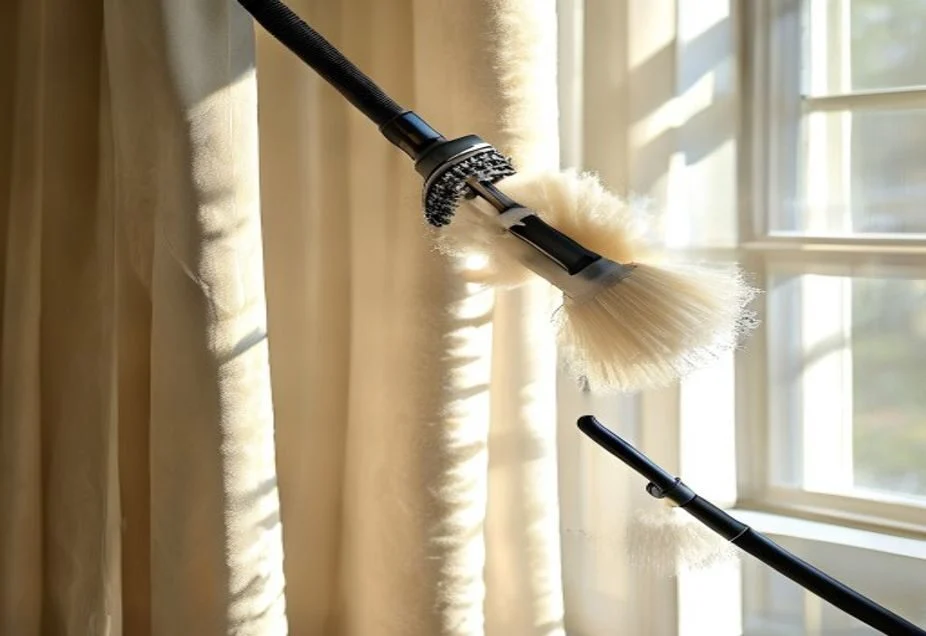
- Take them down and shake or vacuum off the dust first. Curtains hold a startling amount, and washing them dusty just makes muddy water. Use the upholstery tool along the tops and hems.
- Remove hooks, rings and weights, and unclip detachable linings to wash separately.
- Wash cool and gentle: 30°C, delicates or hand-wash cycle, mild detergent and no heavy fabric softener. Cool water is the single biggest shrinkage-preventer. If the machine itself is musty, our guide to cleaning a washing machine is worth reading first.
- Do not overload. Curtains need room to move, and a packed drum creases them badly.
- Skip the tumble dryer. Heat is what shrinks curtains. Hang them damp, ideally back on the pole, or over a drying rack, and let gravity pull the creases out.
The rehang-damp trick: for many curtains, hanging them back up while still slightly damp lets their own weight drop the creases out as they dry, often saving you ironing entirely. It is the same principle that works for shower curtains and washable blinds. For hard-to-wash blinds, see our guide to cleaning blinds.
If your curtains are dry clean only but you want the gentlest home approach, our guide to dry cleaning at home covers home dry-cleaning kits and steaming. It is lower risk than washing, though still not risk-free on true dry-clean-only fabric. Doing it at home keeps the cost low if you are careful.
Option three: steam and home dry-cleaning kits
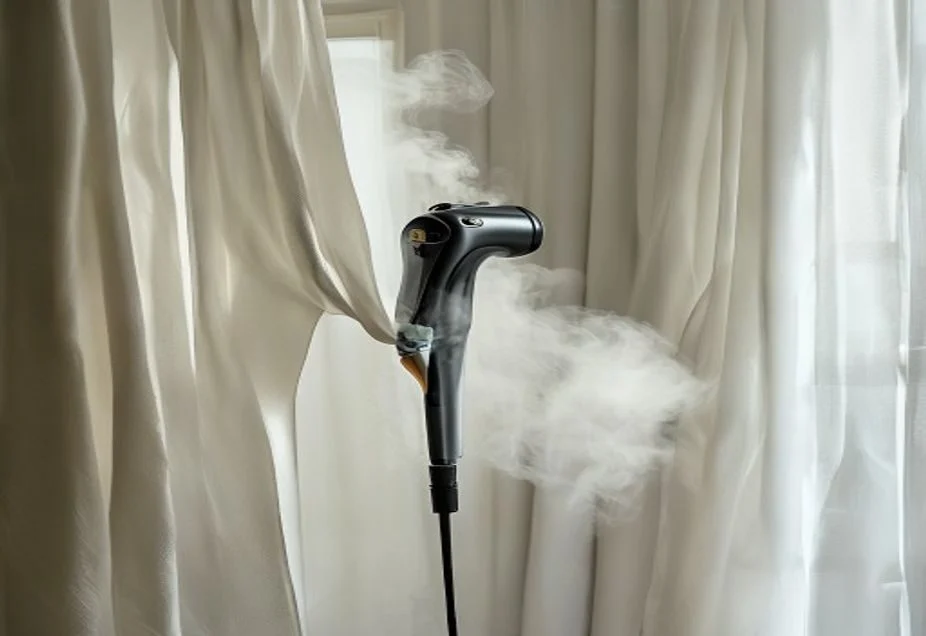
A clothes steamer used on curtains still hanging at the window freshens them, drops creases and lifts some odours without taking anything down. It is safe on most fabrics, but test velvet first because steam and pressure can mark the pile. Home dry-cleaning kits, used in the tumble dryer with a cloth, are a lighter-touch option for fabrics that tolerate a gentle warm tumble. Both are lower risk than washing for borderline fabrics, though neither replaces a proper clean on heavily soiled curtains, and you should always follow the kit’s own instructions and fabric label.
For washable curtains only, a short air or no-heat tumble of about 15 minutes with a damp cloth in the drum can shake out dust and refresh them with essentially no shrinkage risk.
Option four: vacuum, spot-treat, repeat
Most curtains do not need a full clean nearly as often as people think. They need the dust taken off and odours lifted. Vacuum monthly with the upholstery brush, top to bottom, which stops dust setting into marks, and spot-treat stains as soon as you see them rather than waiting for the annual clean, since a small mark dealt with early rarely needs professional attention. If you do blinds as well as curtains, our window tracks guide covers the other dusty corner of a window.
This habit is where the real saving sits. Do it and a full clean becomes a once-a-year or even less frequent job. The picks below are the three things that make it easy. As an Amazon Associate we earn from qualifying purchases, and the links are Amazon UK searches, so check the current price and compatibility before buying.
Featured pick: an upholstery brush attachment. Choose one that fits your vacuum’s tube (check the diameter or your model number) and has soft bristles so it does not snag the weave. This is the tool you will use most, and it suits every curtain fabric. Search upholstery brush attachments. Keep the suction low on delicate or loosely woven fabrics.
Alternative: a fabric freshener spray. Useful for lifting stale smells between cleans on washable curtains. Look for a spray labelled safe for fabrics, test on a hidden patch, and avoid soaking, since damp curtains can mark. Search fabric freshener sprays.
Alternative: a home dry-cleaning kit. Handy for refreshing curtains whose label says dry clean only, with the caveat that it is a light clean, not a replacement for a professional one. Check the kit’s fabric list and dryer instructions first. Search home dry-cleaning kits.
Which should you choose?
Pick professional cleaning for silk, velvet, wool, interlined or valuable curtains, and for anything where a mistake would cost more than the cleaning. Wash at home when the label allows, the test patch passes and the fabric is cotton or a synthetic. Use steaming and vacuuming for everything in between.
How often? A full clean every one to two years is plenty for most living-room and bedroom curtains, provided you vacuum between cleans. Clean sooner in a smoking household, with pets, near a cooker where grease settles, or if you have dust allergies, since curtains trap a lot of dust. Kitchen and bathroom curtains need attention more often because of grease and moisture, while bedroom curtains need it least. A duvet is another big dry-clean-or-wash decision where washing usually wins, and our guide to cleaning a duvet explains why.
Three more questions
Are blackout curtains dry clean only?
Not always. Many blackout curtains have a rubberised or foam-type backing that the maker may advise against washing or heating, so read the care label first. If it allows washing, use a cool gentle wash and never tumble dry. If the label is missing or says dry clean, check with the cleaner that they handle coated fabrics.
Can I iron curtains?
Sometimes. Use a low heat on the reverse side, following the care label, and press only while slightly damp. Never iron velvet or textured fabrics flat, as the pile will crush. A clothes steamer run down hanging curtains is usually safer, and rehanging them damp often removes creases without any ironing.
Do curtains shrink when dry cleaned?
Much less than when washed, because solvent is used instead of water, but shrinkage is not impossible with some fabrics and linings. If your curtains are made-to-measure and the fit matters, mention it to the cleaner and ask whether they will press or rehang them to length.