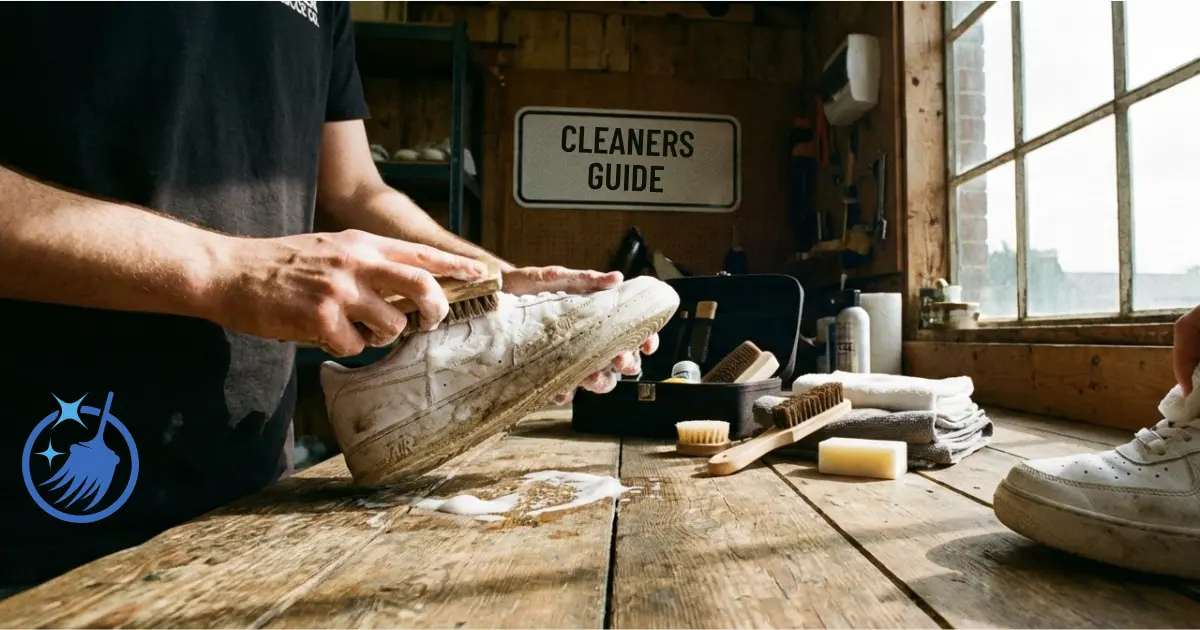
You lift your white trainers off the rack and they are not white any more. The toe caps have gone grey, there is a tide mark along the sole, and something that might once have been mud has dried into the stitching. Before you resign them to the gardening shelf, it is worth knowing that most pairs come back with washing-up liquid, bicarbonate of soda and an old toothbrush. The one thing that really matters is matching the method to what the trainer is made of.
This guide starts with how to read your pair, then covers a five-minute clean, a proper deep clean, the washing machine question, the awkward parts such as soles and laces, and what to try when the first go does not work.
Disclosure: Cleaners Guide is a participant in the Amazon Associates programme, so if you buy through links on this page we may earn a small commission at no extra cost to you. It never changes our recommendations, we suggest products because they do the job and we point out cheaper options where they do the same thing. Prices and availability change, so always check the current price before buying.
| Method | Time | Best for |
|---|---|---|
| Five-minute wipe | About 5 minutes | Trainers worn once or twice, light dirt |
| Deep clean by hand | About 30 minutes plus drying | Grubby soles, visible stains, smells |
| Machine wash | One cycle plus drying | Canvas, fabric and mesh with a care label that allows it |
| Dry brush and eraser | A few minutes | Suede and nubuck |
Most of the supplies are in the kitchen cupboard. If you want a refresher on the other uses of the same cupboard staples, our grout cleaning guide uses bicarbonate of soda in a similar way, and our cleaning products section covers when a shop-bought product is worth it. The Cleaners Guide home page lists the rest.
Read the trainer before you pick a method
Check the label inside the tongue or the maker’s care page, then look at what the upper is made of. The quickest way to spoil white trainers is to use the right method on the wrong material.
| Material | Do | Avoid |
|---|---|---|
| Leather or synthetic leather | A barely damp cloth with a drop of washing-up liquid, then a clean damp cloth and a dry towel | Soaking, the washing machine, harsh bleach, biological detergent |
| Canvas or fabric | Soapy water and a soft brush, bicarbonate of soda paste on rubber, machine washing if the label allows | Hot washes, tumble drying |
| Mesh and knit | A soft brush, small circles and dabbing, plus a short soak for ground-in dirt | Hard bristles and rubbing that snag the weave |
| Rubber soles and toe caps | Bicarbonate of soda paste, a non-gel white toothpaste dab or a melamine sponge | Coloured cleaners or gel toothpaste that can stain |
| Suede or nubuck | A dry suede brush and a suede eraser | Water, washing-up liquid and pastes |
White leather
Leather is one of the easier materials, but it needs gentle handling to avoid cracking or discolouration. Take out the laces and insoles. Mix warm water with a few drops of washing-up liquid, dip a soft cloth and wring it out well, because leather does not like excess water. Wipe the whole upper, use a very soft toothbrush with light circular motions on stubborn marks, then wipe off all soap with a clean damp cloth and dry straight away with a tea towel.
For scuffs, some people use a tiny dab of white vinegar on a cotton bud. Test a hidden area first and stop if the finish looks dull. For a stubborn stain, mix bicarbonate of soda and water into a paste at about two parts bicarb to one part water, leave it on for five minutes, then wipe off with a damp cloth. Do not soak leather trainers or put them in the machine, because too much water can break down the fibres and warp the shape.
White canvas
Canvas is tougher and takes more scrubbing. It can go in the machine (see below), but hand cleaning gives more control. Take out laces and insoles, knock off loose dirt, and scrub the canvas in circles with a toothbrush and soapy water. Use a bicarbonate of soda and water paste on the rubber sole. Wipe off the soap with a clean damp cloth several times until none is left, stuff with kitchen roll and dry somewhere airy, out of direct sunlight, which can cause yellowing.
White mesh
Mesh traps dirt between its fibres but is too delicate for hard scrubbing, so patience is the technique. Remove laces and insoles. A 10-minute soak of the whole shoe in warm soapy water helps to loosen embedded dirt first. Then use a soft toothbrush in small circles and a cotton bud for tight areas. Rinse by dabbing with a clean damp cloth. Mesh dries slowly, so stuff the shoes with kitchen roll, change it once, and give them good airflow.
White suede or nubuck
Suede needs a completely different approach. Water and washing-up liquid can stain and mat it. Use a suede brush to lift the nap in one direction and remove surface dirt, then a suede eraser on marks. Our guide to cleaning suede shoes covers it properly. Some people dab a stubborn stain on suede with a cloth barely dampened with white vinegar and brush once dry, but moisture can leave water marks, so treat that as a last resort and test first. For badly stained suede, take it to a professional shoe cleaner. Never use bicarbonate of soda paste or soapy water on suede.
Before you start, check three things
- Colourfast trim. Many white trainers have coloured logos, stripes or panels. Test the cleaner on a hidden spot and use less water near them, because dye can bleed into white.
- Glue and foam. If the sole edge is lifting, keep water away from the join and fix the glue before cleaning, or hand-wash very lightly.
- Coatings. Patent, glossy or coated leather marks easily. A soft cloth is all they need, and abrasive pastes will dull them.
Also work in good light. Grey dirt hides in textured fabric and on midsoles, and you only notice it when the shoes are drying and it is too late. A bright window or a torch shows what has been missed.
The five-minute clean
For trainers worn once or twice with only light surface dirt. It suits every material except suede, though go lightly on leather.
- Take out the laces and knock the trainers together outside to shake off loose dirt.
- Mix a small bowl of warm water with a squirt of washing-up liquid.
- Dip a microfibre cloth in, wring it out so it is damp and not soaking, and wipe the whole upper of both shoes.
- Scrub the soles with an old toothbrush dipped in the soapy water, getting into the grooves.
- Wipe everything with a clean damp cloth to remove soap, stuff with kitchen roll and leave to air dry.
Do this after every two or three wears and you will rarely need the long version. If you can see dirt packed into the grooves of the sole, or the shoes smell off, move on to the deep clean. The same slow, no-heat approach to air drying fabric applies in our car seats guide.
The deep clean, step by step
This is for trainers that have not been cleaned for a few weeks, have visible stains or smell a bit off. It works for all materials except suede, and takes about 30 minutes of attention plus drying time.
- Strip them down. Take out the laces and insoles completely so you reach every part and the insoles can dry properly, which also helps with smells.
- Dry brush first. Use an old toothbrush or dry brush to knock off caked mud, outside or over a bin. Mud turns to paste if you wet it too soon.
- Mix the solution. Warm water with a good squirt of washing-up liquid, and for heavily soiled pairs add a tablespoon of bicarbonate of soda.
- Clean the uppers. Work in small sections in circles, paying extra attention to the toe box and heel. Use a soft cloth on leather, and you can be firmer with canvas and mesh. Foam is normal.
- Do the soles. Make a thick paste with about two parts bicarbonate of soda to one part water, apply with a toothbrush and scrub into the grooves. A melamine sponge, dampened, is good on smooth rubber and toe caps.
- Tongue and stitching. Lift the tongue and scrub the underside, and use a cotton bud with the solution along white stitching so you do not oversaturate the surrounding material.
- Rinse properly. Wipe with a clean damp cloth several times. Soap left behind attracts dirt and can leave streaks or a yellow cast as it dries.
- Dry slowly. Stuff with kitchen roll or newspaper, changing it after an hour if soaking wet. Leave somewhere airy, away from radiators (heat weakens glue), tumble dryers (which can warp them) and direct sun (which yellows white). Allow up to 24 hours.
Our full guide to cleaning trainers covers coloured and sports styles as well.
Can you put white trainers in the washing machine?
Sometimes. The machine can clean trainers well if the label allows it and you protect them and the drum.
| Trainer type | Machine wash? |
|---|---|
| Canvas | Usually yes, if the label allows it |
| Fabric or synthetic | Often yes, check the label |
| Mesh | Yes, on a gentle cycle, if the label allows it |
| Leather | No |
| Suede or nubuck | No |
| Anything with glued trims, foam parts or delicate decoration | No, hand wash |
- Remove laces and insoles, and wash the laces separately in a mesh bag.
- Knock off loose dirt and mud first.
- Put the trainers in a mesh laundry bag or a pillowcase, which protects them and cuts noise.
- Add a couple of old towels to cushion and balance the load.
- Choose a gentle or delicate programme with cold water, and use about half your usual amount of liquid detergent.
- Use no spin or the lowest spin if you can, then stuff with kitchen roll and air dry.
Never tumble dry trainers. Some pairs have glued parts that can separate, and some have leather accents that will be damaged, so read the care label, and hand wash if you are unsure.
Soles, toe caps, stitching and laces
Sometimes it is only one part that has gone grubby.
- Rubber soles. Bicarbonate of soda paste with a toothbrush, scrubbed in circles. A melamine sponge or a tiny drop of white vinegar added to the paste helps with scuffs. Products such as The Pink Stuff paste also work on rubber, though avoid it on leather and mesh because it is abrasive.
- Toe caps. They take a beating and turn grey or yellow. Use the same paste and leave it on for 5 to 10 minutes before scrubbing.
- Stitching. A cotton bud dipped in soapy water along each line. A soft toothbrush gets into dirtier seams.
- Mesh panels. Dab, do not scrub.
- Laces. Soak in warm water with washing-up liquid for 20 minutes then rinse, or put them in a mesh bag in a machine wash. Hang to dry, and never thread wet laces back in.
If the insoles are the smelly part, cleaning shoe insoles has its own steps, and if you need to buy new ones the replacement is usually cheap.
If it did not work: yellowing, grey, mud, grass, scuffs and smell
Yellowing
It comes from too much sun, heat, or soap residue left behind. Mix one part white vinegar to two parts water and add a tablespoon of bicarbonate of soda (it will fizz). Apply to the yellowed areas with a cloth or soft brush, leave for 10 minutes, scrub gently and rinse thoroughly. If that does not work, some people use a paste of bicarbonate of soda and 3% hydrogen peroxide from a chemist. Use it only on white fabric or rubber, never on leather or coloured parts, test a hidden spot first, rinse well, and do not leave it on for long. Do not leave trainers to dry in strong sun afterwards.
Grey and dull
Grey usually means embedded dirt. Do a full deep clean with extra attention on the soles, and for canvas a machine wash can restore brightness. Rinse thoroughly and dry completely.
Mud
Let it dry fully, then brush off as much as you can with a dry brush. Then scrub the remaining stain with washing-up liquid and warm water on a toothbrush. Canvas can take vigorous scrubbing, but go gently on the other materials.
Grass
Grass contains natural dyes and can be stubborn. On leather, dab with a little white vinegar on a cloth and test first. On canvas and fabric, make a paste of washing-up liquid and bicarbonate of soda, leave it 15 minutes then scrub. An oxygen-based stain remover powder, such as Vanish Oxi Action, mixed to a paste with water, works on white fabric trainers too. Leave it for about 10 minutes, scrub and rinse.
Scuffs
Black scuffs come from other shoes or car pedals. A melamine sponge works well on rubber. On fabric or leather, a tiny bit of white non-gel toothpaste on a cloth, rubbed gently, can lift them. Test first.
Smells
If they still smell after cleaning, look at the insoles and lining. Sprinkle bicarbonate of soda inside and leave it overnight, then shake it out. Replace insoles if they are the source. For a bad smell, place the trainers without insoles in a sealed bag with a sock filled with bicarbonate of soda for up to two days.
Midsole yellowing and glue marks
Foam midsoles and clear soles can turn yellow with age, which cleaning does not reverse. Wipe them with the paste or a melamine sponge to remove surface grime, then accept that deep yellowing is the material ageing. Dried glue marks around the sole edge are better rubbed away with a dry rubber eraser than scrubbed with water, which can loosen the bond.
Things to avoid
- Bleach on the shoe. It weakens fibres, harms glue and often turns white to yellow.
- Soaking. Glue breaks down and shape is lost.
- Radiators and sun. They weaken glue, crack materials and yellow whites.
- Coloured products. Blue washing-up liquid or gel toothpaste can leave a tint.
- Rough scrubbing on leather.
- Storing them damp. They need to be bone dry or they will go mouldy and smell.
- Biological detergent on leather. The enzymes can harm it, so use non-bio or washing-up liquid.
- Cleaning only the uppers. Dirty soles make the whole shoe look grubby.
A white-trainer kit checklist
You can do nearly everything above with washing-up liquid, bicarbonate of soda, white vinegar, a toothbrush and microfibre cloths. If you would like a bit more help, here is a checklist of six items, with what to look for. The links go to Amazon UK searches so you can compare sizes, makes and current prices.
- Cleaning kit. A brush with a bottle of solution, often sold for leather and canvas. Search kits with a brush or kits for white trainers. Check it suits your material, and note the brush should be soft.
- Liquid trainer cleaner. Search trainer cleaners. Look for a clear or white formula, one that names your material on the label, and avoid dyed products.
- Sole eraser or whitener. Search sole whiteners and erasers. Melamine-style erasers lift scuffs off smooth rubber, but they are abrasive, so keep them off leather and printed areas.
- Protector spray. Search protector sprays. Choose one for your material, apply to clean, dry shoes in a ventilated space and follow the reapplication advice on the can.
- Suede brush and eraser. Search suede care sets. Only for suede and nubuck, used dry.
- Oxygen-based stain remover. Search oxygen stain removers. For tough marks on white fabric only. Follow the label, rinse well and keep it away from leather.
Keeping them white
| Task | How often | Why |
|---|---|---|
| Quick wipe-down | After every 2 to 3 wears | Stops dirt setting |
| Spot clean stains | As soon as you see them | Fresh marks come out easily |
| Deep clean | Every 3 to 4 weeks if worn regularly | Removes build-up and smells |
| Sole scrub | About every 2 weeks | Soles show the dirt most |
| Wash laces | About monthly | They yellow quickly |
| Re-apply protector spray | After each deep clean | Keeps liquid and dirt out |
- Spray clean, dry trainers with a protector made for the material.
- Keep a microfibre cloth by the door and wipe them when you take them off.
- Rotate pairs so each can air out fully.
- Store them on a rack or in the box, with tissue in the toe if you will not wear them for a while.
- Think twice about white on wet days and muddy paths.
- Keep gym trainers in a separate bag.
- Swap insoles every 6 to 12 months or when they smell.
When they are past saving
It is worth trying a proper clean first, but some pairs cannot be rescued. Signs include soles separating from the uppers, holes or tears in the fabric, a midsole that has compressed flat, extensive cracks in leather, yellowing that returns after repeated cleans, and a smell that nothing shifts. Structural damage cannot be cleaned away. If the shoes are just dirty, however, a proper deep clean often brings back more than you would expect. For expensive pairs, a professional trainer cleaner may be worth it.
Seven things people ask about white trainers
What is the best thing to clean white trainers with?
Warm water with washing-up liquid suits most materials. For soles and stubborn marks, bicarbonate of soda paste works well. Specialist cleaners can help but are rarely essential, so spend extra only if you have a leather or expensive pair and want a formula designed for it.
Does toothpaste clean white trainers?
White non-gel toothpaste can lift small scuffs because it is mildly abrasive. Apply a little to a cloth or toothbrush, rub gently, then wipe with a damp cloth. Avoid gel or coloured toothpaste, which can stain. Bicarbonate of soda paste does a similar job on soles.
How do I stop white trainers turning yellow?
Rinse away all soap after cleaning, dry them away from sun and radiators, and store them somewhere cool and dry. Yellowing comes from heat, light and soap residue. If it has already happened, try the vinegar and bicarbonate treatment above, and use a protector spray to help afterwards.
How do I clean white trainers that have gone grey?
Grey usually means embedded dirt, so do a deep clean: remove laces, brush off loose dirt, scrub with soapy water and a toothbrush and work the soles with bicarbonate paste. Canvas can then go through a gentle machine wash. Rinse thoroughly and dry fully.
Can I use bicarbonate of soda on white trainers?
Yes. It is a gentle abrasive and deodoriser, and works especially well on rubber soles and toe caps. Use a paste of about two parts bicarbonate to one part water. Avoid it on suede, and rinse it off leather rather than leaving it to dry.
How often should I wash white trainers?
A quick wipe after every two or three wears, spot cleaning as soon as you see a mark, and a deep clean every three to four weeks if you wear them regularly. Clean sooner after rain, mud or a festival, because stains are easier to remove when fresh.
Can I use The Pink Stuff on white trainers?
It works well on rubber soles and white rubber sections, applied with a damp cloth or toothbrush. It is quite abrasive, so keep it off leather, mesh, printed logos and any coating. Rinse it off thoroughly afterwards and test a hidden area if you are unsure.
Can you clean white trainers with bleach?
It is best avoided. Bleach can weaken fibres, damage glue and stitching, and often turns white shoes yellow, especially on leather and synthetics. Use washing-up liquid, bicarbonate of soda and a soft brush instead. If you are tempted for a stubborn stain on plain white fabric, test a hidden spot first and rinse thoroughly.
Does hydrogen peroxide help whiten white trainers?
It can brighten white fabric and rubber soles when used as a paste with bicarbonate of soda, using the 3% strength sold in pharmacies. Keep it off leather, suede and coloured parts, test a hidden spot, rinse well, and do not leave shoes in strong direct sunlight to dry.
How do I clean On Cloud shoes?
Check the care instructions from On for your model first. In general, remove the laces and insoles, wipe the uppers with a soft brush or cloth, lukewarm water and a little mild soap, then rinse and air dry away from heat. Avoid hot water, tumble dryers and harsh cleaners.