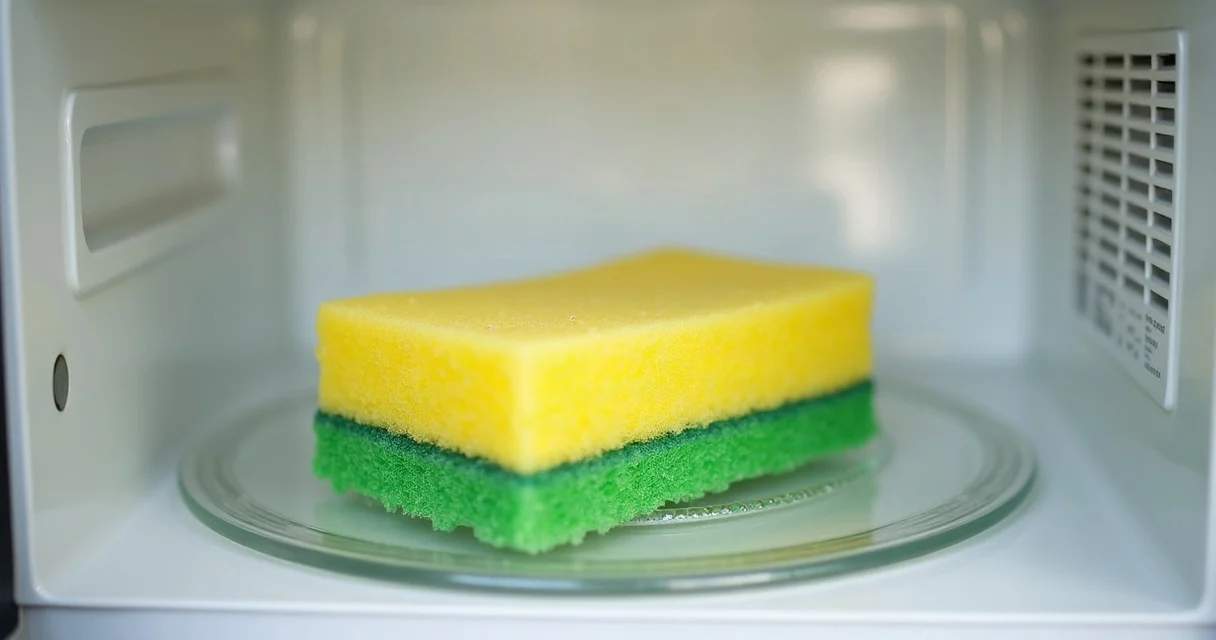
The short answer: yes, microwaving kills germs, and dramatically so. In a US Department of Agriculture study, microwaving a soaking-wet kitchen sponge for one minute destroyed 99.99999% of the bacteria on it, along with most yeasts, moulds and even spores. The secret isn’t the microwaves themselves, it’s the steam they create inside the wet sponge, which effectively cooks the microbes throughout. A hot dishwasher cycle does almost as well. Cold methods, a quick bleach dip, a lemon-juice soak, a rinse, barely helped by comparison.
But there are two things you must know before you try it, and they’re the reason this guide exists. First, safety: a sponge has to be dripping wet and completely metal-free, or it can catch fire in the microwave. Second, and just as important, it doesn’t last: sponges recolonise with bacteria within days, and research shows regularly-sanitised sponges aren’t reliably cleaner over time, and may even end up harbouring hardier bugs. So microwaving is a useful top-up, not a magic reset. This guide covers exactly how to do it safely, which methods actually work (with a chart), and the routine that genuinely keeps your kitchen hygienic. Sources are linked at the end.
How we researched this: the findings below draw on a USDA Agricultural Research Service study and peer-reviewed research on the kitchen-sponge microbiome. Full references are at the bottom.
Disclosure: Cleaners Guide is a participant in the Amazon Associates programme, so if you buy through links on this page we may earn a small commission at no extra cost to you. It never changes our recommendations, we suggest products because they work and we point out cheaper options where they do the same job. Prices and availability change, so always check the current price before buying.
Does microwaving actually kill germs?
Yes, when it’s done properly. The clearest evidence comes from a 2007 study by the US Department of Agriculture’s Agricultural Research Service. Researchers deliberately soaked kitchen sponges and scrubbing pads in a broth swimming with bacteria, faecal matter and food debris, then tried different ways of cleaning them. Microwaving a soaking-wet sponge for one minute killed or inactivated over 99.99999% of living bacteria, a “seven-log” reduction. It also wiped out most yeasts and moulds, and inactivated more than 99% of a bacterial-spore species (Bacillus cereus), which is impressive because spores are famously tough.
A dishwasher with a drying cycle came a very close second, killing about 99.9998% of bacteria. The cold methods people reach for most often, a quick dip in bleach solution, lemon juice, or plain water, trailed far behind, removing only somewhere in the region of 37% to 87% depending on the method. In other words, the two methods that use heat did the real work. The chart below shows the gap.
One caveat worth stating up front: this was a laboratory test on deliberately filthy sponges, so the exact percentages won’t map perfectly onto your kitchen. But the ranking is the useful part, and it’s been repeated in principle many times since: heat and steam sanitise a sponge; a cold rinse or a brief chemical dip mostly just moves germs around.
Why heat works and cold soaking doesn’t
The word “microwaving” is slightly misleading. It isn’t the microwave radiation itself that sanitises the sponge, it’s the steam. A wet sponge is mostly water, and microwaves heat that water fast. Once it reaches boiling point, the whole sponge fills with steam at around 100°C, and that moist heat penetrates every pore. Heat kills microbes by denaturing their proteins and enzymes, essentially cooking them, and moist heat does this far more efficiently than dry heat, which is exactly why autoclaves in hospitals sterilise with pressurised steam rather than a hot-air oven. Your microwave is a crude, kitchen-scale version of the same principle.
This is also why the sponge must be soaking wet. A dry or barely damp sponge has little water to turn into steam, so instead of gently cooking through, the dry fibres keep heating until they scorch and can catch fire. Wet equals steam and safety; dry equals a fire hazard and poor sanitising. We’ll come back to the safety side in detail below.
Cold methods fail for two reasons. First, they don’t reach a temperature that reliably kills bacteria, most food-poisoning bugs shrug off room-temperature conditions. Second, a sponge is a dense, three-dimensional maze of pores absolutely packed with organic gunk (food, grease, protein). A quick dip in bleach or lemon juice can’t penetrate that maze, and the organic load “uses up” a disinfectant like bleach before it can reach the bacteria hiding deep inside. Heat has no such problem: steam goes everywhere the water goes, which is everywhere.
How to microwave a sponge safely
See non-scratch sponges on Amazon →
Done carelessly, this is one of the few kitchen tips that can genuinely start a fire. Done properly, it takes two minutes and works. The single rule that keeps it safe: the sponge must be dripping wet, and it must contain no metal. Here is the method step by step.
- Check the sponge has no metal. Ordinary cellulose or foam sponges are fine. Do not microwave any sponge with a metal scouring pad, metallic scrubbing layer, or a foil-backed section, metal sparks and can ignite. If you’re not sure what’s inside it, don’t risk it.
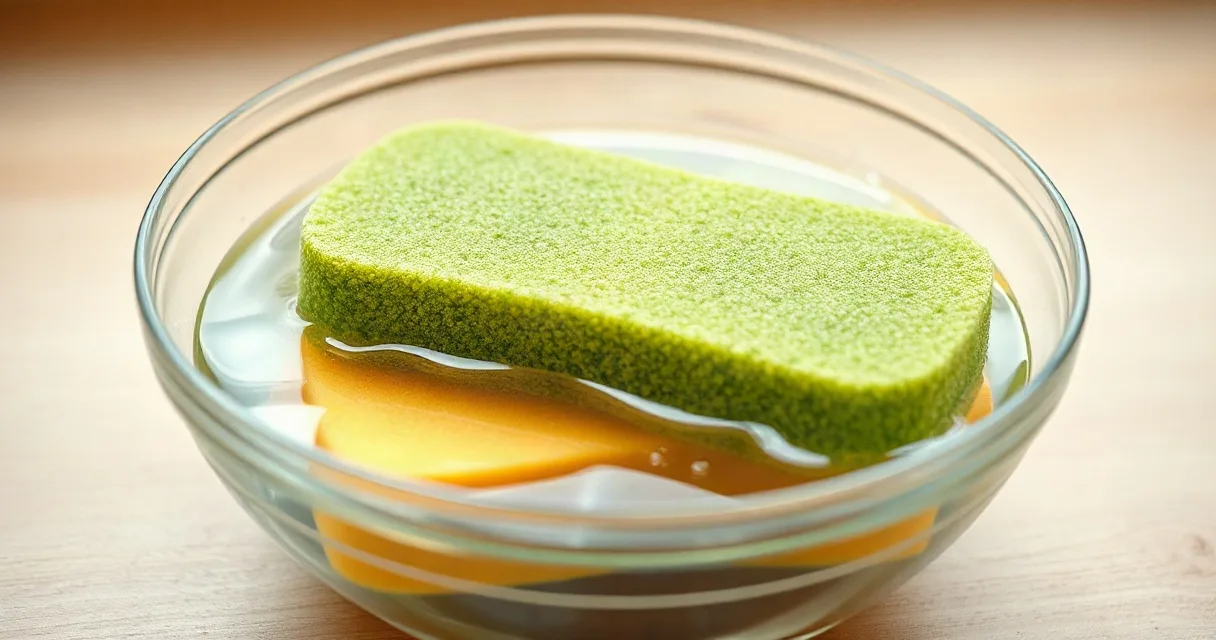
- Soak it until it’s dripping. Rinse out food debris first, then saturate the sponge with water so it’s genuinely soaking, not just damp. Adding a splash of water to a microwave-safe bowl and sitting the sponge in it is a good way to guarantee it stays wet throughout.
- Microwave on full power for 1 minute (up to 2 minutes for a thick cellulose sponge). The USDA test used one minute for a sponge and two for a heavier scrubbing pad. Never go longer “to be safe”, longer is exactly what causes scorching.
- Stay in the room and watch it. If you see smoke or smell burning, stop the microwave immediately. Treat this like anything else heating on a hob: don’t wander off.
- Let it cool before touching it. This is the step people skip and regret. A just-microwaved sponge is scaldingly hot and full of near-boiling water, it can cause a nasty steam burn. Leave it in the microwave for a couple of minutes, then lift it out with tongs or oven gloves and let it cool fully before wringing.
That’s the whole method. The two failure modes to remember are dry sponge = fire and hot sponge = burn. Get the sponge soaking wet, keep the time short, watch it, and let it cool, and neither happens.
The methods that work, and the ones that don’t
Microwaving isn’t the only way to sanitise a sponge, and it isn’t always the most convenient. Here’s how the common methods actually compare, based on the USDA findings and the underlying science of heat versus cold disinfection.
| Method | How well it sanitises | What to know |
|---|---|---|
| Microwave (soaking wet, 1–2 min) | Excellent, ~99.99999% in tests | Only if wet and metal-free. Fire risk otherwise. Very hot afterwards. |
| Dishwasher (full cycle + heated dry) | Excellent, ~99.9998% | The heated drying cycle matters as much as the wash. Convenient if you run one anyway. |
| Boiling in water (~5 min) | Very good | Reliable moist-heat method; useful if you don’t trust your microwave. Use tongs. |
| Bleach soak (proper dilution, several minutes) | Moderate, better with longer contact | A quick dip barely helps; it needs real contact time and correct dilution to matter. |
| Lemon juice or vinegar soak | Weak | Smells fresh, doesn’t reliably kill kitchen bacteria in a sponge. |
| Rinsing under the tap | Poor | Removes loose debris only. Does not sanitise. |
The headline is simple: heat sanitises, cold mostly doesn’t. If you run a dishwasher regularly, tucking the sponge into the cutlery basket for a hot cycle with a heated dry is arguably the easiest effective method of all, no fire risk, no burn risk, nothing to watch. Boiling works too. The chemical soaks are the ones to be sceptical of: they feel like they should work, but the tests show a wet sponge’s pores and food load defeat them unless you’re rigorous about dilution and contact time.
The catch: sanitising doesn’t keep a sponge clean
Here’s the part most “just microwave your sponge” articles leave out, and it’s the most important thing on this page. Killing the bacteria in a sponge right now does not keep it clean. A sponge is warm, wet and full of food, a near-perfect incubator, so the survivors and any new bacteria you introduce at the next wash-up recolonise it within days, often back to something close to their original numbers.
Worse, there’s evidence that routine sanitising can backfire. A widely-reported 2017 study of used household sponges (Cardinale and colleagues) found that sponges people said they cleaned regularly were not lower in bacteria than un-cleaned ones, and actually had a higher proportion of certain bacteria linked to the tougher, potentially more problematic groups. The likely explanation is a kind of survival-of-the-fittest: a quick sanitising knocks out the weaklings but leaves the hardiest bugs, which then repopulate the sponge with less competition. Later metagenomic work on regularly microwave-treated versus untreated sponges reached broadly the same conclusion, treatment reshuffles the community rather than reliably sterilising it long-term.
None of this means microwaving is pointless. It genuinely does slash the bacterial count in the moment, which is useful before a job where you care, say, wiping down after raw chicken. But it does mean you should treat sanitising as a top-up between replacements, not a substitute for replacing. The one thing that reliably gives you a clean sponge is a new sponge.
The routine that genuinely keeps a kitchen hygienic
See surface sprays on Amazon →
Putting the evidence together, here’s a routine that actually works rather than just feeling productive:
- Replace sponges often, every week or two. This is the single most effective step. Sponges are cheap; a fortnightly swap costs pennies and sidesteps the whole recolonisation problem. Bin any sponge that smells, however recently you cleaned it, odour is bacteria.
- Sanitise between replacements. A microwave, dishwasher or boil once or twice a week keeps the count down in the meantime. Think of it as maintenance, not a reset.
- Dry it out every day. Bacteria thrive in a wet sponge. Wring it hard after each use and stand it somewhere airy so it dries fully between uses, a sponge that spends the night in a puddle at the bottom of the sink is the worst case. Drying alone meaningfully slows regrowth.
- Keep raw-meat cleanup separate. Don’t use your general washing-up sponge on surfaces that touched raw meat or their juices. Use paper towel you can throw away, or a dedicated cloth you can hot-wash.
- Consider a dishcloth or brush instead. A cloth can go through a hot 60°C wash; a washing-up brush dries far faster than a sponge and holds fewer bacteria. Both are easier to keep genuinely clean than a sponge.
If you want the background on why sponges get so grim in the first place, see our explainer on whether kitchen sponges are really that dirty, and for the bigger picture on where the germs actually are, is the kitchen dirtier than the bathroom?
Does microwaving kill germs on other things?
The same principle, it’s the steam, not the microwaves, tells you what else this does and doesn’t work on. A damp cloth or dishrag can be sanitised much like a sponge, provided it’s wet and metal-free. A dry object won’t be sanitised reliably, because there’s no water to make steam; you’ll just heat it unevenly, and you risk melting plastics or starting a fire. Microwaving isn’t a general-purpose disinfector for dry household items.
What about food? Microwaves do kill germs in food, but only where the food actually reaches a safe temperature. Because microwaves heat unevenly, cold spots can survive, which is why reheating instructions tell you to stir halfway and observe standing times. The rule for food is the temperature it reaches (piping hot all the way through), not the fact that it’s been in the microwave. For a fuller treatment of heat and germs, see does steam cleaning kill germs and dust mites?
Sanitising helps, but swapping sponges often keeps a kitchen cleaner.
The bottom line
Microwaving a soaking-wet, metal-free sponge for one to two minutes really does kill almost all the bacteria in it, the evidence for that is strong. But it’s the steam doing the work, it’s genuinely a fire risk if the sponge is dry or has metal, and, crucially, it doesn’t stay clean: sponges recolonise within days. So use microwaving (or a hot dishwasher cycle) as a top-up a couple of times a week, dry the sponge out daily, and, the step that matters most, replace it every week or two. Sanitising buys you a cleaner sponge for a day; replacing is what keeps your kitchen genuinely hygienic.
Myths vs facts
| Myth | The reality |
|---|---|
| “Microwaving a sponge doesn’t do anything.” | False. A wet sponge microwaved for a minute lost ~99.99999% of bacteria in testing. |
| “You can microwave a sponge dry to freshen it.” | Dangerous. A dry sponge can scorch and catch fire. It must be soaking wet. |
| “Once I’ve microwaved it, the sponge is clean.” | Only briefly. It recolonises within days, sanitising is a top-up, not a reset. |
| “A quick bleach or lemon dip works just as well.” | No. Cold dips trailed far behind heat in tests; sponge pores and food load defeat them. |
| “Sanitising means I never need to replace my sponge.” | Wrong, and possibly counterproductive, replace every 1–2 weeks regardless. |
| “Microwaving disinfects anything I put in it.” | No. It’s the steam from water that sanitises; dry items aren’t reliably cleaned. |
Frequently asked questions
How long should I microwave a sponge for?
One minute on full power for an ordinary wet sponge; up to two minutes for a thick cellulose sponge or scrubbing pad. Don’t exceed this, longer heating is what causes scorching. The sponge must be soaking wet the whole time.
Does the sponge really need to be wet?
Yes, this is non-negotiable. The water is what turns to steam and sanitises the sponge, and it’s also what stops the fibres overheating. A dry or barely damp sponge can catch fire. Soak it until it’s dripping before it goes in.
Can a sponge really catch fire in the microwave?
Yes, if it’s dry or contains metal. Dry fibres keep heating until they scorch and ignite, and metal scouring layers spark. This is why the two rules are: soaking wet, and no metal. Stay in the room while it runs.
Is the dishwasher just as good as the microwave?
Almost, a full cycle with a heated drying phase killed about 99.9998% of bacteria in the USDA test, just behind microwaving. It’s also safer and needs no supervision. If you run a dishwasher anyway, it’s arguably the most convenient effective method.
How often should I sanitise my sponge?
Once or twice a week is a sensible maintenance rhythm between replacements. But remember it’s a top-up: sanitising daily won’t keep a sponge lastingly clean, because it recolonises. Drying the sponge fully each day matters just as much.
How often should I actually replace my sponge?
Every one to two weeks, and immediately if it smells or looks grubby. Replacing is more effective than any sanitising method for keeping germ levels down, and sponges are cheap enough that a fortnightly swap is easy to justify.
Does microwaving a sponge remove the smell?
It reduces it temporarily by killing the odour-producing bacteria, but the smell usually returns within days as they regrow. A persistently smelly sponge is telling you it’s time to bin it, not sanitise it again.
Can I microwave a sponge with a scouring pad on it?
Not if the scouring layer contains metal, it can spark and ignite. Many green scouring pads are metal-free plastic, which is fine, but if you can’t be certain, sanitise it by boiling or in the dishwasher instead.
Does soaking a sponge in bleach or vinegar work?
Far less well than heat. In testing, cold soaks removed only a fraction of what microwaving or the dishwasher achieved, because a sponge’s pores and food residue stop the liquid reaching and killing the bacteria deep inside. Bleach helps a bit more with correct dilution and real contact time, but heat is the reliable option.
Is microwaving a sponge actually worth doing?
Yes, as part of a routine, not as a magic fix. It genuinely cuts the bacterial count in the moment, which is worthwhile before or after a messy job. Just pair it with daily drying and, above all, regular replacement, since sanitising alone won’t keep a sponge clean for long.
Does microwaving kill germs in food?
Only where the food reaches a safe temperature throughout. Microwaves heat unevenly, so cold spots can let bacteria survive, which is why you should stir food, observe standing times, and make sure it’s piping hot all the way through before eating.
References
- US Department of Agriculture, Agricultural Research Service. “Best Ways to Clean Kitchen Sponges” (2007), ars.usda.gov
- ScienceDaily. “Microwave Your Kitchen Sponge To Keep It Clean, Says New Research” (2007), sciencedaily.com
- Cardinale, M. et al. “Microbiome analysis and confocal microscopy of used kitchen sponges reveal massive colonization by Acinetobacter, Moraxella and Chryseobacterium species.” Scientific Reports (2017), nature.com
- Jacksch, S., Thota, J., Shetty, S., Smidt, H., Schnell, S. & Egert, M. “Metagenomic Analysis of Regularly Microwave-Treated and Untreated Domestic Kitchen Sponges.” Microorganisms (2020), ncbi.nlm.nih.gov
Last reviewed: August 2026. This guide is general household information, not food-safety or fire-safety certification. Follow your microwave manufacturer’s guidance and never leave a microwave unattended while sanitising a sponge.