Short answer: no. Bicarbonate of soda cleans and deodorises very well, but it is not a disinfectant. Lab comparisons keep finding that it leaves most of the bacteria it touches alive, including the ones behind food poisoning, so it should never be the step you rely on to make a surface safe.
That does not make it a poor product. It just has a narrower job than its reputation suggests, and the evidence is clearer than most of the folklore around it.
What the lab comparisons actually show
Scientists measure germ kill in "logs". One log is a tenfold drop, so a three-log reduction removes 99.9 percent of the germs and leaves one in a thousand. That sounds a lot, but products sold as disinfectants are held to a stricter bar. In Europe, the standard bactericidal suspension test, EN 1276, asks for at least a five-log reduction (99.999 percent) within a set contact time.
Published comparisons of bicarbonate of soda against bleach and alcohol found it removed fewer than three logs of the test organisms, while the commercial products cleared them easily. Put plainly, bicarb can weaken or slow some bacteria, but plenty survive. Bicarbonate of soda is also not sold as a disinfectant, which is why you will not find a kill claim or a contact time on the tub.
The reason is chemical. In water, bicarb is only mildly alkaline. That is gentle enough to be safe on most surfaces and in food, but it is also not harsh enough to rupture bacterial cells the way bleach, alcohol or hydrogen peroxide can. The same gentleness is why it is so pleasant to use.
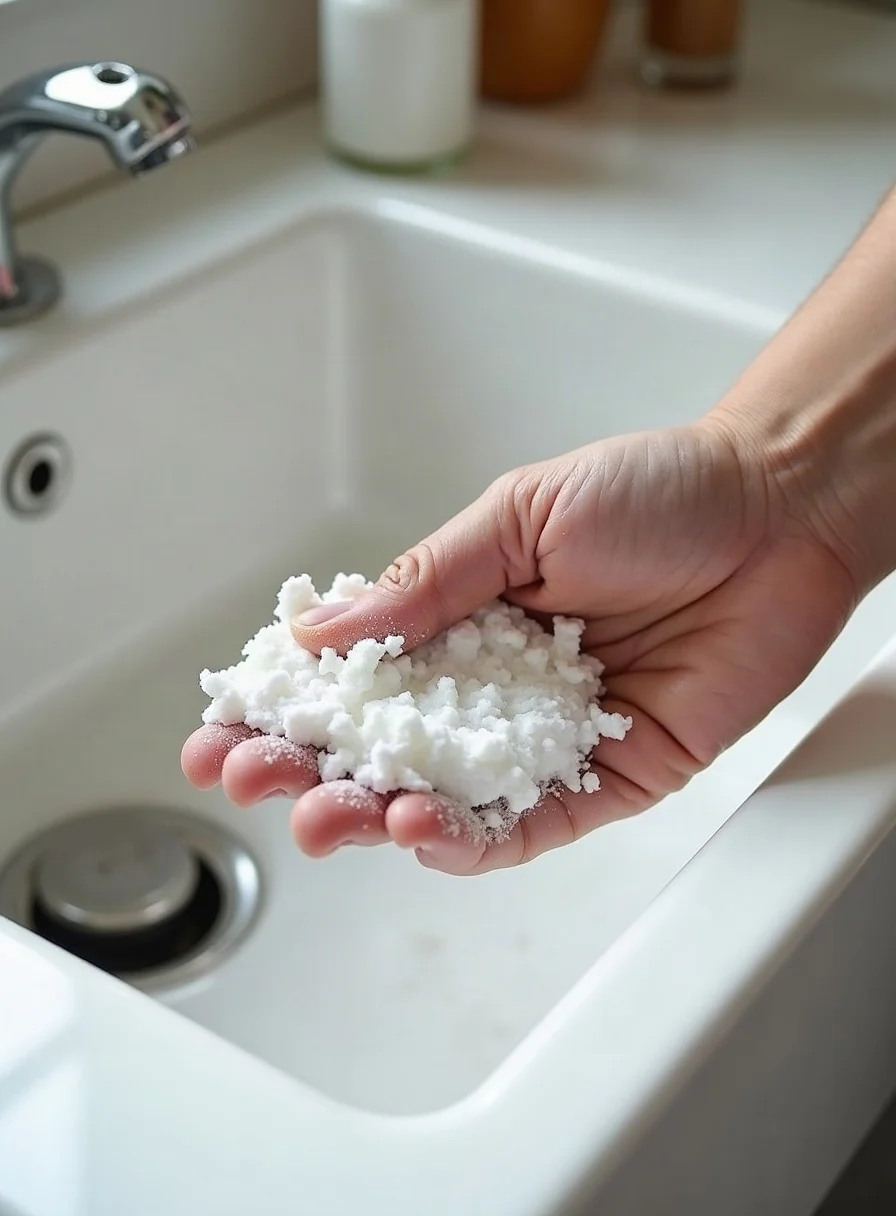
The jobs bicarb is genuinely good at
Once you stop asking it to kill germs, it is one of the most useful things in the cupboard.
- Scrubbing. As a mild abrasive, it lifts baked-on food, tea stains and soap scum without scratching most hard surfaces.
- Deodorising. It neutralises acidic and greasy smells rather than masking them, which is why it works in fridges, bins, carpets and trainers.
- Softening water. A scoop in the washing drum can help detergent work in hard water areas.
- Helping other cleaners. Research suggests bicarb can weaken bacteria and make a proper cleaner or disinfectant work better, so think of it as a partner, not a replacement.
Where relying on it goes wrong
The trouble starts when a surface looks and smells clean and so gets treated as safe. After raw meat, a sickness bug or a nappy change, clean-smelling is not the same as germ-free.
- It will not reliably deal with E. coli or salmonella on a worktop or chopping board.
- It is not a mould treatment. For what does work, see what kills mould.
- It is not a swap for bleach when you genuinely need to disinfect.
If you are weighing up other kitchen-cupboard options, we have separate write-ups on whether hydrogen peroxide disinfects and whether disinfectant wipes work.
Baking soda plus vinegar: all fizz, no kill
The internet’s favourite pairing is not a disinfectant either. Bicarbonate of soda is an alkali and vinegar is an acid, so they react, froth and largely cancel each other out, leaving mostly salty water. The fizz can help shift a lightly blocked drain physically, but it sanitises nothing. We go through the detail in does mixing baking soda and vinegar actually clean, and vinegar on its own gets the same treatment in does vinegar disinfect, where the short answer is barely.
One related warning: vinegar must never be mixed with bleach, because the combination can release chlorine gas. Our guide to cleaning products you should never mix covers the combinations to avoid.
Why the myth sticks
It sticks because bicarb leaves things visibly clean and fresh-smelling, and our brains read "smells clean" as "is germ free". Add the popularity of low-chemical cleaning and it is easy to assume a tub of bicarb does everything. It does a lot, just not that. The fix is to match the product to the job:
| The job | What to reach for |
|---|---|
| Scrubbing grime and stains | Bicarbonate of soda paste |
| Getting rid of smells | Bicarbonate of soda |
| Killing germs (after raw meat, illness) | A disinfectant spray, or heat |
| Limescale on taps and kettles | White vinegar or citric acid |
| Mould on grout or sealant | A mould spray or the right cleaner |
| Claim | What the evidence says |
|---|---|
| Baking soda disinfects surfaces | No. It is not sold as a disinfectant and removes far fewer germs than bleach or alcohol in tests. |
| Bicarb kills E. coli and salmonella | Not reliably. It may weaken some bacteria but leaves plenty alive. |
| Baking soda and vinegar make a powerful disinfectant | No. They neutralise each other. Good for fizzing a drain, not for sanitising. |
| Bicarb is useless then | Far from it. It is an excellent cleaner and one of the best household deodorisers. |
If a surface does need disinfecting
Bicarb has a place in the first half of the job, and a proper disinfectant or heat handles the second.
- Remove visible dirt first. Disinfectants work poorly on a dirty surface, and a paste of bicarb and a little water is a fine way to lift stuck-on grime.
- Rinse or wipe away the residue so it does not dilute or block the next product.
- Apply a disinfectant and keep the surface wet for the contact time printed on the label. Wiping it off straight away defeats the point.
- Use heat where you can. A hot wash for cloths, or a dishwasher cycle for hard items, is a no-chemical alternative.
- Wash your hands and wash or bin the cloth afterwards.
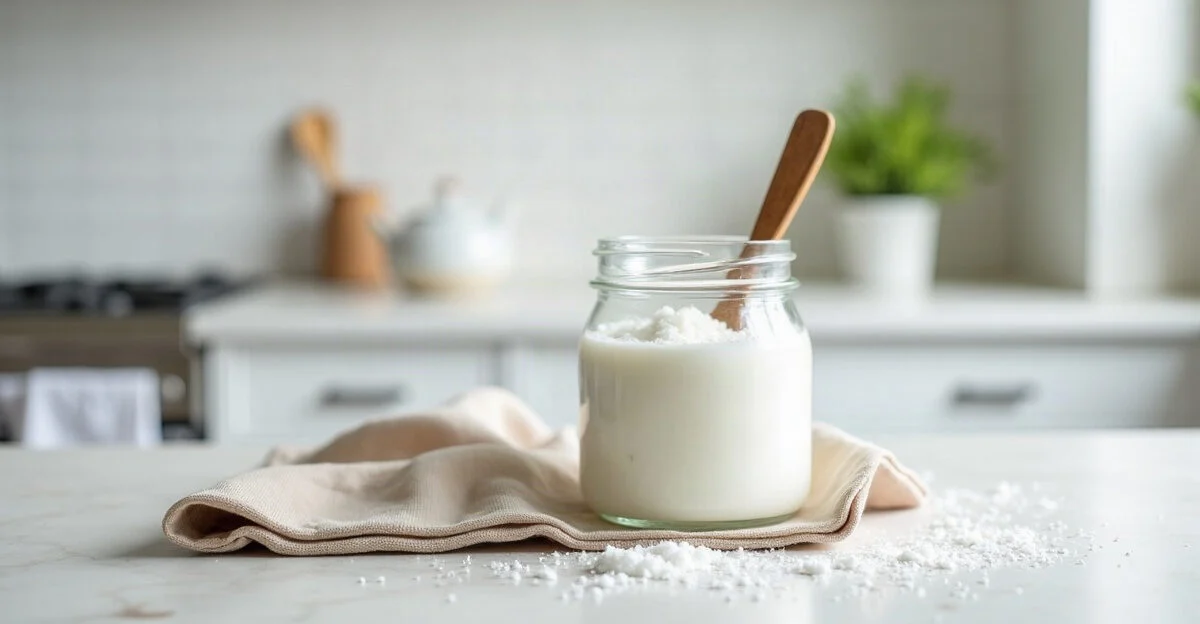
For deodorising, sprinkle bicarb on carpets, mattresses or trainers, leave it a few hours and vacuum it up, or keep an open tub in the fridge. A good shake down the plughole followed by hot water also keeps drains fresher.
Four things worth having, and what to look for
As an Amazon Associate we earn from qualifying purchases. These links go to Amazon UK searches, so you can compare sizes and makes yourself.
- Bicarbonate of soda. Look for plain sodium bicarbonate with no added fragrance, in a tub big enough that scrubbing and deodorising does not feel wasteful. Do not confuse it with baking powder. Keep it dry or it clumps.
- Disinfectant spray. Check that the label says what it kills and gives a contact time. Some cite tests such as EN 1276 or EN 13697. Ventilate, keep it away from food unless the label says it is food-safe, and never mix it with other products.
- White vinegar. Useful for limescale on taps and kettles and for some grease. Keep it off natural stone such as marble and limestone, and never combine it with bleach.
- Microfibre cloths. Handy for the wipe-off stages. Use separate colours for dirty and cleaner jobs and wash them according to the care label. Our comparison of microfibre and cotton cloths helps you choose.
Quick answers on bicarb
- Can bacteria survive baking soda?
- Yes. Many do. It can slow or weaken some bacteria, but it leaves most alive, which is why it does not count as a disinfectant.
- Can baking soda remove mould?
- It can help scrub light surface mould and lift the musty smell. It does not reliably kill mould at the root, and it is no answer to a damp problem that keeps feeding it.
- Is baking soda abrasive?
- Mildly. The fine grains are gentle enough for most sinks, hobs and pans, but they can dull glossy finishes and aluminium. Test a hidden patch first and avoid heavy rubbing on polished surfaces.
- Can I use bicarb instead of bleach?
- Not for disinfecting. Bleach kills germs and mould, while bicarb cleans and deodorises. If you want to avoid bleach, choose a different suitable disinfectant rather than leaning on bicarb.
- Is baking soda the same as bicarbonate of soda?
- Yes. It is sodium bicarbonate, called bicarbonate of soda in the UK and baking soda in the US. Baking powder is a different product, made of bicarb plus an acid and a starch.