The headline that gets shared is that a reusable water bottle can be tens of thousands of times dirtier than a toilet seat. It is a real swab result, and it is also a poor guide to what you should do about your own bottle. Here is what such studies measured, what they cannot tell you, and the cleaning habits that actually matter.
The short version: a bottle can become a germ trap if it is never taken apart and never dried, but most of what grows is your own mouth bacteria, and for plain water in a regularly washed bottle the risk is low.
What the swab headline really measured
One widely reported swab study by WaterFilterGuru, a water-filter website, found the average reusable bottle carried around 20 million bacteria (colony-forming units) and framed that as tens of thousands of times more than a toilet seat. Other coverage has called bottles a "breeding ground" for bacteria. Bear in mind that the source sells filtration products, and that swab studies of this sort are small and not peer-reviewed in the way medical trials are.
It helps to keep the same cool head we used when asking whether your phone is dirtier than a toilet seat or whether the kitchen is dirtier than the bathroom. A colony count tells you how much grew on a plate, not how likely you are to get ill. Most of what grows on a bottle is your own mouth flora, which your body already lives with. The genuine takeaway is that a neglected bottle gets grimy, mouldy and smelly, and that is worth avoiding.
What the studies did report is useful, though. The swabs also picked up gram-negative rods and bacillus, groups that in the wrong circumstances can cause stomach upsets. That is the reason to be more careful for children, older people and anyone with a weakened immune system.
Where the biofilm builds up
The bottle body, the big open cylinder, is the easy part to rinse and the least of your problems. The bacteria concentrate in the fiddly bits you cannot easily reach.
In the swab studies, spout-top and screw-top lids carried the most bacteria of all, and slide-top lids were the worst design. Straws, bite valves, silicone gaskets and narrow necks all create tiny nooks where backwash, saliva and drink residue settle and form biofilm, a slimy layer of bacteria that a quick rinse never removes. If your bottle smells musty, biofilm is the most likely cause.
Look out for black or pink specks, slime on the seal, or a film inside the lid. Those are signs that moisture has been trapped for a while. Pop the seal out and scrub it. If staining or a smell comes straight back, replace the seal rather than carrying on with it, because porous silicone can hold onto residue that no amount of soaking removes. Mould you can see is also a good reason to wash the whole bottle again before the next fill.
Why plain water and squash are not the same risk
The risk rises sharply the moment you put anything sugary in a bottle, such as squash, juice or a protein shake, because sugar feeds bacteria and mould. Sharing a bottle, or topping it up all day without ever washing it, does the same. Warmth matters too: a half-drunk bottle left in a hot car or gym bag is the ideal incubator.
For plain water, cleaned regularly, a reusable bottle is low risk. For a sugary drink left sitting in a warm bag, it is a different story, and the bottle should be washed that same day.
How often to clean it, and how
Wash the bottle every day. That is the usual guidance from food hygiene sources, and it is realistic. If you only drink water and refill through the day, a proper wash at the end of each day is enough. Take every part apart for a deeper clean at least once a week, and more often if the bottle holds anything but water. Leaving it for weeks gives biofilm and mould plenty of time to establish, particularly around the lid and straw.
| Part | How often | How |
|---|---|---|
| Bottle body | Daily | Hot soapy water and a bottle brush |
| Lid, spout, threads | Daily | Scrub with a brush, get into the grooves |
| Straw and bite valve | Daily rinse, weekly deep clean | Thin straw brush, then a soak |
| Silicone seal | Weekly | Pop it out, wash, dry before refitting |
Two things matter most: taking it apart, and drying it fully.
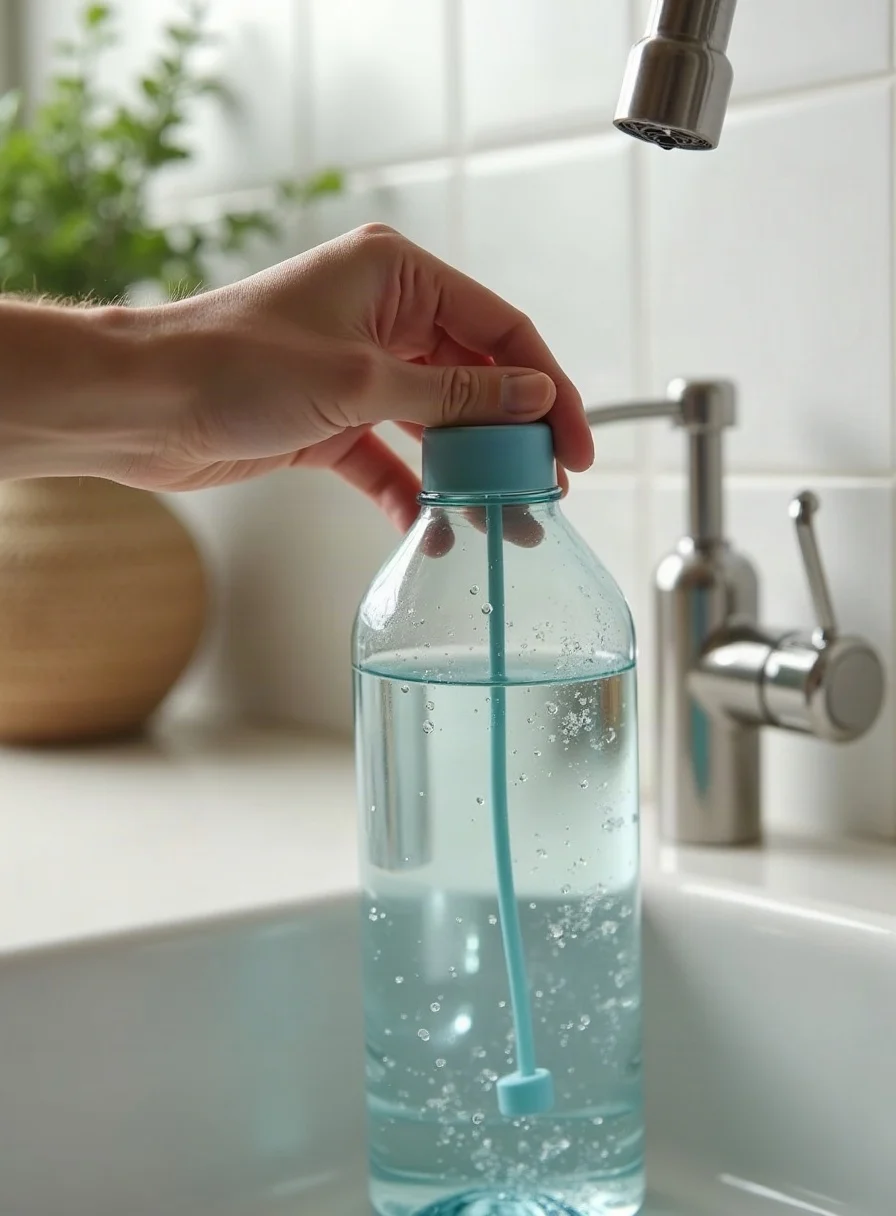
- Empty and rinse the bottle after every use, ideally with warm water.
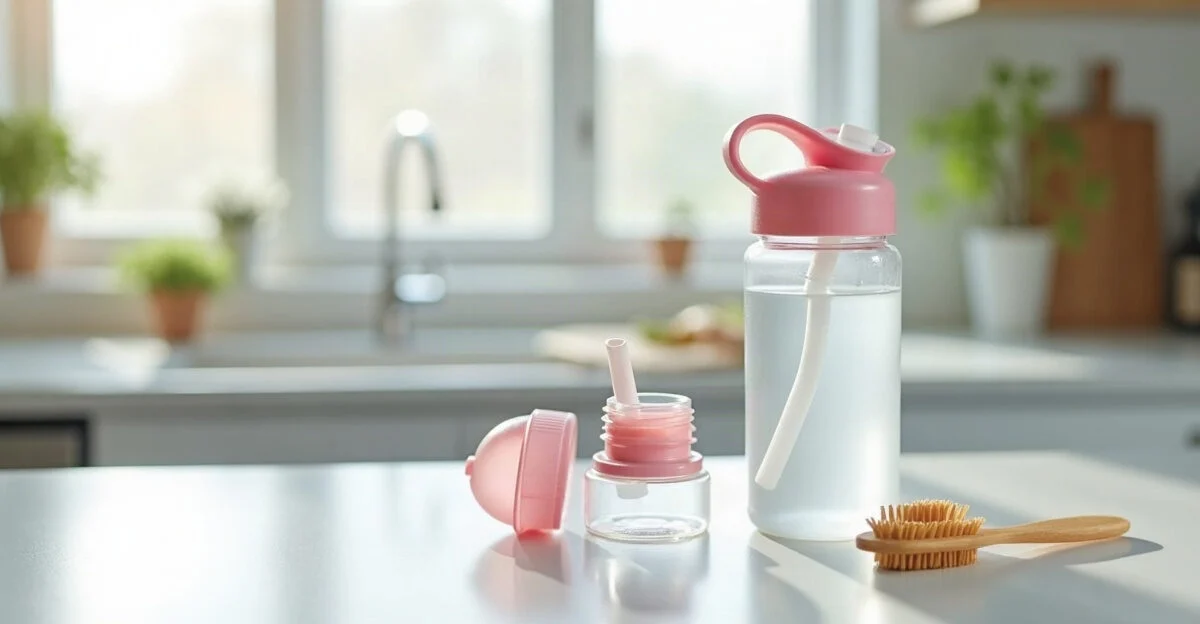
- Take everything apart: unscrew the lid, pull out the straw, bite valve and any silicone seal or gasket. These are where the gunk hides.
- Wash each part in hot soapy water with a bottle brush that includes a thin straw brush. Scrub the threads and the underside of the lid.
- For a weekly deep clean, or to shift a musty smell, soak everything in bottle cleaning tablets following the pack directions, or in warm water with white vinegar or bicarbonate of soda. Use one or the other, not a mixture, then rinse very well. Our look at whether vinegar disinfects explains what it can and cannot do.
- Dry every part completely with the cap off, upside down on a rack. Most people skip this and it matters most: no moisture, no biofilm and no smell.
If your bottle is stainless steel, the same routine applies, and that guide also covers descaling and stain removal. Check the maker’s care instructions, because some advise against bleach on stainless steel. Many bottle bodies are dishwasher safe but some lids and seals are not, and our comparison of dishwasher versus hand washing is useful for the cases where a machine helps. Washing in hot water, as covered in hot versus cold water cleaning, helps with greasy residue but a brush does the real work.
A six-item checklist for bottle care
As an Amazon Associate we earn from qualifying purchases. You do not need all of these, so treat the list as a menu. The links go to Amazon UK searches so you can compare sizes and makes.
- ☐ Bottle brush set: a long-handled brush for the base plus a thin straw brush. Check that the bristle head will fit through your bottle’s neck.
- ☐ Bottle cleaning tablets: for a weekly soak or a stubborn smell. Follow the pack dilution and rinse thoroughly. Do not combine with vinegar.
- ☐ Bottle drying rack: holds the bottle upside down so air gets in. Choose one that fits your bottle’s height and has a stable base.
- ☐ Replacement straws and seals: swap them when cracked, stained or sticky. Make sure they are made for your exact model.
- ☐ Wide-mouth bottle: fewer parts and a neck your hand and brush can reach make it easier to keep clean, whatever the material. Look for a lid that comes apart fully.
- ☐ White vinegar: a low-cost alternative to tablets for an occasional soak. Rinse well afterwards, and never mix it with bleach or any other cleaner.
A few habits cost nothing. Dry it fully between uses, keep it to water where you can, do not leave it full and warm, replace worn parts, and do not share bottles or top up a used bottle without washing it first.
If the bottle is for a child, a school bag or a sports kit, the same rules apply with a little more attention. Children tend to mouth the spout, share drinks and leave bottles shut in a warm bag, so a daily wash and an open-lidded dry overnight is a sensible habit, and a bottle with a simple lid that comes apart is easier for them to keep clean.
Bottle claims, checked
| Claim | The reality |
|---|---|
| Your water bottle is 40,000 times dirtier than a toilet seat | A real swab headline, but counts vary wildly and most bacteria are your own harmless mouth flora. Treat it as "clean it more", not "panic". |
| Rinsing with water is enough | No. Water alone does not remove biofilm from the lid and straw. Use hot soapy water and a brush. |
| Only the inside of the bottle matters | The lid, straw and seal are the dirtiest parts. Take them apart to clean them. |
| A quick shake dry is fine | Damp is the whole problem. Dry every part fully with the cap off. |
Bottle questions we keep seeing
What is the most hygienic type of reusable water bottle?
There is no single winner. Stainless steel and glass do not hold odours like some plastics, and a wide mouth with few parts is easiest to clean. Whatever the material, a bottle you take apart, scrub and dry will beat a fancy one that you never wash.
Is it safe to reuse a single-use plastic bottle without washing it?
It is not a good idea for more than a day or two. The narrow neck makes cleaning difficult, and scratches and wear give bacteria places to hide. Rinse and wash it if you do reuse it, and replace it when it is cloudy, scratched or smells.
Do reusable plastic bottles give you microplastics?
Plastics can shed tiny particles as they scratch, age and get heated, and research on how much we take in and what it does is still developing. To reduce wear, avoid abrasive scourers, very hot cycles for bottles not labelled for them, and replace badly scratched bottles.
Can I put my water bottle in the dishwasher?
Often yes for the body, but check the label. Many stainless steel and plastic bottles are dishwasher safe, but some lids, straws and silicone seals are not, and a machine may not reach inside a narrow neck. A brush by hand is more reliable for the fiddly parts.
What if the musty smell will not go?
Smells can stay in silicone seals and soft plastic straws. If a full soak and scrub has not shifted it, replace the seal or straw, which are usually sold separately. If the bottle itself still smells after several cleans, it may be time for a new one.
Is it bad to refill the same bottle all day?
Refilling with plain water is fine during the day as long as you wash the bottle properly at the end of it. Problems come from never washing it, or refilling a bottle that held a sugary drink without cleaning it first.