You lean in to check the roast and cannot see it. The window of the oven door has gone the colour of tea, the lower edge is freckled with black, and there is a greasy smear that reappears however many times you wipe. So you open the door to look, and the heat you paid for walks out into the kitchen.
Dirty oven glass is common and very fixable, though the right fix depends on what you are looking at. This guide begins with the symptoms, because a light film, a burnt-on crust, a white haze and grime trapped between the panes each need a different treatment. It then goes through fixes from easiest to hardest, and ends with the point at which you should stop and call someone.
Disclosure: Cleaners Guide is a participant in the Amazon Associates programme, so if you buy through links on this page we may earn a small commission at no extra cost to you. It never changes our recommendations, we suggest products because they work and we point out cheaper options where they do the same job. Prices and availability change, so always check the current price before buying.
What you can see, and what it usually means
| Symptom | Usual cause | Start with |
|---|---|---|
| A thin grey or brown film, glass still fairly clear | Fine grease mist from everyday cooking | Warm soapy water and a microfibre cloth, then a steam soften if needed |
| Cloudy brown patches, sticky to the touch | Grease that has been baked on a few times | Bicarbonate paste, left for a while |
| Black or dark brown crust, especially at the bottom | Carbonised splashes | A proper oven cleaner gel or a long bicarbonate soak, then gentle scraping |
| Streaks after cleaning | Cleaner residue, lint, hard water minerals | Wipe again with plain water, then a vinegar spray and a dry buff |
| White haze or film | Dried cleaner or limescale | Diluted white vinegar, then rinse |
| Grime you can see but cannot touch | It is between the panes | The no-disassembly method, or the door per the manual |
| Cloudiness that nothing shifts | Etching from harsh abrasives or very hot cleaning | Cannot be cleaned off. See the last section |
| Smoke after cleaning | Cleaner left on surfaces | Rinse and wipe again, then see the troubleshooting notes |
| Cracks, chips or a bulging pane | Damage | Stop using the oven and call a professional |
It also helps to know there are three surfaces to deal with. The inside face of the inner glass takes the splashes. The outside face of the outer glass picks up fingerprints. Between them, on most ovens, is a gap where steam and grease can drift in through the vents. Most people only ever need the first two.
Why the glass gets so dirty
Every time fat spits, a fine mist lands on the coolest surface in the oven, and the door glass is the coolest surface. Each following cook bakes that film harder, which is why a thin haze turns into a brown, varnish-like layer. Steam carries grease through the door vents too, which is how the gap between the panes fills. The glass is dirty in layers, and gentle, repeated treatment takes the layers off the same way they went on.
Before you start
- Let it cool completely. Touch the glass with the back of your hand. If there is any warmth, wait. After a pyrolytic (self-cleaning) cycle, which runs well above 400 degrees C, give it many hours. A cool cleaner on hot glass can crack it, and chemical cleaners should never be used on a warm surface.
- Switch off at the oven and the wall. You will be working near the door and the cavity.
- Gloves and ventilation. Wear rubber gloves with any oven cleaner, and with bicarbonate paste too, since it dries the hands. Open a window or run the extractor. Keep children and pets out of the kitchen while you work and while the oven is airing.
- Read the label and the manual. Oven cleaners vary from mild to caustic, so look for hazard wording and follow the contact time. If you plan to take the door apart, the manual tells you whether it is allowed, how it comes apart, and if it affects the warranty. Search the model number (inside the door frame or on the data plate) plus ‘manual’ if you have lost it.
- Never mix products, particularly bleach with ammonia or acids. Our list of oven cleaning tips repeats the safety points for the cavity itself.
- Don’t lean on the door. It is not a shelf, and the hinges and glass will not thank you.
Judge how bad it is
A quick look tells you where to start and how long to leave a product.
- Light. A slight haze or a few spots, but you can still see through the glass. A steam and soapy wipe may do it.
- Medium. Obvious grease marks, darker patches and a cloudy look. You can see through but not clearly. Use bicarbonate paste, or a degreaser, with a decent soak.
- Heavy. A thick brown or yellow coat with black burnt-on areas, and you can hardly see through. Expect a gel cleaner or a long soak, repeated applications, and possibly more than one day.
Whatever the level, the principle is the same. Let the product or the steam do the work, and do not turn up the pressure when something resists. If a mark will not budge, wipe off what you have applied, apply fresh product and wait longer, rather than scrubbing harder. Two or three rounds with proper contact time beat one aggressive scrub, and they do not scratch the glass.
Glass is tougher than it looks, but not tougher than you
- Don’t use green scouring pads, steel wool or abrasive powders. They leave scratches that cannot be removed.
- Don’t apply cleaner to warm glass, and don’t use cold water on a hot door.
- Don’t force screws or clips. Overtightened fixings can crack glass.
- Don’t leave the door open and unsupported when you are working, or lean on it.
- Work in sections from top to bottom so dissolved grease runs onto the part you have not yet cleaned.
Fixes, easiest first
Fix 1: soften it with steam and a soapy wipe
Steam is the easiest way to loosen the film without scrubbing. Put an oven-safe dish of water with a couple of tablespoons of white vinegar on a shelf, heat the oven to about 120 degrees C for half an hour, switch off, and leave the door shut for another fifteen minutes. Open the door carefully (steam is hot) and let it cool until the glass is safe to touch. The condensation will have loosened a lot of the grease, and some will already have run down the glass.
Mix warm water with a squirt of washing-up liquid, wring a microfibre cloth until it is damp, and wipe the glass in sections from top to bottom. Rinse the cloth often. For a light film this may be all you need. Rinse with a second cloth wrung out in plain water and buff dry. Our guide to cleaning oven door glass has more on the routine version of this job.
Fix 2: a bicarbonate paste
For a medium coating of baked-on grease, bicarbonate of soda is gentle enough not to scratch and cheap enough to repeat. Mix about half a cup of bicarbonate of soda with a few tablespoons of water to a thick paste, a little thicker than toothpaste.
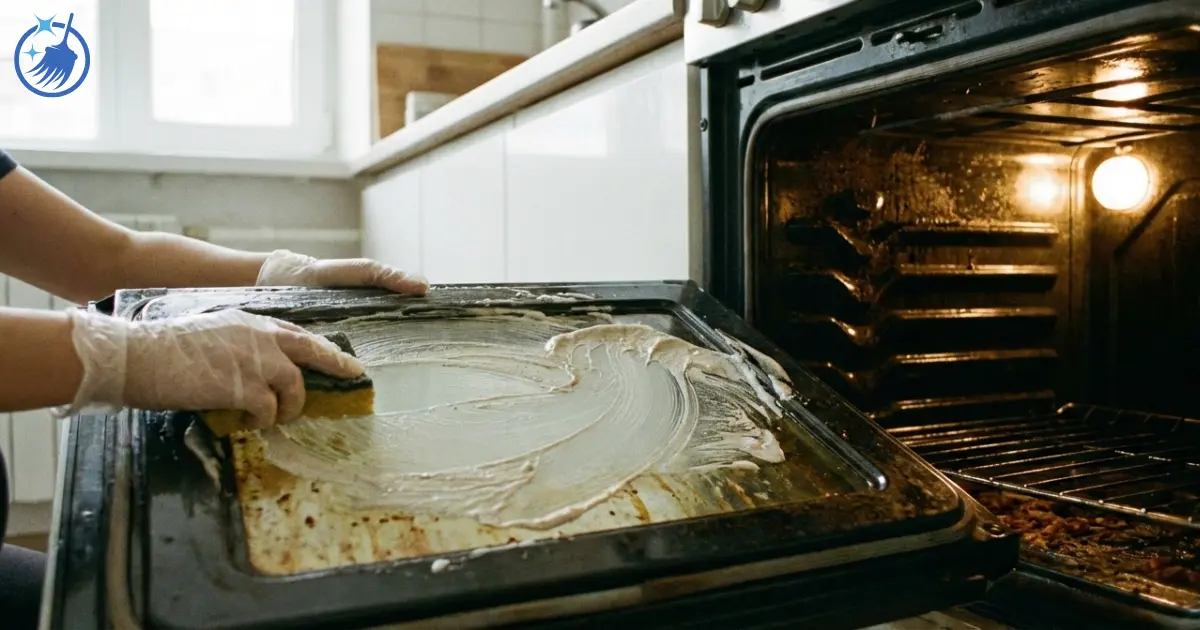
- Spread it over the cool glass with a non-scratch sponge or gloved fingers, thicker over the worst patches.
- Leave it for 20 to 30 minutes, or longer on stubborn marks. Overnight is fine if you cover it with cling film to stop it drying out.
- Work over it with a damp non-scratch sponge using small circles. If you are pressing hard, stop and give it more time instead.
- Wipe off with a damp microfibre cloth, rinsing the cloth often.
- Repeat on the toughest spots. Two gentle rounds beat one hard scrub.
Bicarbonate does not shift thick carbon in one go. That is normal. Expect to repeat it, or move to Fix 3 for the worst areas.
Fix 3: a purpose-made oven cleaner
For thick, dark, carbonised grease, a gel or foam oven cleaner is faster and needs less scrubbing, because it is designed to cling to vertical surfaces and stay in contact. We link ERES Oven Cleaner Gel Spray, a gel-format spray, and RILEA HP12 multipurpose degreaser, which is a spray degreaser that can also be used on other greasy kitchen surfaces. Both are examples of the two common formats, and you can compare others on the oven glass cleaner search. Check the label on whichever you choose for the active ingredients, hazard wording, how long to leave it and whether it is suitable for glass, and expect a strong smell from some.
- Make sure the glass is cool, wear gloves, and ventilate.
- Apply an even coat to the glass only, keeping it off seals, the control panel and the rubber door gasket where you can.
- Leave for the time on the label. Gels often give 15 to 20 minutes, sprays less. Do not let it dry on the glass.
- Wipe with a damp microfibre cloth, then wipe again with a clean cloth and plain water until you are sure no product remains. Residue left on the glass can smoke or smell when the oven heats up.
- Buff dry with a dry cloth, and check from an angle.
Fix 4: stubborn spots
A few spots may stay. Re-apply paste or gel to them only and give them a long soak, then try again. If a spot still will not lift, you can use a razor-blade scraper made for glass, held flat against wet glass at a shallow angle, pushed in one direction with very light pressure. Many manufacturers allow this on plain oven glass and many do not, and a slip scratches permanently, so check your manual first and leave it alone if you are unsure. Some people use a wet pumice stick on plain glass. We would not recommend it unless you test it on a hidden corner, and it must never be used on coated or printed glass.
Using the oven again afterwards
Once the glass is clean, wipe the rest of the door, the door frame and the cavity edges with a cloth rung out in plain water, because cleaner that dripped down onto the seal or the floor is what usually smokes later. Leave the door open for a while to air, then cook as normal, with a window open the first time. Any faint smell should fade after one or two uses. If you used a strong oven cleaner, the label may say how long to wait before cooking. Follow it.
Fix 5: streaks, haze and white film
Streaks are almost always residue, lint or minerals. Wipe again with a cloth wrung out in plain water, then spray a half and half mix of white vinegar and water and buff dry with a clean microfibre cloth. Use real microfibre cloths, not paper or old cotton, and wash them without fabric softener. A white film is usually limescale or dried cleaner. Spray the vinegar mix generously, wait five to ten minutes, wipe and buff. Rinse the glass with clean water if you used any cleaner, so that residue does not burn on at the next preheat. Our general advice on streak-free glass is in the guide to cleaning double glazed windows.
Picking the right cloth and sponge
The sponge and cloth matter as much as the product. A non-scratch sponge (the soft white or blue type) lifts softened grease without marking glass. A green scourer, steel wool or a scrubbing brush will etch it. Microfibre cloths pick up the dissolved grease rather than smearing it. Keep one for greasy jobs only, wash them hot without fabric softener, and replace a cloth that has gone stiff or greasy. Cotton rags and kitchen paper leave fibres, and paper falls apart when wet. Our general advice on cloths is in microfibre vs cotton cloths.
The outside face
The outside takes fingerprints, dust and the odd splash. Wipe it with a cloth wrung out in warm water and a few drops of washing-up liquid, then a clean damp cloth, then buff dry. Window glass cleaner is fine on the outer face. Keep sprays off the control panel and out of the vents, and spray the cloth rather than the door.
| Option | Best for | Effort | Cautions |
|---|---|---|---|
| Steam and soapy wipe | Light film, regular upkeep | Low | Hot steam on opening |
| Bicarbonate paste | Medium coating, avoiding chemicals | Medium, needs time | Dries hands, slow on thick carbon |
| Gel or foam oven cleaner | Thick baked-on grease | Low to medium | Gloves, ventilation, rinse thoroughly, check label |
| Spray degreaser | Frequent upkeep and other greasy surfaces | Low | Strong smell on some, rinse well |
| Scraper or pumice | A few stubborn spots | High risk | Can scratch for good, only if the manual allows |
Natural or chemical?
It comes down to the state of the glass and how you feel about fumes. Bicarbonate paste and steam are cheap, gentle and easy to repeat, and they suit light to medium film and regular upkeep, though they take time. A gel or degreaser is quicker on thick carbon but needs gloves, ventilation and careful rinsing, and some have a strong smell. Many people keep both: a tub of bicarbonate for routine jobs, and a bottle of proper cleaner for the days when it has been left. We cannot offer figures for how much each removes, because it depends on the grease and the glass, and you will see the difference yourself within one pass. The price of the products is small compared with the cost of replacing a scratched or cracked door pane, so use the gentlest method that works.
Questions that come up at this stage
Can I clean the glass without taking the door off? Yes, and most people do. Open the door fully or to about 45 degrees, clean the inside face as above, and only remove the door if you need to reach between the panes. A low stool in front of the oven makes the angle easier on your back.
How long should I leave oven cleaner on? As long as the label says, and no longer than it allows. Gels commonly give 15 to 20 minutes and sometimes more for heavy soil. Sprays are often shorter. Bicarbonate paste benefits from 20 to 30 minutes or more. Never let a chemical cleaner dry on the glass, and re-apply fresh if the first round did not do the job.
Can I use oven cleaner on the outside of the door? You can, but you do not need to. The outer face does not see baked-on grease, so washing-up liquid and water or a normal glass cleaner is enough. If you do use oven cleaner near the outside, rinse it off thoroughly because it can mark painted or metal trim.
Can I stop grease getting between the panes? Not completely, since the door is vented. You can cut it by containing splashes (trays, covers, roasting bags), keeping the oven reasonably clean overall, and avoiding unnecessarily high temperatures. Check your manual in case your door has vent guards or filters that can be cleaned.
The kit, as a checklist
None of this is essential and most of it is probably in the house already. This is the whole list for the glass, including the Amazon UK searches and the product links mentioned above.
- Microfibre cloths. At least three: one to apply or wipe, one rinsed in plain water, one for the dry buff. Microfibre cloths in a multipack are cheap. Look for a tight weave, and avoid cloths that shed.
- A non-scratch sponge. White or blue non-scratch sponges are made for glass and enamel, unlike green scourers, which scratch. Search non-scratch sponges.
- Bicarbonate of soda. The gentle option. Look for a tub labelled bicarbonate, and keep it for cleaning. Bicarbonate of soda is easy to find.
- An oven cleaner gel. For the thick stuff. ERES Oven Cleaner Gel Spray is an example of a gel spray.
- A multipurpose degreaser. RILEA HP12 is an example, handy if you want one spray for the hob and extractor too.
- An oven glass cleaner. Browse oven glass cleaners for one made for the job, and read the label.
Also useful but not worth a link: rubber gloves, a bowl, an old towel to rest the door on, a slim plastic stick or ruler for the gap between the panes, and a torch.
Between the panes: the hard one
Most oven doors are built from several panes of glass, with air channels so the outer pane stays cooler than the inside. That means they are not sealed units, and grease and steam get in through the vents over the years. Seeing grime in there is common. Seeing a bit of mist that comes and goes as the door cools is also common. Neither is automatically a fault. If you can see it but cannot touch it, it is between the panes.
First try: without taking anything apart
Check the vents along the top and bottom edges of the door. Take a slim, flexible plastic stick or ruler, wrap a microfibre cloth around the end and secure it with a rubber band or two, and dampen it with warm soapy water. Slide it carefully into the gap and sweep it along. Replace the cloth as it gets dirty. This is fiddly, and you will not reach everything, but it can clear the worst of the visible grime. Avoid bent wire hangers that can scratch the glass or snag in the seal.
If you need to take the door or glass apart
Many ovens are designed so that the user can take the door off and release the inner glass, others are not. Read your manual first, because it tells you the order, the screws, the clips, and whether doing it affects your warranty. Cleaning between the panes carries real risks: cracked glass, damaged seals and a door that does not go back together properly. If your manual does not describe it, do not guess.
| Door design | What to expect | Advice |
|---|---|---|
| Hinge-lock doors, common on many freestanding and built-in ovens | Flip small locks or clips at each hinge, close the door to a set angle, lift off | Follow your manual. The door is heavy |
| Doors with screws or clips along the top edge | Panes lift out one at a time after the fixings are removed | Photograph each stage, keep screws in order |
| Sliding or hidden doors such as slide-and-hide designs | More complex mechanisms with several locks | Use the maker’s instructions for your model, and consider a professional |
| Pyrolytic oven doors, often with extra panes | More panes and specific fixings | Follow the manual, and leave it to a professional if unsure |
In general the steps are these. Open the door and unlock the hinge clips. Hold the door firmly with both hands and lift it off in the manner your manual describes, and rest it on a towel, outside face down. Remove the screws or clips that hold the glass, taking photos at each step. Lift out each pane carefully and clean both faces with bicarbonate paste or glass cleaner, rinse and dry. Clean the inside of the frame, wipe any vent guards, and put everything back in reverse order, checking that clips and seals seat properly and screws are snug, not overtight. Refit the door onto the hinges, check that it opens and closes smoothly and seals evenly, and set the hinge clips back.
If something does not move, do not force it. Stop, check the manual and, if in doubt, call the manufacturer or an engineer. Tape a note of the order to the towel, and take your time. A rushed reassembly is how doors end up sealing badly.
Keeping the glass clear for longer
- Wipe after cooking. When the oven is cool, a quick pass with a damp cloth removes fresh splashes before they bake on. Keep a cloth and a spray bottle of plain water near the oven.
- Catch drips. Put a baking tray on the shelf below pies, gratins and anything that bubbles, and cover dishes during the start of cooking.
- Consider roasting bags for big joints, which contain most of the spitting. Follow the pack instructions on temperature and use.
- Watch the temperature. Very hot ovens spit more fat.
- Do a monthly check of the glass, and a deeper clean every few months, rather than waiting for a crust.
- Don’t rely on the self-clean cycle for the glass. It ashes the cavity but the glass usually still needs cleaning by hand, and very hot cycles put strain on seals. Use it as the manual advises.
For the rest of the oven, see our full oven cleaning guide, and if the glass gets scratched at any stage, our page on cleaning oven glass without scratching explains what to avoid. Similar principles apply to stainless steel parts around the door, and to other kitchen appliances such as the dishwasher, the air fryer and the washing machine. Heavily burnt-on food is also covered in our guide to cleaning a burnt pan, and our other guides cover more household jobs.
When something goes wrong, or you should stop
Still cloudy after cleaning
Cloudiness that does not change after cleaning, vinegar and a re-wipe is likely etching, a roughening of the glass surface from abrasives or harsh chemicals. It cannot be polished out at home. The glass may be replaceable by the manufacturer or an engineer, but if it does not affect your view or the oven’s operation, many people live with it. From now on, use only non-abrasive tools.
Smoke or a chemical smell after cleaning
Almost always residue. Open the windows, run the extractor and let the oven cool. Wipe the door, the cavity floor, the sides and the edges of the door seal again with a cloth and plain water. Check the base under the lower element for spilled food. Run the oven empty at a moderate temperature for a short spell with the room ventilated, and stay nearby. If it keeps smoking, switch it off and check for food debris, and if you cannot find the cause, get it looked at.
Streaks you cannot get rid of
Three things cause most persistent streaks: cleaner left behind, hard water minerals in the rinse water, and fibres from the cloth. Work through them in that order. First wipe with a cloth wrung out in plain water, rinsing the cloth often. Next use a half and half mix of white vinegar and water, which dissolves mineral film, and buff with a clean dry microfibre cloth. Last, check the cloth itself: cotton and paper leave fibres, and microfibre washed with softener leaves a coating that smears. If the glass is still streaky in one spot, the glass may be etched there.
Spots that will not shift
Wet the spot, apply fresh paste or gel to that spot only, and leave it longer, an hour or overnight with a cling film cover if the label allows. Then wipe and repeat. Resist the urge to switch to a hard tool. A fresh round with proper dwell time works more often than people expect.
Cracked, chipped or bulging glass
Stop using the oven. Cracked glass can shatter when heated. Contact the manufacturer or a qualified appliance engineer for a replacement pane. Do not try to patch it.
Persistent moisture between panes
Light mist that clears as the door cools is common. Heavy, constant moisture, dripping, or a door that looks damaged may suggest a damaged seal or an issue with ventilation. Have it checked rather than cleaning repeatedly.
Call a professional if
- Your oven is under warranty and the manual says not to take the door apart.
- The door is complex, heavy or in a position you cannot safely handle, or you are worried about damaging expensive built-in units.
- There is heavy grime between the panes that you cannot reach.
- The glass is cracked, chipped, scratched deeply or bulging.
- There is a gas smell, or the oven shows electrical faults. Gas problems need a Gas Safe registered engineer, and electrical faults a qualified electrician.
Prices for oven cleaning services vary by area and oven type, so get a couple of written quotes that say whether the door and glass are included. For a one-off clean before moving, a professional may be better value than buying everything.
A short action plan
- Cool the oven, clear the area and put your gloves on.
- Run a steam soften while you gather your kit, if the glass is more than lightly dirty.
- Wipe, paste or gel, depending on how bad it is, and give it time.
- Wipe off thoroughly, rinse, dry and buff, then check from an angle.
- Deal with what is left. If grime is between the panes, decide whether to try the slim-tool method, follow the manual to take the door apart, or call someone.
- Wipe the glass after messy cooking from now on.
Four quick answers
- How often should I clean the glass? It depends on how much you cook. A wipe after messy cooking, a proper clean every month or two for regular use, and a deeper clean when you notice a film. Between the panes, once or twice a year at most, and only if it is visible.
- Can I use baking soda on oven glass? Yes, as a damp paste, left for a while and wiped with a soft sponge. Do not scrub dry powder hard, and do not rely on it for thick carbon.
- Does the self-cleaning cycle clean the glass? Not reliably. It ashes the cavity but glass usually needs separate cleaning, and frequent very hot cycles stress the door. Follow your manual on how often to use it.
- Can I put the oven door or glass in the dishwasher? No. The door is too large and heavy, and strong detergent and heat can damage seals, coatings and the glass itself. Wash glass panels by hand.
- How do I remove baked-on grease from oven door glass? Spread a paste of bicarbonate of soda and water over the cool glass, leave it for 20 to 30 minutes or longer, then wipe with a damp soft sponge. Repeat if needed, and use a plastic scraper or razor scraper held flat only if the maker allows. Rinse and buff dry.
- Can I clean oven glass with Windex or glass cleaner? Glass cleaner is fine for light film on a cool, clean inner surface, but it will not cut baked-on carbon. Spray it onto a cloth, not into door vents or seals, and wipe it off fully. For tougher deposits, use a bicarbonate paste or an oven cleaner approved for glass.
- What do professional oven cleaners use to clean an oven? Many use strong alkaline degreasers, often applied in a controlled way, with protective gear and thorough rinsing, and some use dip tanks for removable parts. These are not suitable for casual use at home, so follow your oven manual and product label, and ventilate well.