The short answer: yes. The 3% hydrogen peroxide in the brown bottle is a genuinely effective disinfectant, the US Centers for Disease Control calls it “a stable and effective disinfectant” on hard surfaces, active against bacteria, viruses, fungi and even bacterial spores. It works by oxidation: the molecule falls apart into ferociously reactive hydroxyl free radicals that tear through a microbe’s DNA, proteins and cell membrane. Because that attack is chemical and indiscriminate, hydrogen peroxide is genuinely broad-spectrum, and it breaks down into nothing worse than water and oxygen, which is why the EPA lists it as a safer disinfectant active ingredient.
But “does it disinfect” hides four things worth understanding, and the chemistry explains all of them. First, contact time matters enormously, it kills everyday bacteria in a couple of minutes but needs the surface to stay wet, and some spores can take over two hours. Second, it’s unstable: light and heat break it down (that’s why the bottle is brown), and it quietly loses strength once opened. Third, you must never mix it with vinegar in a bottle, that makes caustic peracetic acid. And fourth, despite generations of habit, it’s no longer recommended for wounds, because the same oxidation that kills germs also damages your own healing cells. This guide walks through the actual reactions, with diagrams, then shows how to use it properly. Every claim is sourced at the end.
How we researched this: the chemistry and contact-time figures below come from CDC disinfection guidance, the EPA, and peer-reviewed work on how hydrogen peroxide damages cells. Full references are at the bottom.
Disclosure: Cleaners Guide is a participant in the Amazon Associates programme, so if you buy through links on this page we may earn a small commission at no extra cost to you. It never changes our recommendations, we suggest products because they work and we point out cheaper options where they do the same job. Prices and availability change, so always check the current price before buying.
What hydrogen peroxide actually is
Hydrogen peroxide is water with one extra oxygen atom: H₂O₂ instead of H₂O. That sounds trivial, but that second oxygen changes everything. The two oxygen atoms are joined by a weak oxygen–oxygen (O–O) bond, and that bond is the whole story. It is easily broken, and when it breaks it releases oxygen in a highly reactive form. So hydrogen peroxide is inherently unstable, it “wants” to fall apart back into water and oxygen, and that restlessness is exactly where both its germ-killing power and its shelf-life problems come from.
The bottle under your sink is typically a 3% solution, three parts hydrogen peroxide to 97 parts water. That is the standard household and first-aid strength, and it is the concentration the CDC assessed as an effective surface disinfectant. Higher grades exist (roughly 6–10% for hair bleaching and tougher mould jobs, and 35% “food-grade” for industrial use, which is corrosive and must always be diluted), but for cleaning a kitchen or bathroom, 3% is the one that matters.
How it kills germs: oxidation and free radicals
Hydrogen peroxide is an oxidiser. It doesn’t poison microbes with a foreign chemical the way an antibiotic does; it chemically burns them apart. The real weapon is a fragment called the hydroxyl radical (•OH), one of the most aggressive oxidising species in all of chemistry. The diagram below shows the three reactions a single H₂O₂ molecule can undergo, and they explain everything this product does, from the fizz to the kill to why it goes flat.
The killing happens through the middle reaction, the Fenton reaction. Traces of iron are everywhere, including inside living cells. When iron in its Fe(II) state meets hydrogen peroxide, it rips the molecule apart to produce a hydroxyl radical: Fe(II) + H₂O₂ → Fe(III) + OH− + •OH. The iron is then regenerated and goes round again, so a little iron can generate a lot of radicals. Once formed, the hydroxyl radical reacts with essentially the first thing it touches, it oxidises the fatty lipids in the cell membrane, wrecks the microbe’s proteins and enzymes, and shatters its DNA. Peer-reviewed work going back to Imlay and Linn’s classic 1988 study in Science showed this DNA damage is a primary way hydrogen peroxide kills bacteria.
Two consequences follow directly from this mechanism. First, because the hydroxyl radical is non-selective, it attacks any biological molecule, hydrogen peroxide is genuinely broad-spectrum: bacteria, viruses, fungi and spores are all vulnerable in principle. Second, that same indiscriminate attack is why it is not a gentle wound cleaner: your own skin and healing cells are made of the same oxidisable lipids, proteins and DNA. Peroxide cannot tell the difference between a bacterium and one of your fibroblasts.
Why it fizzes, and what the fizz really means
Pour peroxide on a cut and it foams dramatically. That fizz is the first reaction in the diagram, decomposition, running at full speed: 2 H₂O₂ → 2 H₂O + O₂. The bubbles are pure oxygen gas. What speeds it up so violently is an enzyme called catalase, which your blood and tissue cells are packed with (so are most bacteria). Catalase is one of the fastest enzymes ever measured, a single molecule can break down tens of millions of hydrogen peroxide molecules every second, so the moment peroxide meets blood, the reaction erupts.
Here is the crucial misunderstanding, though: the fizz is not proof it is disinfecting. That foaming is your own catalase converting the peroxide into harmless water and oxygen, which actually uses up the peroxide before its radicals can do much killing. The mechanical bubbling can lift loose debris out of a wound, but it also damages healthy tissue, and it is why modern medical advice has moved away from hydrogen peroxide for wound care in favour of plain soap and water. On a hard kitchen surface there is no catalase, so it doesn’t foam, and that is fine, because there it has time to work as an oxidiser rather than being instantly fizzed away.
What it kills, and how long it takes
This is where most people go wrong. Hydrogen peroxide does kill a wide range of microbes, but the time it needs varies by more than a hundredfold depending on the target. A quick squirt that you wipe off in ten seconds barely does anything. The CDC’s disinfection data shows the pattern clearly: everyday bacteria fall in a couple of minutes, but the cold virus needs several, some hardy bacteria shrug off a 3% solution for ten minutes, and bacterial spores can take up to 150 minutes. The chart puts these on one scale.
The single most important word here is contact time. Whatever you are disinfecting, the surface has to stay visibly wet with peroxide for the time that microbe needs, if it dries or you wipe it straight off, the reaction stops. For ordinary household germs on a worktop, keeping it wet for about five minutes is a sensible target; it comfortably covers everyday bacteria and viruses. It will not reliably kill spores (the kind behind, for example, C. difficile), which is why hospitals use much stronger vaporised peroxide for those. For a normal kitchen, that limitation rarely matters, but it’s honest to know where the line is.
How to use 3% hydrogen peroxide properly
See hydrogen peroxide on Amazon →
Getting real disinfection out of the brown bottle is mostly about respecting contact time and not diluting or degrading it by accident. Here’s the method.
- Clean the surface first. Oxidisers are “used up” by organic matter, grease, food, soil all consume the radicals before they reach germs. Wipe visible dirt away first, then disinfect a clean surface.
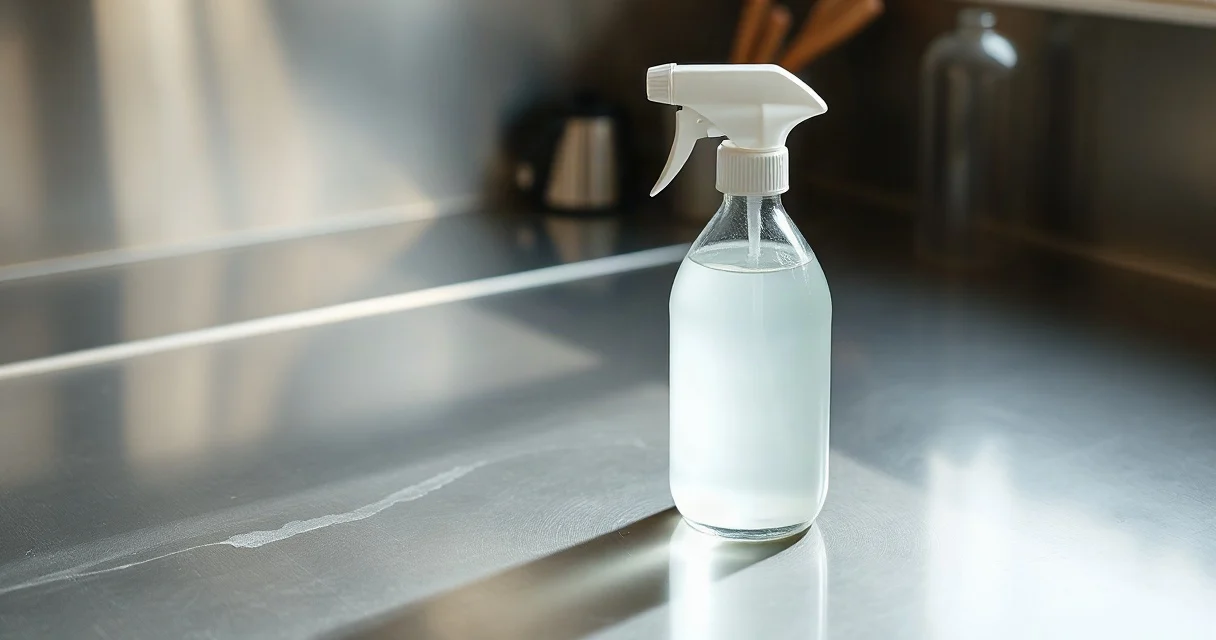
- Apply it straight from the bottle, undiluted. 3% is already the working strength. Decant into an opaque spray bottle if you like, but don’t dilute it further, and don’t add anything to it.
- Let it sit, keep it visibly wet for about five minutes. This is the step that actually disinfects. Spray generously so it doesn’t dry out; re-mist if it starts to. On a food-contact surface, 3% is considered safe for this use.
- Wipe with a clean cloth (or let it air-dry). There’s no toxic residue to rinse, peroxide breaks down to water and oxygen, so you can simply wipe or leave it.
- Spot-test anything colour-sensitive. Peroxide is a mild bleach. It’s fine on tile, stainless steel, glass, worktops and most plastics, but test fabrics, grout colourant and painted surfaces first.
Peroxide is especially good on porous, stain-prone spots where its oxidising action doubles as a stain remover: grout, chopping boards, and the inside of the fridge. It’s also our pick for killing mould on hard surfaces, where it penetrates better than bleach.
Concentrations: 3%, 6–10% and 35%
Not all hydrogen peroxide is the same, and the strength decides both what it’s good for and how carefully you must handle it.
| Strength | Typical use | Handling |
|---|---|---|
| 3% (household / first-aid) | Surface disinfecting, stain removal, mould on hard surfaces | Ready to use; mild bleach; the everyday choice |
| 6–10% (cosmetic / stronger) | Hair bleaching, tougher mould and grout jobs | Wear gloves; can irritate skin; ventilate |
| 35% (“food-grade” / industrial) | Commercial food-surface sanitising, always diluted down | Corrosive, causes burns; must be diluted; not for casual use |
“Food-grade” is a common source of confusion: it refers to the absence of stabiliser additives, not to something you should swallow. At 35% it is a hazardous chemical. For household cleaning, stick with 3%.
Why the brown bottle matters
See amber spray bottles on Amazon →
Look again at the third reaction in the diagram: H₂O₂ , UV→ 2 •OH. Light, especially ultraviolet, splits hydrogen peroxide into hydroxyl radicals, which then react away to water and oxygen. In other words, light destroys it, and so does heat: the decomposition rate roughly doubles for every 10°C rise in temperature. That single fact explains the brown bottle. The dark plastic blocks light so the peroxide inside doesn’t quietly decompose on the shelf. It’s also why you should keep it somewhere cool and dark, and never decant it into a clear container for long-term storage.
The catch is that this happens whether you can see it or not. An opened bottle slowly loses strength over months, and a bottle that’s a couple of years old may be little more than water, with no visible sign anything has changed. This is the same “silent failure” problem bleach has, and it’s a real disinfection risk: you think you’re sanitising when you’re really just wiping with weak water. There’s an easy check, pour a little onto a surface with catalase, such as a piece of raw potato or a drop of blood in the sink; if it fizzes, it’s still active; if it sits there flat, it’s spent. For the full picture on which cleaners go off and when, see our guide to whether cleaning products expire.
The vinegar mistake: peracetic acid
A popular “hack” is to spray hydrogen peroxide and vinegar together for extra cleaning power. Do not combine them in one bottle. They react to form peracetic acid: H₂O₂ + CH₃COOH → CH₃CO₃H + H₂O. Peracetic acid is a genuinely useful industrial disinfectant, but at home it’s a caustic irritant that can burn skin and airways and give off harsh fumes, and sealing the mixture in a closed bottle is worse still, because the ongoing reaction builds pressure. There is a safe version of this idea: use them sequentially, peroxide on the surface, let it dwell and wipe, then vinegar (or the other way round), which some food-safety studies find effective. Just never mix them into one solution. It joins a short list of combinations to avoid; see our guide to cleaning products you should never mix.
Should you use it on cuts and wounds?
For generations, hydrogen peroxide was the go-to for grazes, and the fizz felt reassuring. But the chemistry that makes it kill bacteria doesn’t spare your own cells. Those same hydroxyl radicals oxidise the healthy fibroblasts your body needs to rebuild tissue, and studies have found peroxide can slow healing. Modern medical guidance is to clean minor wounds with plain running water and mild soap instead, keeping hydrogen peroxide for hard surfaces and objects. It’s a good example of a wider theme in cleaning science: “kills germs” and “safe to put on living tissue” are two very different tests.
Use it at the right strength and keep it active in the dark.
The bottom line
Yes, 3% hydrogen peroxide disinfects, properly, on hard surfaces, by oxidising microbes apart with hydroxyl radicals. To get that benefit: clean first, apply it undiluted, and keep the surface visibly wet for about five minutes. Store it cool and dark in its brown bottle, replace it every so often (it fades silently), never mix it with vinegar in a bottle, and keep it off your skin and wounds. Used that way it’s one of the most useful, and most environmentally benign, disinfectants in the house, breaking down into nothing but water and oxygen.
Myths vs facts
| Myth | The reality |
|---|---|
| “Hydrogen peroxide doesn’t really disinfect.” | It does, the CDC rates 3% as effective on surfaces against bacteria, viruses, fungi and spores. |
| “The fizz on a cut proves it’s working.” | The fizz is your catalase making oxygen, it actually uses the peroxide up, and damages healing tissue. |
| “A quick spray-and-wipe disinfects.” | No. It needs contact time, keep the surface visibly wet for about five minutes. |
| “Peroxide + vinegar makes a super-cleaner.” | Mixed in a bottle it makes caustic peracetic acid. Use them one after the other instead. |
| “It lasts for years in the cupboard.” | Light and heat break it down; an old or clear-bottled solution can be little more than water. |
| “‘Food-grade’ 35% is a healthy thing to drink.” | False and dangerous, 35% is corrosive. Only 3% is for household use, and none is for drinking. |
Frequently asked questions
Does hydrogen peroxide actually disinfect surfaces?
Yes. The CDC describes 3% hydrogen peroxide as a stable, effective disinfectant for hard surfaces, active against bacteria, viruses, fungi and, given enough time, spores. It works by oxidation, generating hydroxyl radicals that destroy microbes’ membranes, proteins and DNA.
How long should I leave it on a surface?
Keep it visibly wet for about five minutes for everyday germs. Contact time is the key variable: everyday bacteria die in a minute or two, viruses take several minutes, and if it dries out or you wipe it off immediately, it barely works.
Does hydrogen peroxide kill viruses?
Yes. As an oxidiser it damages viral proteins and genetic material. The CDC notes 3% peroxide inactivates rhinovirus (a common cold virus) in roughly 6–8 minutes, again, only if the surface stays wet that long.
Does it kill mould?
On hard, non-porous surfaces, yes, 3% hydrogen peroxide kills mould and its oxidising action also lifts the stain. It penetrates better than bleach on many surfaces. For the full comparison, see our guide to what actually kills mould.
Can I mix hydrogen peroxide and vinegar?
Not in the same container. Together they form peracetic acid, which is caustic and irritating and can build pressure in a closed bottle. You can use them sequentially on a surface, one, wipe, then the other, but never combine them into a single solution.
Why does hydrogen peroxide come in a brown bottle?
Because light breaks it down. UV splits hydrogen peroxide into hydroxyl radicals that decay to water and oxygen, so the dark bottle blocks light and slows that decomposition. Heat speeds decomposition too, which is why cool, dark storage matters.
Does hydrogen peroxide expire or go flat?
Yes, and silently. Once opened it loses strength over months, and an old bottle may be mostly water with no visible change. Test it by pouring a little on raw potato or into a sink with a trace of blood, active peroxide fizzes; spent peroxide just sits there.
Is it safe on food-contact surfaces?
At 3%, hydrogen peroxide is considered suitable for disinfecting food-contact surfaces like chopping boards and worktops, and it leaves no toxic residue, it breaks down to water and oxygen. Clean off food debris first so the peroxide isn’t used up before it reaches germs.
Should I put hydrogen peroxide on a cut?
Current medical advice says no, not routinely. The oxidation that kills bacteria also harms the healthy cells that heal the wound and can slow recovery. Clean minor wounds with running water and mild soap; keep peroxide for surfaces and objects.
Is hydrogen peroxide better than bleach?
Different tools. Peroxide is gentler to handle, leaves no residue and is more environmentally benign, and it penetrates porous surfaces well. Bleach is a stronger, faster disinfectant for heavy jobs but is harsher and leaves residue, and it, too, loses strength over time. Neither should be mixed with acids or each other.
Why doesn’t it foam on my kitchen counter?
Because the dramatic fizz needs the enzyme catalase, which lives in blood, tissue and microbes, not on a clean worktop. No foam there is normal, and actually better: it means the peroxide isn’t being instantly broken down, so it has time to oxidise germs.
Related reading: the full routine for one of those stain-prone spots, how to clean and sanitise a wooden chopping board.
References
- US Centers for Disease Control and Prevention. “Chemical Disinfectants, Guideline for Disinfection and Sterilization in Healthcare Facilities” (hydrogen peroxide section), cdc.gov
- US Environmental Protection Agency. “Safer Choice”, hydrogen peroxide as a safer disinfectant active ingredient, epa.gov
- Imlay, J. A. & Linn, S. “Toxic DNA Damage by Hydrogen Peroxide Through the Fenton Reaction in Vivo and in Vitro.” Science (1988), science.org
- Legrini, O., Oliveros, E. & Braun, A. M. Advanced oxidation / UV–H₂O₂ photolysis producing hydroxyl radicals, introductory review, tandfonline.com
- Medical News Today. “Hydrogen peroxide: Definition, uses, and risks” (wound-care guidance), medicalnewstoday.com
Last reviewed: August 2026. General household information, not medical advice. Always follow the product label, wear gloves with stronger grades, and never mix cleaning chemicals.