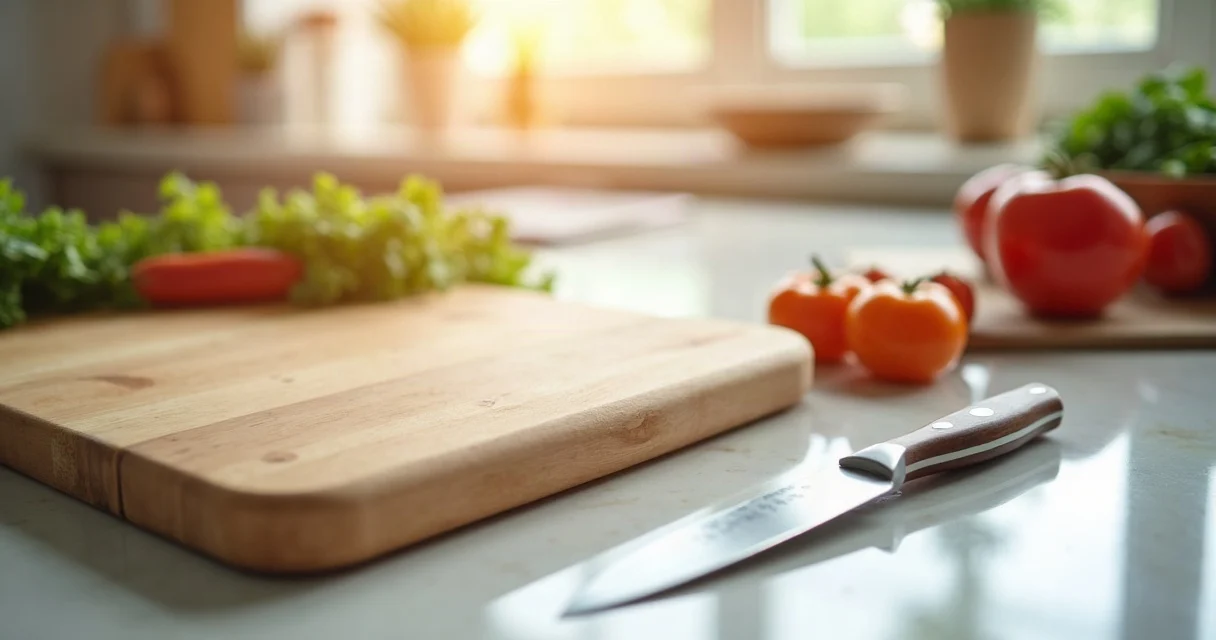
The short version: wash a wooden chopping board by hand with hot, soapy water and a scrub after every use, dry it standing upright, and oil it now and then with food-grade mineral oil. Never soak it, and never put it in the dishwasher, because prolonged water and heat warp, crack and split the wood. To properly sanitise after raw meat, a quick soap-and-water wash removes most bacteria, but for a true sanitising step you want a weak bleach solution or 3% hydrogen peroxide, not lemon or vinegar.
Here is the part most people get completely backwards: a wooden board is not the unhygienic choice. Classic food-safety research at the University of California, Davis found that bacteria left on wood are drawn down into the fibres and die, while the same bacteria survive and even multiply on scratched plastic. So the board your grandmother used may well be safer than the plastic one marketed as “hygienic”. This guide covers the daily clean, how to sanitise properly (and which popular hacks do not actually work), removing stains and smells, oiling and conditioning, when to replace a board, and exactly how wood compares to plastic. Every claim is sourced at the end.
How we researched this: the advice below draws on peer-reviewed food-safety research, UK Food Standards Agency guidance on cross-contamination, and manufacturer care instructions. Full references are at the bottom.
Disclosure: Cleaners Guide is a participant in the Amazon Associates programme, so if you buy through links on this page we may earn a small commission at no extra cost to you. It never changes our recommendations, we suggest products because they work and we point out cheaper options where they do the same job. Prices and availability change, so always check the current price before buying.
How to clean a wooden chopping board (the daily routine)
Ninety per cent of the job is a good wash straight after use, before food residue dries on. It takes about a minute.
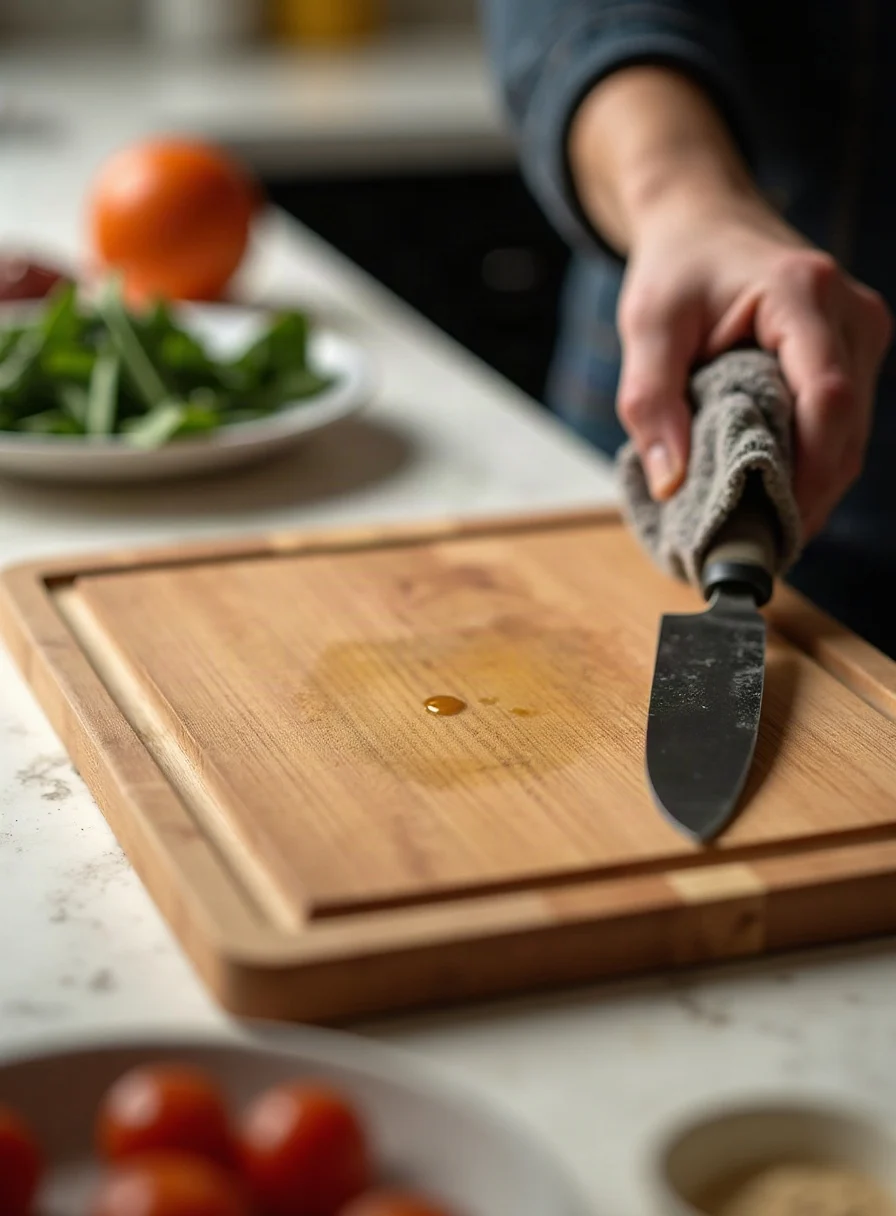
- Scrape off the debris. Use the back of a knife or a bench scraper to clear crumbs and scraps into the bin.
- Wash with hot, soapy water. Use washing-up liquid and a sponge or a soft nylon brush, and clean both sides. Cleaning both faces matters: washing only one side lets the board dry unevenly and warp.
- Rinse thoroughly. Make sure no soap or food is left in the surface.
- Dry it immediately with a towel, then stand it on its edge, or in a rack, so air reaches both faces. This is the single most important habit for making a board last.
Two rules that sit above everything else: do not soak the board (leaving it in the sink swells the wood, which then cracks as it dries) and never put it in the dishwasher (the long hot soak and blast-drying are the fastest way to split a good board in half). Lay a wet board flat to dry and it will cup or warp; stand it up instead.
Is a wooden board actually hygienic? Wood vs plastic
For years people were told to switch to plastic because wood “harbours bacteria”. The research says the opposite. In a well-known set of experiments at the University of California, Davis, microbiologist Dean Cliver and colleagues deliberately contaminated wooden and plastic boards with bacteria such as Salmonella and E. coli, then measured what survived.
The findings were striking. On wood, the bacteria were pulled down into the fibres, away from the surface, and the vast majority died within minutes to a few hours. Left overnight, wooden boards had no detectable live bacteria. On plastic, the bacteria stayed on the surface, survived, and multiplied if the board was left damp overnight. Crucially, a knife-scarred plastic board was almost impossible to clean by hand, because bacteria sheltered in the cuts even after a hot soapy wash, whereas a heavily used wooden board behaved much like a new one.
The honest takeaway is not “wood is self-cleaning, so relax”. It is that a well-kept wooden board is at least as safe as plastic, and often safer, so you can choose wood on looks and kindness-to-knives without a hygiene guilt trip. Whichever you use, the rules are the same: wash it properly after raw meat, keep it dry, and replace it once the surface is deeply scored. If you like the wider question of where kitchen germs really live, see our piece on whether the kitchen is dirtier than the bathroom.
How to sanitise a wooden board after raw meat
Everyday chopping of bread, fruit and veg needs nothing more than the hot soapy wash above. Raw meat, poultry and fish are different, because they can carry bacteria like Salmonella, Campylobacter and E. coli. After those, add a genuine sanitising step. Two options actually work on wood:
- Diluted household bleach. Mix about one teaspoon of plain (unscented) bleach per litre of water (roughly one tablespoon per gallon). Wash the board first, then spread the solution over the surface, leave it for a few minutes, rinse well with hot water, and stand it upright to dry. This is the sanitiser most food-safety bodies recommend for boards.
- 3% hydrogen peroxide. Wash first, then wipe or pour 3% hydrogen peroxide over the board, leave it to fizz for a few minutes, and rinse. It is food-safe, leaves no residue (it breaks down to water and oxygen), and is gentler to keep in the kitchen than bleach. See our guide to how hydrogen peroxide disinfects for the detail.
Better still, avoid the problem: keep a separate board for raw meat and another for ready-to-eat food. UK Food Standards Agency guidance is built around exactly this, preventing raw-meat juices touching anything eaten uncooked. Professional kitchens formalise it with colour-coded boards (red for raw meat, blue for raw fish, green for salad and fruit, and so on); at home, two boards and a bit of discipline do the same job.
Do salt, lemon and vinegar actually work? The methods compared
Plenty of popular guides tell you that scrubbing with lemon and salt “kills germs”. That is not quite true, and it matters. Salt, lemon and vinegar are good at cleaning and deodorising, but they are not reliable sanitisers: they do not kill bacteria dependably enough to count as a disinfecting step after raw chicken. Here is what each method is genuinely for.
| Method | What it’s good for | Does it truly sanitise? | Notes |
|---|---|---|---|
| Hot water + washing-up liquid | Everyday cleaning after most foods | Removes most bacteria (not a full sanitiser) | The daily default. Scrub both sides, dry upright. |
| Diluted bleach (1 tsp/litre) | Sanitising after raw meat, poultry, fish | Yes | Rinse well; use plain unscented bleach; dry upright. |
| 3% hydrogen peroxide | Sanitising; food-safe and residue-free | Yes | Let it fizz a few minutes, then rinse. |
| Coarse salt + half a lemon | Deodorising and light stain removal | No (cleans, doesn’t sanitise) | Salt scours; lemon lifts smells. Great as a finisher. |
| Bicarbonate of soda paste | Lifting stubborn stains and odours | No | Make a paste with water, scrub, rinse. |
| White vinegar (diluted, <5 min) | Mild cleaning and deodorising | Not reliably | Don’t leave it soaking; acid can raise the grain. See does vinegar disinfect? |
So the sensible routine is a two-step one: clean with hot soapy water (and use salt-and-lemon or bicarb when you want to tackle stains or smells), then sanitise with diluted bleach or hydrogen peroxide only when you have handled raw meat. Do not rely on lemon or vinegar to do the sanitising job.
Removing stains and smells
See board care wax on Amazon →
Garlic, onion, beetroot, turmeric and raw meat all leave their mark. The fix is gentle abrasion plus something that lifts odours:
- Salt and lemon. Sprinkle coarse salt over the board, then scrub with the cut face of half a lemon, squeezing a little as you go. Leave for five minutes, then rinse and dry. The salt scours, the lemon deodorises and mildly bleaches stains.
- Bicarbonate of soda paste. For stubborn stains, mix bicarb with a little water into a paste, scrub it in, leave briefly, then rinse. Good for deeper discolouration.
- A spell in daylight. After washing, standing the board in indirect daylight for an hour or two helps fade stains and freshen it. Avoid long spells in hot direct sun, which can dry and crack the wood.
How to oil a wooden chopping board
See food-safe board oil on Amazon →
Oiling is what keeps a board from drying out, cracking and staining. Dry wood is thirsty wood: it soaks up juices and smells. A conditioned board repels water and lasts for years.
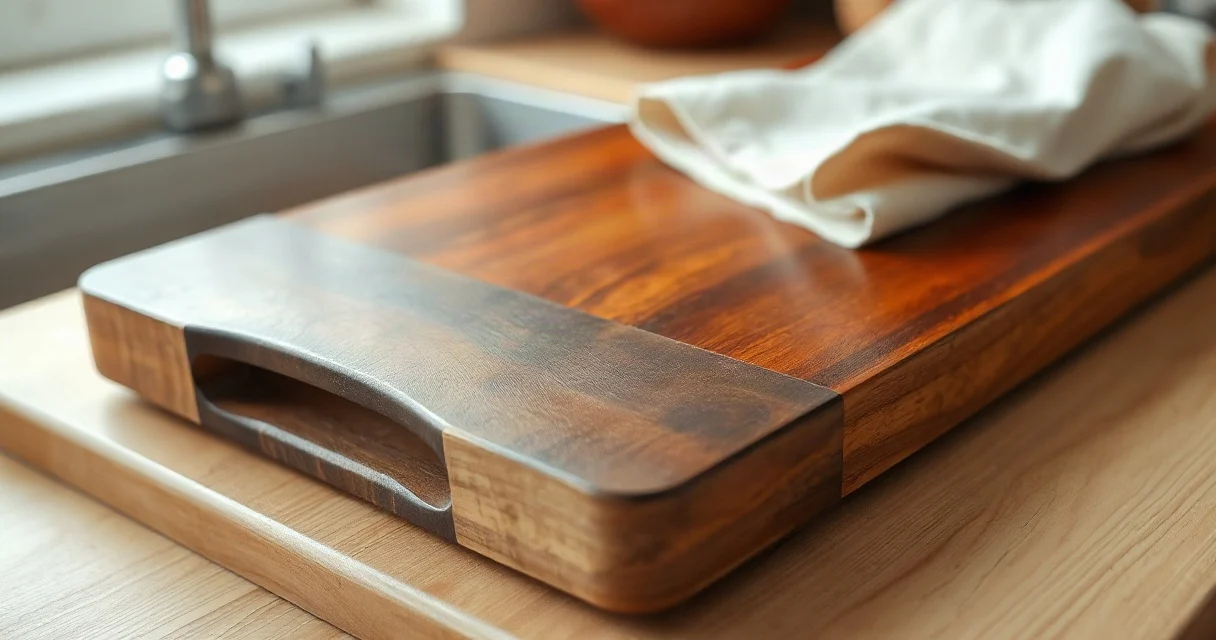
- Make sure the board is clean and fully dry. Oil traps moisture underneath if you rush this.
- Use food-grade mineral oil. It is odourless, tasteless and, crucially, does not go rancid. A dedicated board oil is the same thing.
- Apply generously with a cloth or paper towel, working it in along the grain, and do the edges and underside too.
- Let it soak in for at least 20 minutes, or ideally overnight, then wipe off any excess so the surface is not greasy.
- For extra protection, finish with a board cream (mineral oil blended with beeswax). The wax seals the surface and beads water, which is lovely on boards you also use for serving.
Never use olive, vegetable, sunflower or other cooking oils. They oxidise and turn rancid inside the wood, leaving a sticky film and a stale smell that is very hard to remove. How often to oil depends on use: a heavily used board benefits from a monthly top-up, a lightly used one every few months. The simplest rule is to oil it whenever the wood starts to look pale, dull or dry, or water stops beading and soaks straight in.
The quickest ways to ruin a board (what to avoid)
- The dishwasher. The prolonged hot, wet cycle and forced drying warp, crack and split wood, sometimes on the very first wash.
- Soaking or leaving it wet in the sink. The wood swells, then cracks as it dries unevenly.
- Drying flat. One face dries faster than the other and the board cups. Always stand it upright.
- Cooking oils for conditioning. They go rancid. Mineral oil or a proper board cream only.
- Leaving stains and smells to set, or ignoring a board until it is deeply grooved.
When to replace a wooden chopping board
See wooden chopping boards on Amazon →
A good hardwood board can last a decade or more with care, but replace it when:
- It has deep knife grooves that trap food and cannot be scrubbed clean (light scoring is fine and can be sanded).
- There are cracks or splits, or the board has warped enough to rock on the worktop.
- You can see black mould growing in cracks or the end grain that will not scrub out (more on what actually kills mould).
- It holds a smell even after cleaning and oiling, which usually means bacteria or rancid oil deep in the wood.
Wooden chopping board: pros and cons
The pros:
- Naturally hygienic: bacteria are drawn in and die, rather than lingering on the surface.
- Kind to knives, so your blades stay sharp for longer.
- Durable: a quality board lasts many years and can be sanded back to look new.
- Handsome enough to double as a serving or cheese board.
The cons:
- Needs care: hand-wash only, dry upright, oil regularly.
- Not dishwasher-safe, unlike plastic.
- Heavier and pricier up front than a plastic board.
- Can stain from strong-coloured foods if not cleaned promptly.
Clean, deodorise and seal a wooden board the right way.
The bottom line
A wooden chopping board is easy to keep clean and genuinely hygienic if you follow a simple rhythm: scrape, wash in hot soapy water, dry upright, and oil when it looks thirsty. Sanitise with diluted bleach or hydrogen peroxide after raw meat, keep a separate board for raw meat in the first place, and skip the dishwasher and the olive oil. Do that and the board will outlast several plastic ones, and be the safer surface all along.
Myths vs facts
| Myth | The reality |
|---|---|
| “Wooden boards are less hygienic than plastic.” | Research found the opposite: bacteria die in wood but survive on scratched plastic. |
| “Scrubbing with lemon and salt kills the germs.” | It cleans and deodorises but does not reliably sanitise. Use bleach solution or peroxide after raw meat. |
| “You can put it in the dishwasher if you’re quick.” | No. The hot, wet cycle warps and cracks wood, often the first time. |
| “Any oil will do to condition it.” | Only food-grade mineral oil (or board cream). Olive and vegetable oils go rancid. |
| “A smelly or grooved board just needs another wash.” | Deep grooves, cracks or set-in smells mean it is time to sand it back or replace it. |
Frequently asked questions
Are wooden chopping boards hygienic?
Yes. Food-safety research at UC Davis found bacteria are drawn into wood and die, while they survive and multiply on scratched plastic. A well-maintained wooden board is at least as safe as plastic, provided you wash it properly and keep it dry.
Can you put a wooden chopping board in the dishwasher?
No. The long, hot, wet cycle and forced drying make wood swell, warp, crack and split. Always hand-wash a wooden board, dry it with a towel, and stand it upright to finish drying.
How do you disinfect a wooden board after raw chicken?
Wash it first with hot soapy water, then sanitise with either a weak bleach solution (about one teaspoon per litre of water) or 3% hydrogen peroxide. Leave it a few minutes, rinse well, and dry upright. Better still, keep a separate board just for raw meat.
Does vinegar or lemon sanitise a chopping board?
Not reliably. Vinegar, lemon and salt are useful for cleaning and removing smells and stains, but they are not dependable sanitisers. For a true sanitising step after raw meat, use diluted bleach or hydrogen peroxide.
What oil should you use on a chopping board?
Food-grade mineral oil, or a board cream made from mineral oil and beeswax. Avoid olive, vegetable, sunflower and nut oils, which oxidise, turn rancid and leave a sticky, smelly film in the wood.
How often should you oil a wooden chopping board?
Roughly monthly for a board in frequent use, every few months for a lightly used one. The easiest guide is to oil it whenever the wood looks pale or dry, or water no longer beads on the surface.
Why should you never soak a wooden board?
Wood absorbs water and swells; as it dries unevenly it cracks, splits and warps. Wash it quickly, rinse, dry with a towel and stand it upright, rather than leaving it sitting in the sink.
How do you get smells out of a wooden chopping board?
Scrub with coarse salt and half a lemon, or a bicarbonate of soda paste, then rinse and dry. A short spell in indirect daylight helps too. A smell that survives all that usually means it is time to sand or replace the board.
Wood or plastic chopping board: which is better?
For hygiene, a maintained wooden board matches or beats plastic, and it is kinder to knives. Plastic wins only on being dishwasher-safe and cheaper, and it becomes a real hygiene risk once knife-scarred. Many kitchens use wood for general prep and a separate plastic board purely for raw meat.
Can you sand a wooden chopping board?
Yes. Light knife scoring and surface stains can be sanded out with fine sandpaper, then the board re-oiled, which effectively renews it. If it has deep cracks or splits, though, replacement is safer.
References
- Ak, N. O., Cliver, D. O. & Kaspar, C. W. “Cutting boards of plastic and wood contaminated experimentally with bacteria.” Journal of Food Protection (1994), UC Davis Food Safety Laboratory, summary via PubMed.
- Dean O. Cliver, “Cutting Boards and Bacteria” research overview, naturalhandyman.com.
- UK Food Standards Agency, avoiding cross-contamination and cleaning guidance, food.gov.uk.
- Manufacturer care guidance on food-grade mineral oil and board conditioning (general industry advice).
Last reviewed: August 2026. General household guidance, not formal food-safety certification. Follow your board maker’s care instructions and your local food-hygiene advice.