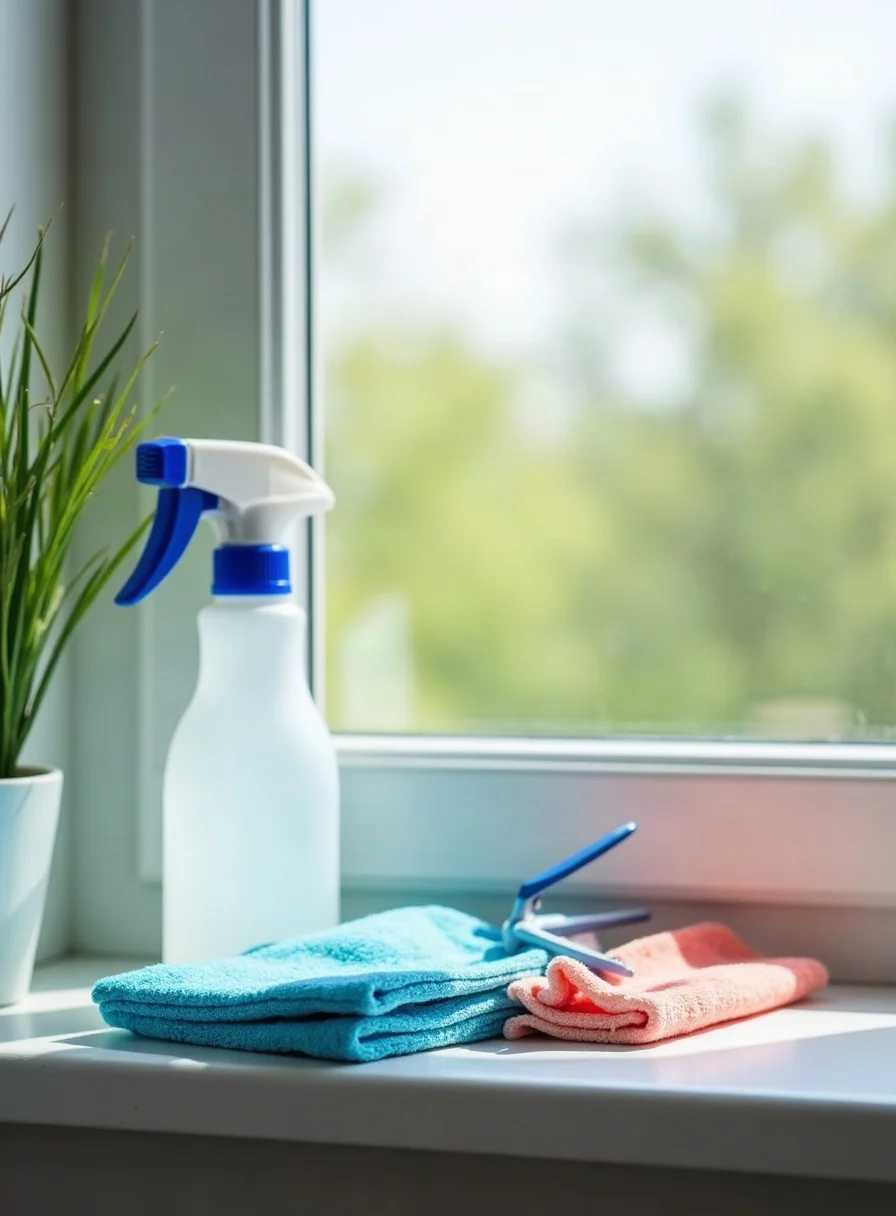
Window cleaners use a remarkably short kit: a squeegee, a washer or scrubber, a bucket of water with a little washing-up liquid, and cloths to dry the edges. For upstairs glass they add a telescopic pole, and big firms use water-fed poles. The finish comes from technique, mainly pulling a clean, sharp blade across wet glass and wiping it after every stroke, not from a secret product.
This guide goes through each tool and what to look for when buying one, what to put in the bucket, the stroke-by-stroke method, and how the kit changes for patio doors, small panes and upstairs windows. It finishes with a few safety points, because reaching windows is where most window cleaning accidents happen.
Disclosure: Cleaners Guide is a participant in the Amazon Associates programme, so if you buy through links on this page we may earn a small commission at no extra cost to you. Product links go to Amazon UK listings or searches, so check the current price, size and reviews before buying.
The kit, tool by tool
The squeegee
A squeegee is a T-shaped tool with a flexible rubber blade held in a metal or plastic channel. It pulls the water and dirt off the glass in one pass, which a cloth cannot do without leaving lint or smears. If you only buy one good tool, make it this.
- Blade: soft but firm rubber with a clean, square edge. A nicked or rounded blade leaves streaks.
- Channel: stainless steel or aluminium holds the blade straight; flimsy plastic flexes and leaves gaps.
- Replaceable blade: choose a model where the rubber can be swapped, so you can renew it instead of the whole tool.
- Handle: comfortable and secure. A rigid frame with no wobble keeps pressure even.
- Size: 15 to 25 cm for small windows, mirrors and shower screens, around 35 cm for most home windows, 45 cm or more for patio doors and big panes.
Professional-style brands are sold in several widths, such as the GBPro Professional Window Squeegee, and a lower-cost extendable option is the Amazon Basics extendable window squeegee. A general search for a window squeegee will show other makes. Whichever you pick, check the listing for the blade material and whether spare rubbers are sold.
Why not just use a cloth? A cloth soaks up some of the water and pushes the rest around, so it takes more passes and often needs a buffing finish. A squeegee leaves a thin, even film that dries clear when the blade is clean. That is also why the blade is the part to look after: a sharp edge on clean rubber is what you pay for. Before first use, wipe a new blade with a damp cloth and test it on a small window.
The scrubber, also called a washer or applicator
This is a T-bar with a removable microfibre or sponge sleeve. You dip it in your cleaning solution and scrub the glass to loosen dirt before you squeegee. A cloth can do the job on small windows, but a scrubber holds more solution, works over a wider area, and matches the width of the squeegee, so you cover the glass in fewer passes. Washable sleeves can be rinsed after each job and laundered. Many people buy it as part of a kit, such as the window cleaning kit with extension poles which pairs a silicone squeegee with a microfibre scrubber head.
Telescopic poles for higher windows
A pole lets you clean upstairs windows from the ground, with no ladder to set up. Look for lightweight aluminium or similar sections with secure twist or clip locks, a universal thread that accepts different heads, and a rotating head if you have awkward angles. A pole that slips under load is more than annoying, because the head can fall. Poles are sold in a range of lengths, and many kits combine a squeegee and scrubber on one pole, such as the 4.5M window squeegee cleaner tool kit or the longer 4M long reach window cleaning kit with a rotating head.
| Pole length | Suits | Notes |
|---|---|---|
| 2 to 3 m | Ground floor exteriors, conservatories, high interior glass | Easy to handle and store |
| 4 to 5 m | Most two-storey homes | The usual choice for a house; heavier to hold at full stretch |
| 6 m and above | Taller buildings | Harder to control; a professional is often the better option |
Keep any pole well away from overhead power lines and cables, indoors and outdoors, and never use one if you are not sure what is above you. A metal pole near an electric line can be lethal.
Cloths
Even with a squeegee you need a cloth for drying edges, catching drips, wiping the blade between strokes and polishing the odd mark. Use clean, lint-free microfibre, and have several so that you always have a dry one. Glass-specific weaves are sold as microfibre glass cloths. Old t-shirts leave lint, and newspaper can smudge, so they are not worth the trouble. Our guide on cleaning windows without streaks covers the other common causes of smears.
A bucket, and optionally a spray bottle
An ordinary bucket that is wide enough to dip the scrubber in is all you need, preferably light in colour so you can see how dirty the water has become. A spray bottle is handy for interiors, small panes and quick touch-ups, where carrying a bucket is more bother than it is worth.
What goes in the bucket
Mostly water. Window cleaners generally use clean water with a very small amount of washing-up liquid, just enough to loosen grease and dirt. A few drops in a bucket is the sort of amount, not a squeeze. Too much soap is one of the commonest causes of streaking, because the film does not squeegee off cleanly. Warm or lukewarm water works better than cold, and it should be changed when it looks grey, not after a fixed number of windows.
Other options
- White vinegar and water: a weak mix, roughly one part vinegar to ten parts water, suits light interior cleaning. It cuts grease less well than soap and is not ideal for heavy exterior dirt. Do not use it on natural stone sills or near some metal finishes. Never mix vinegar with bleach.
- Window cleaning concentrate: sold for trade and home use. Dilute strictly as the label says, since stronger is not better.
- Purified water: used with water-fed poles. Water that has been filtered to remove minerals dries without spots, which is why it suits big jobs. It needs specialist equipment and is not necessary at home.
- Spray glass cleaner: handy for small interior jobs, but the cost per window adds up on a whole house and the squeegee does the work anyway.
Newspaper is an old tip that tends to leave ink and fluff, and a squeegee does the job faster. Methylated spirits is sometimes recommended in cold weather. It is flammable and has a strong smell, so if the weather is cold enough for water to freeze on the glass, it is usually better to leave the job for a warmer day. See also hot versus cold water for cleaning if you are not sure what temperature suits.
The technique, stroke by stroke
- Mix the solution. Lukewarm water in the bucket, a few drops of washing-up liquid, stirred gently so there are not many bubbles.
- Dust and clear the frame and sill first. Loose dirt and cobwebs turn to mud when wet and drip back onto clean glass. Lay a towel inside to catch drips.
- Wet and scrub the glass. Dip the scrubber, wring out the excess so it is wet but not dripping, and work over the whole pane in overlapping strokes, paying attention to edges and corners. Heavy exterior dirt needs longer, while light interior dust needs very little.
- Squeegee off. Place the blade at a slight angle against the glass, with even pressure and no gaps. Overlap each stroke by a couple of centimetres.
- Wipe the blade after each stroke. A damp or dry cloth over the edge removes the dirty water that would otherwise smear back on the next pass.
- Detail the edges. Use a dry microfibre cloth around the frame, on the sill, and to catch drips. Check from a different angle for marks and touch up with the squeegee.
- Do not let it dry first. Squeegee while the glass is still wet.
Work in a sensible order
Clean from the top of the house down, and exterior before interior if you are doing both, so drips from above do not mark glass you have finished. Within a window, do the frame and sill first, then the glass. Rinse and wring the scrubber often, change the water once it is grey, and keep a dry cloth in your pocket for runs. If you are doing a whole house, plan the sunny sides for early morning or evening and start on the shaded ones.
Three ways to pull the squeegee
Horizontal strokes are the easiest to learn. Start at the top corner, pull across, wipe the blade, step down with a slight overlap and repeat to the bottom, finishing with a vertical pass down each edge to catch drips. Vertical strokes work well on narrower panes and for poles, starting at the top and pulling straight down, then overlapping across. An S-pattern is a continuous zigzag across a large pane without lifting the blade. It is quicker once practised but easy to get wrong at first, so start with horizontal strokes.
How often to clean
There is no single right interval. Windows near busy roads, under trees, by the coast or in kitchens get dirty faster than those on a quiet side of the house. Many households do the outside a few times a year and the inside when sunlight shows up the smears. A quick squeegee over condensation-prone panes in winter keeps moisture and mould off the frames, which is worth more than polishing for appearance.
A first clean of badly neglected windows
If the glass has not been done for a long time, do a first pass to remove the worst, then a second with fresh solution and a clean blade. Trying to get it all in one go just pushes grit around. Frames, seals and sills hold much of the dirt that washes onto the glass, so clean those first. Do not use abrasive pads or scourers on glass, and be careful with any coating or film you cannot identify.
Weather and timing
Direct sun dries the solution before the blade reaches it and leaves marks, so work on shaded sides first or choose an overcast day or the early morning or evening. In very cold weather solution can freeze on the glass, which damages nothing but ruins the finish, so leave it. In spring and autumn conditions are usually easiest. Our wider guide, the best way to clean windows, compares more methods, and cleaning double glazed windows covers frames and seals.
If streaks or marks remain
| What you see | Likely cause | What to try |
|---|---|---|
| Lines across the glass | Dirty, nicked or dried-out blade | Wipe or replace the blade, then re-wet and redo |
| Hazy film that smears | Too much soap or a residue from a previous cleaner | Re-wash with plain water and a tiny amount of soap |
| Dots along the edges | Water running back from the frame | Wipe the frame and edges dry with a cloth |
| Spots that dry on the glass | Cleaning in sun, or hard-water minerals | Re-wet, work in shade, finish with a dry microfibre cloth |
| Cloudy patches that stay | Limescale or etching on the glass | Try a limescale remover suited to glass, or ask a glazier |
| Fine scratches | Grit under the blade or a dirty cloth | Dust and wet the glass well first; rinse tools |
Bird droppings, tree sap and insects soften best if you hold a wet cloth on them for a minute before scrubbing, rather than scraping them off dry. Take care on tinted or coated glass, and on new double glazing with a self-cleaning coating, where the manufacturer’s care guidance should come first.
The right tools for each kind of window
| Window | What helps | Notes |
|---|---|---|
| Ground floor exterior | 35 cm squeegee, scrubber, bucket, cloths | The simplest case |
| Upstairs exterior | Pole kit with squeegee and scrubber heads | Use more solution; squeegee top to bottom; check from inside |
| Interior glass | 25 to 35 cm squeegee or cloth, spray bottle, towel | Lighter solution; protect floors and furniture from drips |
| Small windows and mirrors | 15 to 25 cm squeegee or microfibre | Very small panes are often quicker to wipe |
| Patio doors and large glass | 45 cm or wider squeegee, extension handle | Work in vertical sections; streaks show on big panes |
| Georgian and leaded panes | Small squeegee or cloth, detail brush | Slow work, so allow plenty of time |
| Conservatory roofs | Pole, soft brush, plenty of rinsing | Check the glazing maker’s advice and never walk on the roof |
For shower screens and bathroom glass, a small squeegee after each shower also works, and our guide to cleaning shower glass covers limescale.
Window vacs, water-fed poles and other extras
Window vacuums
Battery-powered window vacuums pull the dirty water into a small tank as you pass them over the glass. They suit people who want fewer drips, for example on interior windows, and work well on condensation. Drawbacks are the battery limiting how much you can do, the extra price compared with a squeegee, and that very small panes are awkward. Most professionals still prefer the squeegee for speed, but for a homeowner who cleans occasionally a window vac is a reasonable option.
Water-fed poles
A water-fed pole is a long, lightweight telescopic pole with a brush at the top and a hose feeding purified water. You scrub with water and let it dry without wiping, since there are no minerals to leave spots. It is the standard for tall buildings and commercial work, but it needs a purification unit and is expensive, so it is overkill for one house. If you search for a water-fed window cleaning pole you will find lighter home versions, though most have limits on height and on purification.
Ladders and working at height
Falls from ladders are a leading cause of injury in home DIY. The Health and Safety Executive’s advice is to avoid ladders for long or risky tasks and to use them only for short jobs, with a stable base, three points of contact and someone to foot them. For anything above the first floor, use a pole, hire a professional window cleaner, or avoid the job. Never lean out of an upstairs window to clean the outside.
Mops and flat washers for the inside
For large interior panes, such as a patio door, a flat microfibre washer on a long handle saves bending. Use it damp, not wet, and follow with a squeegee so no film dries on the glass. Mop heads should be washed regularly, as a grubby one just rubs old dirt onto new glass. Rinse the washer in clean water between windows, and replace the pad when it starts to shed fibres or stops holding water.
Scrapers, tracks and frames
A glass scraper with a fresh blade, used with wet glass at a shallow angle and light pressure, takes off paint flecks and sticker residue. Keep it away from coated, tinted or heat-reflective glass unless the maker says it is safe. For frames and tracks, soft cloths, warm soapy water, an old toothbrush and a vacuum crevice tool do most of the work, and abrasive cleaners should be avoided on uPVC because they scratch. Our guide to cleaning window tracks has the detail.
Safety with the cleaning products themselves
Washing-up liquid and water are about as low-risk as it gets, but keep a few rules. Do not mix products, particularly bleach with vinegar or ammonia, which can release harmful fumes. Keep bottles out of reach of children, and ventilate rooms when you use sprays. If you wear gloves for long jobs, choose ones that give you a good grip on the handles. Wet frames and sills are slippery, so wipe up spills on floors straight away.
Looking after the tools
- Squeegee: wipe the blade and dry the channel after each use, store it hanging or flat so the blade is not left resting on its edge, and replace the rubber when it nicks, rounds or goes hard.
- Scrubber: rinse and wring after each use, hang it to dry rather than leave it damp, and wash the sleeve now and then, without fabric softener, which can leave a film.
- Poles: wipe and dry the sections, check the locks before every use, replace any with bent or cracked tubes, and store them horizontally or hanging instead of leaning upright for long periods.
- Cloths: wash separately from other laundry, skip fabric softener and let them dry fully.
Store tools together in a bucket or caddy so that the kit is ready the next time the windows need doing. Dry blades and cloths before putting them away, since damp storage is what makes microfibre smell and metal parts rust. If something in the kit stops being pleasant to use, such as a squeegee that skips or a pole that sticks, replace or repair it. A small annoyance in the kit becomes a bigger annoyance on the job.
A sensible kit to buy
You do not need to spend heavily. For interior windows and ground floor exteriors, a decent mid-sized squeegee, a scrubber or cloths, a bucket and a pack of microfibre cloths do the job. A decent step up is to add a pole kit for upstairs glass. The GBPro squeegee and the pole kit with squeegee and scrubber are examples of that mix, and the 4.5M kit suits a taller house. Whatever you choose, buy spare squeegee rubbers at the same time, so the tool keeps working as well as when it was new.
Three purchases make the biggest difference: a squeegee with a good blade, a pole if you need one for upstairs glass, and a stack of clean microfibre cloths. The extras, such as specialist concentrates or a window vac, are optional.
DIY or hire a window cleaner?
Learning the squeegee takes a little practice, but most people can get a good result on ground floor and interior windows after a couple of attempts. The sums depend on how many windows you have, how often you want them done and what local window cleaners charge, so get a couple of quotes before you decide. Paying someone makes sense for very high windows, awkward access, windows above a conservatory or porch, when you cannot safely do the work yourself, or when preparing a property for sale. Many round-based window cleaners offer regular visits, which can suit people who want results without learning the technique. Ask what they use, whether they are insured, and how they reach upper windows. Our other guides and the home page, cleanersguide.co.uk, have more on home cleaning jobs.
Window cleaning questions
- What do professional window cleaners use to clean windows? A squeegee, a scrubber or washer, a bucket of water with a little washing-up liquid, and microfibre cloths for detailing. For high windows they add a telescopic or water-fed pole. Technique matters more than the product, and the kit costs little compared with paying someone for every clean.
- What is the best solution for cleaning windows? Clean water with a few drops of washing-up liquid is hard to beat, and it is what many window cleaners use. Too much soap leaves streaks. A weak vinegar and water mix can suit light interior cleaning.
- Why do my windows streak after cleaning? Common causes are too much soap, a dirty or nicked squeegee blade, not wiping the blade between strokes, cleaning in direct sun, or letting the glass dry before squeegeeing. Fix those and the streaks usually disappear. Start with a clean blade, a fresh bucket and a lighter hand with the soap.
- How often should I replace a squeegee blade? When it is nicked, rounded, cracked or starts to leave streaks. There is no fixed interval, because use and storage differ. Buy a spare rubber when you buy the squeegee so you can swap it straight away.
- Is vinegar good for cleaning windows? A weak solution works on light dirt and fingermarks, particularly inside. It struggles with grease and heavy exterior grime, and it should not be used on natural stone or near some metals. Never mix it with bleach.
- Can I use newspaper to clean windows? It is a traditional tip, but it can leave ink and fluff and is slow compared with a squeegee and lint-free microfibre cloth. If you try it, use it dry on already cleaned glass and keep it away from white frames.
- What is the best time of day to clean windows? An overcast day or when the glass is in shade, such as early morning or evening, because the solution does not dry before you squeegee. Avoid direct sun and freezing weather.
- Do I need a pole for upstairs windows? If you want to clean them from the ground, yes. A suitable pole kit avoids ladders. Choose a secure locking mechanism, keep it away from power lines and do not extend beyond what you can control.
- Are window vacs worth buying? They can be, for interior windows, condensation and people who dislike drips. They are slower for big jobs, depend on battery life and cost more than a squeegee. Many people find a squeegee faster once they have practised.
- What is a water-fed pole? A long telescopic pole with a brush at the top that sprays purified water. The purification stops mineral spots, so the glass dries clean. It is used by professionals on tall buildings and is rarely worth the expense for a single home.