Often, yes, if you count bacteria. A UK study found bacteria on 92% of phones sampled, and about 1 in 6 carried E. coli of faecal origin. A frequently repeated line says a typical phone has up to ten times the bacteria of a toilet seat. The reason is not that your phone goes anywhere grim. It is that a toilet gets cleaned regularly and your phone almost never does.
Thinking of a gadget instead of a wipe? See whether UV phone sanitisers actually work, and where they fall short.
Where the "ten times dirtier" line comes from
The widely quoted claim that a phone is ten times dirtier than a toilet seat is associated with microbiologist Professor Charles Gerba at the University of Arizona. The exact multiplier was partly a headline flourish, but the underlying point holds up across many studies: phones carry a heavy, varied load of microbes.
It is worth being precise. Different studies measure different things. Some count living colonies (CFU), others count bacterial gene copies, so a single tidy "10x" figure is illustrative rather than a lab-perfect ratio. What is consistent is the direction. A toilet seat is a hard surface that is regularly disinfected. Your phone is a warm, constantly handled one that rarely sees a wipe.
A note on the chart above: it is a rough illustration of commonly reported findings, not a table of measurements, and only the UK study figures in the next section are specific numbers from a named study. Treat the multipliers for the other items as indicative at best.
What the studies actually measured
Two studies are worth knowing. The most UK-relevant is a 2011 study by the London School of Hygiene and Tropical Medicine with Queen Mary, University of London, released for Global Handwashing Day. Researchers took 390 samples from phones and hands across 12 British cities.
| Finding (UK phones, LSHTM 2011) | Result |
|---|---|
| Phones carrying bacteria of some kind | 92% |
| Phones with E. coli, a marker of faecal contamination | 16% (about 1 in 6) |
| Hands carrying E. coli | 16% |
| Samples taken | 390, from phones and hands in 12 UK cities |
The researchers were blunt about the cause: E. coli on a phone points to hands that were not washed properly after using the toilet. Notably, 95% of people in the study said they washed their hands with soap when they could, yet the swabs told a different story, a neat reminder that we overestimate our own hygiene.
The second is a University of Arizona study involving Professor Gerba that described phones as reservoirs of bacterial contamination, finding colonies of Staphylococcus aureus, Streptococcus, E. coli and even Candida, a yeast, on student phones. As Professor Gerba put it, it is less about where your phone has been and more about where your hands have been. Every door handle, card machine and lift button leaves a deposit, and your phone collects the lot.
Why a phone collects so much
Four things combine to make a phone an ideal germ carrier, and none of them involve dropping it down the loo.
- It goes everywhere your hands go. You touch a surface, then your phone, transferring microbes straight onto the glass.
- It is warm. The battery keeps the phone at a cosy temperature that helps bacteria linger, a bit like a pocket-sized incubator.
- It is held against your face. Your cheek, mouth and the natural oils on your skin all meet the screen during calls.
- It never gets cleaned. This is the big one. We scrub toilets precisely because we associate them with germs, while the phone we touch hundreds of times a day gets ignored.
Add the fact that many people carry their phone everywhere, bathroom included, and you have a device that picks up germs constantly and almost never loses them.
What is living on it, and does it matter?
Most of what is on your phone is harmless. The majority is ordinary skin flora, such as Staphylococcus epidermidis, that lives on everyone and does no harm on intact skin. The less reassuring part is what turns up in a minority of cases: E. coli from faecal contamination, Staphylococcus aureus (which in hospital studies can include the resistant strain MRSA), Streptococcus, and, in cold and flu season, respiratory viruses that can survive on hard surfaces for hours.
Here is the honest answer on illness: for a healthy person, your own phone is a low risk. It mostly holds your own microbes, and your immune system already knows them. "More bacteria than a toilet seat" makes a great headline, but a high bacterial count is not the same as a high chance of illness.
The risk rises in specific situations. Sharing a phone passes your microbes to someone else. In hospitals, phones are a recognised route for spreading resistant bacteria, which is why healthcare settings take them seriously. And when you are ill, or around someone vulnerable, a contaminated phone can help a cold, flu or a stomach bug such as norovirus hop from hand to hand. For a sense of how long those germs can survive on a surface like glass, see how long germs really live on surfaces. And if you wonder whether the loo is even the dirtiest thing in your home, our piece on whether the kitchen is dirtier than the bathroom has the answer.
Cleaning it without ruining the screen
Disinfecting a phone takes about a minute. Apple gives clear guidance on what is safe, and the same principles apply to most modern phones, though you should always check your own maker’s care page.
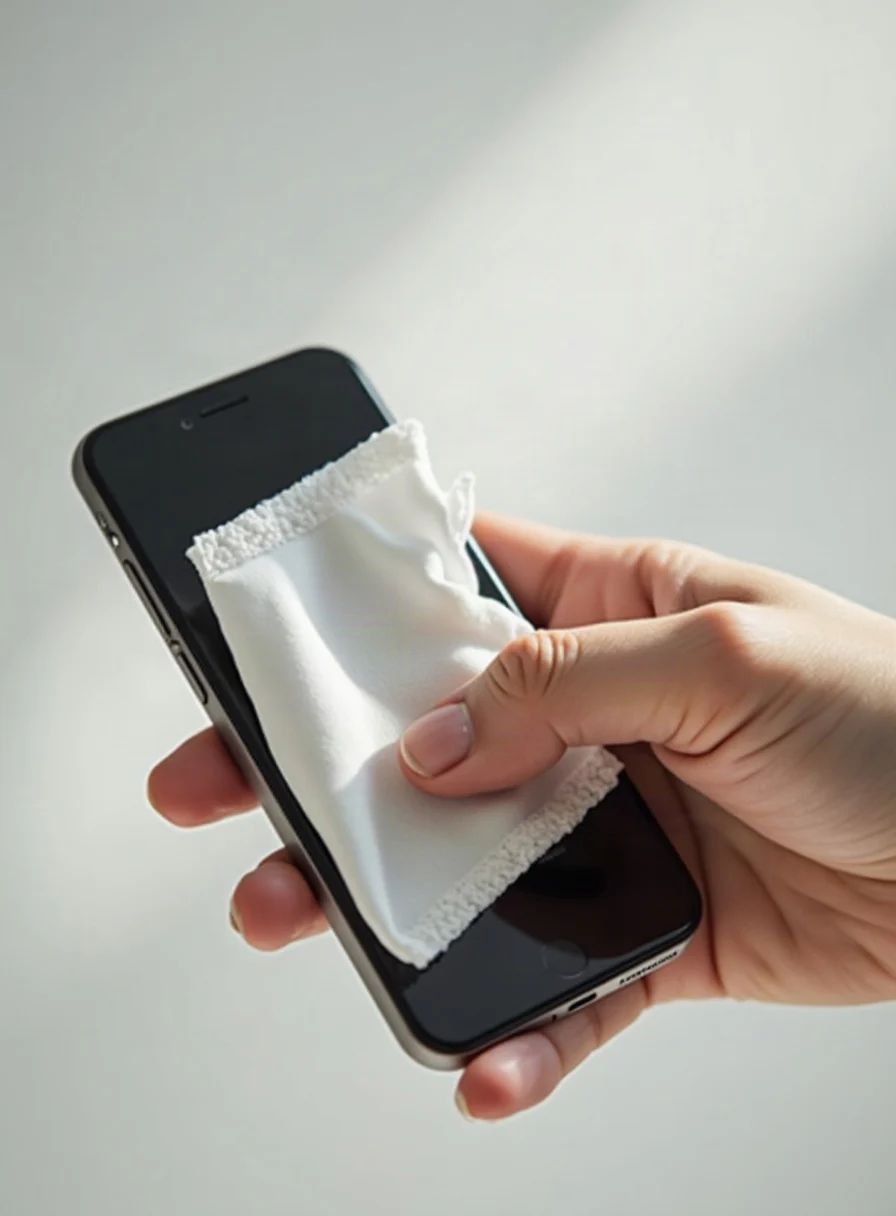
- Power the phone off and unplug it. Take it out of its case and clean the case separately with soapy water.
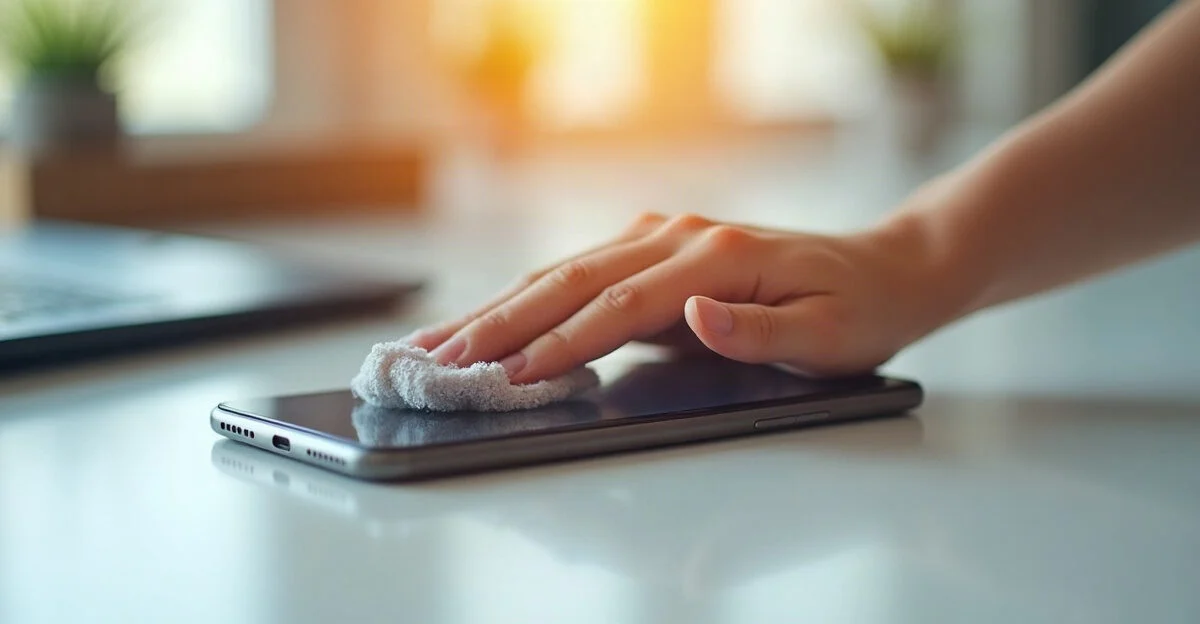
- Wipe the exterior with a 70% isopropyl alcohol wipe. Apple specifically approves a 70% isopropyl alcohol wipe, a 75% ethyl alcohol wipe, or a disinfecting wipe such as Clorox for the outer surfaces.
- For everyday cleaning, a soft, lint-free microfibre cloth very slightly dampened with water is enough to lift oils and smears.
- Dry with a clean microfibre cloth and let it air a moment before putting the case back on.
⚠️ Warning: Do not use bleach or hydrogen peroxide, and never submerge your phone or let moisture get into the charging port or speakers. Apple also warns against household and window cleaners, aerosol sprays, compressed air, ammonia, solvents and abrasives, which can strip the screen’s protective oleophobic (oil-repelling) coating.
If you use a screen protector, clean it with the same gentle method, and see our step-by-step on cleaning a screen protector (top, underside and sticky side). A blocked charging port is worth a gentle clear-out too. For how disinfecting wipes need to be used to work at all, read do disinfectant wipes work.
How often?
A quick wipe with a dry microfibre cloth every day keeps the screen clear and lifts most of the oils. Give it a proper disinfecting wipe two or three times a week, and always after you have been ill, after travelling, or if it has been anywhere near a bathroom. The single most effective habit is not about the phone at all. Wash your hands properly with soap, especially after the toilet. That breaks the exact chain the UK study exposed. Our comparison of hand sanitiser versus soap explains why soap usually comes out ahead.
If you only buy one thing
As an Amazon Associate we earn from qualifying purchases. The links go to Amazon UK searches, so you can compare makes and sizes yourself.
Two alternatives suit different habits. If you would rather avoid liquid near the screen most days, a pack of lint-free microfibre cloths lifts oils and smears when used dry or barely damp, and can be washed and reused. Keep one for the phone only, and wash it according to the care label without fabric softener, which can leave streaks. If you want a hands-off option that treats other small items as well, a UV phone sanitiser is a convenient extra, but it does not remove dirt and cannot reach shadowed spots, so it complements wiping rather than replacing it.
Phone-hygiene claims, checked
| Claim | The reality |
|---|---|
| Your phone is exactly ten times dirtier than a toilet seat | Directionally true, precisely not. Counts vary by study and method, but phones consistently carry more bacteria than a regularly cleaned toilet seat. |
| A dirty phone will definitely make you ill | Usually not. Most of it is your own harmless skin bacteria. Risk rises when sharing phones, when ill, or around vulnerable people. |
| You should clean your phone with neat alcohol or bleach | No. Use a 70% alcohol wipe. Bleach, peroxide and high-strength solvents can damage the screen coating. |
| Only your toilet needs regular cleaning | The opposite lesson: the toilet is fine because you clean it. It is the phone, remote and door handles that get missed. |
Ten quick answers
- How many germs are on a phone? It varies hugely. Studies find a wide mix of species, from harmless skin flora to E. coli and Staphylococcus, and the numbers depend on the person, the phone and how it is measured.
- Can I use hand sanitiser on my phone? It is not ideal. Gels leave residue and some contain additives that are not meant for screens. A 70% isopropyl wipe is the better choice, but check your phone maker’s guidance first.
- Can I spray disinfectant straight onto the screen? No. Spray can seep into ports and speakers, and aerosols are specifically warned against by phone makers. Dampen a wipe or cloth instead and wipe the exterior.
- Does my phone case need cleaning too? Yes. A case traps dirt and moisture against the phone. Wash silicone or hard plastic cases in warm soapy water and dry fully. Treat leather or fabric cases gently and follow the maker’s advice.
- Are tablets and laptop keyboards just as dirty? Any device handled all day collects microbes, so the same logic applies. Use the maker’s cleaning guidance, and see how to clean a keyboard for keys.
- Does a screen protector make a phone more hygienic? Not by itself. It protects the glass and coating, and a smooth protector is easy to wipe, but it still gets dirty and needs the same regular cleaning.
- Can I catch a cold from my phone? It is possible if someone ill has handled it and you then touch your face, as some cold and flu viruses survive on hard surfaces for hours. Washing hands matters more than the phone.
- Do antibacterial phone cases work? Be sceptical. Claims differ by product and cover only the case surface. None replaces cleaning the phone, and you should look for what the maker actually states.
- Is cleaning an Android any different? The basics are similar, but check the care page from Samsung, Google or whoever made your phone, since coatings and seals differ by model. Never submerge a phone that is not rated for it.
- Does taking my phone to the toilet make it dirtier? It can. Flushing can release a fine spray, which we explain in toilet plume and flushing germs, and handling a phone with unwashed hands is exactly how E. coli ended up on 1 in 6 phones. Leave it outside the bathroom.