The usual way a stainless steel bottle gets ruined is not neglect. It is somebody trying to fix a smell with bleach, a boiling kettle or a microwave. Stainless steel looks indestructible, but the finish, the vacuum insulation and the silicone seals each have their limits, and a few popular cleaning habits can wreck all three or make you ill.
So this guide goes safety first. We start with what to check on the bottle, then the hazards worth knowing about, then the gentlest routine that keeps a bottle clean, and only then the stronger fixes for stains, smells and mould, with a caution attached to each. If you are wondering how much it matters, our piece on whether reusable water bottles are a germ trap looks at what swab studies have found. A narrow-necked flask follows the same rules, and our guide to cleaning a hip flask covers the quirks of that shape. Our page on cleaning a kettle explains the limescale side if hard water is your main problem.
Disclosure: Cleaners Guide is a participant in the Amazon Associates programme, so if you buy through links on this page we may earn a small commission at no extra cost to you. It never changes our recommendations, we suggest products because they work and we point out cheaper options where they do the same job. Prices and availability change, so always check the current price before buying.
Read the bottle before you clean it
Ten seconds with the base of the bottle and the maker’s website will tell you more than any general guide. Look for these:
- Single-wall or vacuum-insulated. Insulated bottles have a sealed gap between two steel walls. A dent or a crushed base can break the vacuum, and heat or freezing can stress the welds. Single-wall bottles are simpler and more forgiving.
- Dishwasher safe or hand wash only. Many bottles are fine in the dishwasher, but powder-coated and painted finishes often fade or peel, and some makers say only the lid goes in. If the paperwork is lost, hand washing is always safe.
- Maximum temperature. Some makers allow hot drinks but not boiling water for cleaning, and the lid and seals usually have a lower limit than the steel.
- Lid materials. Plastic, silicone and sometimes a small metal spring or valve. These are what hold odours and mould, and they decide which cleaners are safe.
- Any warranty terms about cleaning products. A few brands name cleaners they do not allow, or recommend their own tablets.
| Bottle type | Usually fine | Take extra care with |
|---|---|---|
| Plain single-wall steel, no coating | Washing-up liquid, bicarbonate of soda, vinegar soaks, brushes | Chlorine bleach and long salt or acid contact |
| Vacuum-insulated, painted or powder-coated outside | Hand washing, soft cloth outside, soaks inside the bottle only | Dishwashers, abrasives, soaking the outside, any knock to the base |
| Steel bottle with a straw lid or push-button valve | Taking the lid fully apart and cleaning every piece | Bleach or hot water on valves and seals |
| Steel bottle with a flip-top or sports cap | Wash the cap separately, dry fully | Leaving it sealed while damp |
| Flask used for tea, coffee, milk or protein shakes | Frequent washing, tablets made for bottles | Leaving milk-based drinks in it for hours |
What can actually go wrong
None of this means you need to be anxious about a water bottle, but each of these is a real way to damage the bottle or yourself, and each is avoided easily.
Mixing chlorine bleach with anything acidic
Bleach and vinegar, bleach and descaler, bleach and a lemon soak all release chlorine gas, which irritates the airways and eyes. Even a bottle you have rinsed can carry enough vinegar to react. Our guide to cleaning products you should never mix explains the combinations to avoid. The simple rule is to pick one product per cleaning session and rinse thoroughly before trying another.
Bleach on stainless steel
Many articles recommend a dilute bleach soak for mould. We would not. Stainless steel resists corrosion thanks to a thin chromium oxide layer, and chlorine, particularly if left in contact, can attack it and cause pitting that traps dirt and makes future cleaning harder. Many bottle makers specifically advise against chlorine bleach. If you ever do use it because the maker allows it, the label of the bleach and the bottle’s care card are the guide, not a guide like this one. The same applies to chlorine-based sterilising tablets sold for baby bottles, unless the bottle’s maker says they are fine.
A sealed bottle with a fizzing mix inside
Baking soda and vinegar release carbon dioxide. Cap the bottle while it is still reacting and the pressure can pop the lid off or force the cap open, spraying liquid into your face. Always leave the lid off while it fizzes, and rest it on top loosely only after the reaction has stopped, if you need to shake.
Microwaves, freezers and sudden temperature changes
Never put a metal bottle in the microwave. Do not freeze one filled with liquid either, because expanding ice can bulge or split the walls and weld lines, and insulated bottles are especially at risk. Pouring very hot water into a cold bottle is a smaller issue, but it can stress a seal. Let the bottle come back to a normal temperature before you wash it.
Abrasives and wire
Steel wool, scouring pads and gritty powders scratch the steel and strip the coating. Scratches hold bacteria and give stains somewhere to settle. Soft brushes and cloths are enough.
Poor drying and forgotten seals
Most mould in a bottle starts in the lid, not the body. A silicone ring that is never removed, a straw never brushed, or a closed bottle stored wet gives mould a perfect start. If a seal smells musty after proper cleaning, replace it, since spare seals are cheap and often sold by the maker.
Why bottles get dirty so quickly
A bottle is warm, damp and dark inside, and it picks up bacteria from your mouth, hands and the tap every time you drink. Microbes can form a thin, slippery layer called a biofilm on the inside surfaces, and once it has taken hold a quick rinse barely shifts it. That is why a bottle can look fine and still smell stale. Steel itself does not harbour smells the way plastic does, because it is non-porous, so the problem is almost always a film on the surface or the parts around the lid. The cure for a film is physical: warm water, washing-up liquid and a brush that actually touches every surface. Disinfectant on top of an unwashed film does little.
Studies that have swabbed reusable bottles have found plenty of bacteria on lids and mouthpieces, as our article on reusable water bottles and germs explains, but finding bacteria is not the same as finding a hazard. A bottle washed regularly and dried properly is a reasonable, everyday item. The aim of the routine below is to stop growth getting a foothold, not to sterilise anything.
Choosing a bottle that is easier to keep clean
If you are buying a new bottle, a few features make cleaning less of a chore. A wide mouth lets you get a hand or a sponge in. A lid with few parts and a seal that pulls out cleanly is quicker to wash than one with a hidden valve. Smooth interior walls without ridges leave fewer places for residue. Check that spare seals and lids are sold, because replacing a worn part extends the life of the bottle. If you drink from the bottle directly, a drinking spout you can reach with a brush matters more than a clever design.
The safe baseline: washing every day
For plain water, this is all most bottles ever need. Do it as soon as the bottle is empty, or at least once a day.
- Empty the bottle and take the lid apart as far as it will go. Remove the seal, straw and any valve.
- Fill the bottle about a third with hot water and a few drops of washing-up liquid. Hot tap water is fine, as long as you are using gloves if it is too hot for your hands.
- Scrub the inside with a bottle brush, working the bristles to the base and the shoulders. A long-handled brush such as a long handle bottle brush reaches the bottom of a tall bottle, and a firm, soft-bristle head will not mark the steel. Skip anything with metal bristles.
- Wash the lid, seal and straw separately in the same soapy water, using a small brush or an old toothbrush on the threads. A bottle cleaning brush set with a thin straw brush and a small detail brush saves a lot of fiddling, and it is worth choosing one with a cover over the bristle tip for the inside of narrow necks.
- Rinse everything until the water runs clear and there is no slippery feel, because soap left behind affects taste.
- Stand the bottle upside down with the lid off and the parts separate until they are fully dry. Do not screw the lid back on while anything is damp.
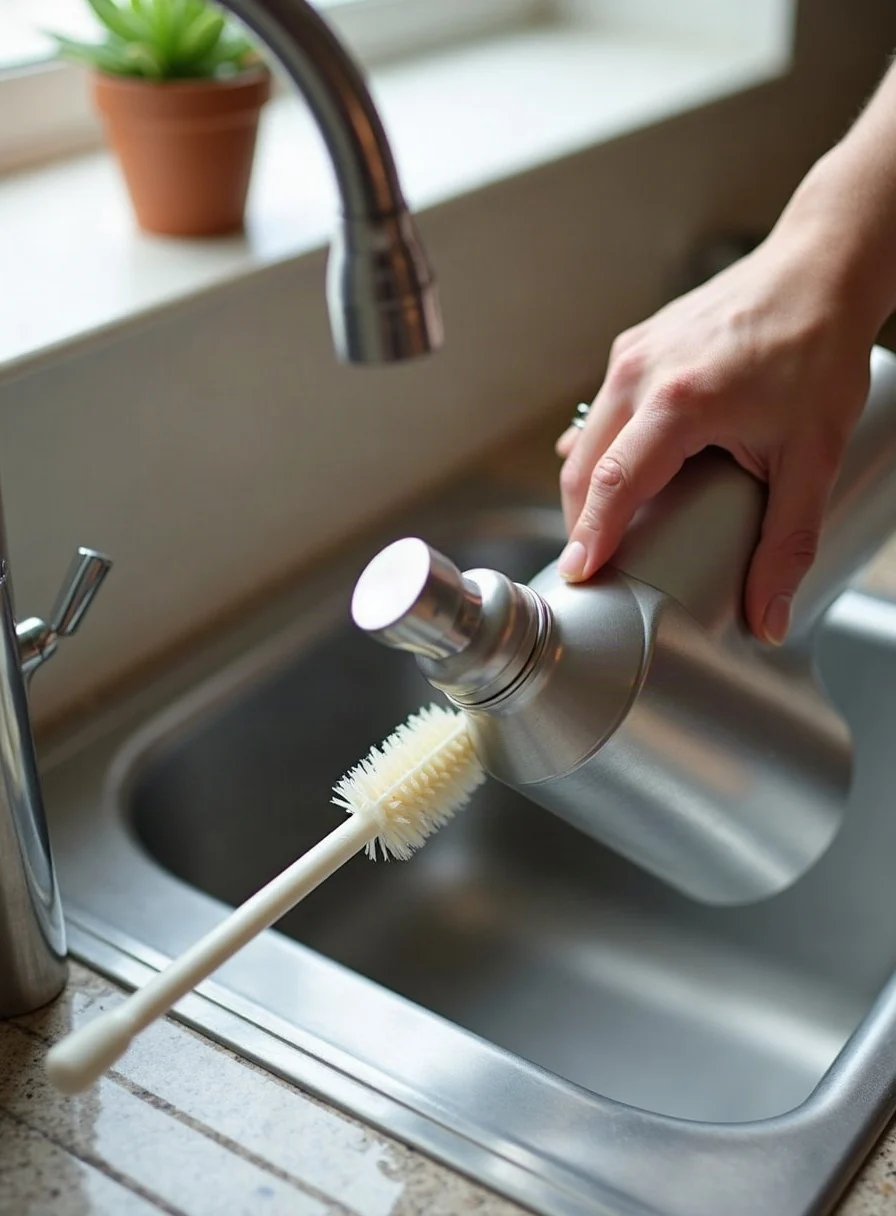
Wipe the outside with a soft cloth. On a painted or powder-coated bottle, leave it out of the sink and do not soak it. If you use the dishwasher, follow the maker’s guidance, and see our comparison of dishwasher versus hand washing for how the two methods differ for items like this.
| Part | How to clean it | How often |
|---|---|---|
| Bottle body inside | Hot soapy water and a bottle brush | After each use for anything other than water; daily otherwise |
| Threads and rim | Small brush or cotton bud and soapy water | Every wash |
| Silicone seal | Pull out of the lid, wash both sides, dry fully | Every wash, replace if it smells or stains |
| Straw or valve | Straw brush or pipe cleaner, then rinse | After each use |
| Outside | Damp cloth, dry | When it is dirty |
Store the bottle with the lid off, or loosely resting on top. A bottle stored sealed and damp for a few days is where most smells come from.
When the dishwasher makes sense
A dishwasher is convenient and reaches high temperatures, which helps with hygiene, and plenty of plain stainless steel bottles are marked dishwasher safe. The caveats are real, though. Powder-coated and painted bottles can lose their finish over many cycles, and some makers say the insulation or the cap seals are not designed for sustained heat. Lids with deep grooves, valves and narrow straws can hold trapped water that does not drain, so even a dishwasher-safe bottle may need a brush first. Put the body and lid on the top rack, separate the seal, and give anything with a straw a hand wash too. If the bottle comes out smelling of the dishwasher, wash it by hand and rinse thoroughly. If you are not sure, hand washing costs a minute and never hurts.
Stronger options for stains and smells, with cautions
Reach for these only when washing has not fixed the problem. They are listed from gentlest to strongest, and you should finish with a full wash and a thorough rinse each time.
Bicarbonate of soda
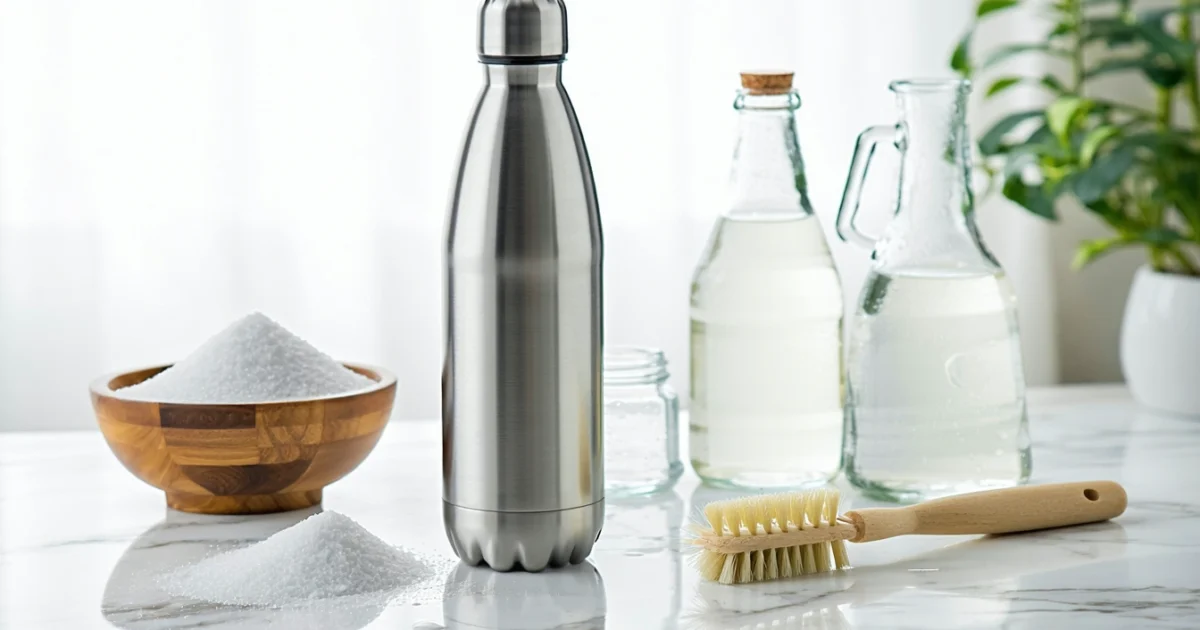
Bicarbonate of soda is mild, cheap and does not harm steel. It absorbs some smells and lifts light tea, coffee and protein film. Our piece on whether bicarbonate of soda disinfects explains why it is better thought of as a deodoriser and a gentle scrub than a sanitiser. Put a couple of tablespoons of bicarbonate of soda in the bottle, add warm water to the shoulder, and leave it, with the lid off, for a few hours or overnight. Brush, then rinse well. For a stubborn stain, mix a little into a thick paste and apply it with a soft cloth or the brush, instead of reaching for a scourer.
Look for a food-grade bicarbonate sold for baking or cleaning, in a tub you can scoop from.
White vinegar
Vinegar dissolves limescale and mineral film, and it helps with sour smells. Mix equal parts white vinegar and water, fill the bottle, and leave it for about half an hour. Some makers allow a longer soak, but most do not want it left for many hours, particularly with seals and valves in it, so check. Wash and rinse afterwards, and if the smell of vinegar lingers, rinse with a little bicarbonate solution and then clean water. Never combine vinegar with bleach. Our piece on whether vinegar disinfects is worth reading before you rely on it to kill germs, because its effect is modest. Do not put vinegar and bicarbonate in at the same time and expect extra cleaning power. The fizz is mostly show and the two largely cancel each other out. Use them one after the other, with a full rinse in between.
Step by step: an overnight bicarbonate soak
- Wash the bottle first so you are not soaking food residue.
- Add two to three tablespoons of bicarbonate of soda to the empty bottle.
- Pour in warm water to about three quarters full, slowly, so it does not foam over.
- Leave the lid off or resting loosely on top. Do not seal it.
- Leave it for a few hours or overnight, stand it somewhere it cannot be knocked over, then brush the inside, especially the base and the neck.
- Rinse several times with warm water, wash with washing-up liquid, rinse again and dry upside down.
Step by step: a vinegar soak for limescale
- Wash the bottle and take the lid apart, and keep silicone seals out of the soak unless the maker says they are fine.
- Mix equal parts white vinegar and water in a jug and pour it in until the bottle is full.
- Leave it for around 30 minutes. For heavy limescale, repeat with a fresh mix instead of leaving it for hours.
- Brush the inside, empty it, then wash with washing-up liquid and rinse until you cannot smell vinegar.
- If a vinegar smell lingers, swill with a teaspoon of bicarbonate in water, then rinse with clean water.
- Dry upside down with the lid off.
Cleaning tablets
Effervescent tablets made for bottles and flasks are the least effort. Choose a product that says it is suitable for stainless steel and for use with food and drink, follow the contact time on the pack, and rinse well. A pack of water bottle cleaning tablets suits anyone with a narrow neck who cannot reach the base with a brush, and anyone who uses their bottle for coffee or sports drinks. Another option is a pack of bottle cleaning tablets aimed at coffee and tea stains. Check the ingredients. Avoid chlorine-based tablets for steel, unless the bottle’s maker allows them. Some people use denture tablets for the same job. If the maker permits it, they are an oxygen-based option, but rinse thoroughly and do not leave them in for longer than the pack says.
| Option | Good for | Typical soak | Watch out for |
|---|---|---|---|
| Hot water and washing-up liquid | Everyday use, plain water | Wash and rinse | Nothing, it is the baseline |
| Bicarbonate of soda | Smells, light stains, tea and coffee film | A few hours or overnight, lid off | Do not seal while it is fizzing; not a sanitiser |
| White vinegar and water | Limescale, sour smells | About 30 minutes | Never with bleach; rinse well; avoid long soaks with seals in |
| Bottle cleaning tablets | Narrow necks, coffee and tea stains | As on the pack | Check they are steel-safe and food-safe; rinse thoroughly |
| Rice or cleaning beads with soapy water | Cleaning without a brush | A minute of shaking | Rinse out every grain or bead |
What was in the bottle changes the clean
Plain water barely dirties a bottle, so a daily wash is generous. Everything else leaves something behind, and what it leaves decides how often you need to go beyond washing-up liquid.
| What you put in it | What it leaves behind | What to do |
|---|---|---|
| Plain water | Very little, but a film can still form in the lid and around the threads | Wash every day or two, dry the lid parts fully |
| Tea or coffee | Brown tannin film and a faint smell that carries into the next drink | Wash each day, bicarbonate soak once a week |
| Milk, milk coffee or protein shakes | Fats and proteins that turn sour quickly in a warm bag | Rinse straight away, wash the same day, never leave overnight |
| Smoothies and juice | Sugars and fruit pulp that cling to seams and valves | Rinse at once, use a brush around the lid, dry upside down |
| Squash or electrolyte drinks | Sugary film, and colour that can stain a seal | Wash daily; check silicone seals for staining |
| Hot soup or food in an insulated flask | Grease and food particles | Hot soapy wash with a long brush; check the maker allows food |
Sugary drinks are the quickest route to a slimy film, because sugars feed whatever is growing. If you cannot wash a bottle straight away, at least empty it and rinse it with plain water, and take the lid off while it waits. Never top up yesterday’s drink with today’s.
A first wash for a new bottle
Wash a new bottle before first use. Factory residues, polishing compounds and packaging dust can sit on the inside, and they are the usual reason a new bottle tastes of metal. Hot soapy water, a good rinse and a full dry are enough. Some makers recommend a bicarbonate soak for the first wash, which does no harm.
Hard water and limescale
In hard-water areas, a white or grey chalky film builds up inside, particularly in a bottle you fill with warm water. It is harmless to drink, but it traps stains and can give water a flat taste. A vinegar soak removes it. If you often see limescale, wipe the bottle dry after washing and let it air out instead of leaving drops of water to evaporate inside.
Mould, slime and smells that will not go
Black, green or pink spots, a slimy film or a musty smell after washing mean something is growing, usually in the lid.
- Look at the lid first. Strip out the seal and any valve, and check the groove they sit in. This is where mould normally hides.
- Soak the parts and the bottle separately. Use the vinegar soak above or a steel-safe tablet, then scrub every crevice with a small brush.
- Replace what will not come clean. A silicone seal that is stained or still smells after two good cleans should be replaced. Spare seals are sold for most major brands.
- Check the bottle itself for scratches, dents or pits. Mould that keeps returning in the same spot suggests damage that holds moisture.
- Know when to retire it. If the inside of the bottle is badly pitted, the lining is peeling, or the mould is beyond reach and keeps coming back, buy a new bottle.
If you are unwell after drinking from a bottle that has been left dirty, particularly with vomiting, stomach pain or fever, speak to a pharmacist or your GP, and tell them it may be linked. Washing-up liquid and a brush does not need to be replaced by anything stronger just because a bottle has been neglected.
Getting rid of persistent smells
Milk, protein shakes, smoothies and coffee leave fats and proteins that hold smells. Wash with hot soapy water, then do a bicarbonate soak overnight with the lid off. If a sour smell lingers, follow with a short vinegar soak (after a good rinse), then a final wash. Rinsing with the lid off, and drying fully, is as important as the chemistry. Do not mask a smell by storing the bottle sealed with flavoured liquid in it, since that just feeds what is already growing. Activated charcoal sachets are sometimes suggested. They absorb odours in dry storage, but they are not a replacement for washing, and no loose charcoal should be left in the bottle.
Removing stains and mineral film
Brown tea and coffee film lifts with bicarbonate paste or a tablet. A white chalky film inside is limescale from hard water, and a vinegar soak will dissolve it. Dark spots or rust-coloured freckles on the steel can be rust from a nearby damaged surface or iron in the water. A little bicarbonate paste or a specialist stainless steel cleaner may help, but if the spot is a pit in the metal, it will not come out and you should consider replacing the bottle.
Rescuing a bottle that has been forgotten for weeks
Everyone has found one at the bottom of a bag. Do not sniff it closely. Empty it somewhere you can rinse away, wearing gloves if there is visible growth, and open the windows if the smell is strong. Then work in this order: wash everything with hot water and plenty of washing-up liquid, taking the lid apart and scrubbing the seal and threads; soak the parts and the body in a steel-safe cleaning tablet solution or a vinegar mix; scrub again; rinse until there is no smell at all; and dry fully. If the seal is black or the smell comes back, replace the seal. If the inside is slimy in a way a brush will not shift, or you can see pits or flaking, the bottle has done its job. Never be tempted to add bleach to speed things up.
A quick check before you drink from it
Before you refill a bottle that has been in a cupboard or a car, look into it under a light, smell it, and run a finger around the inside of the rim and lid. A clean bottle smells of nothing, feels smooth and dry, and shows no film or dark specks. Anything else, wash it again. If it still has any smell of mould after a full clean and soak, do not use it.
Cleaning a bottle without a brush
A narrow neck or a curved base can defeat a brush. These work fine, with some care.
- Uncooked rice and soapy water. Add a tablespoon or two of rice, a few drops of washing-up liquid and warm water, put the lid on and shake for a minute. Rice is soft enough not to scratch steel. Rinse until no grains remain, because stray grains harbour moisture.
- Stainless steel cleaning beads or a chain. Reusable and washable. Rinse them well, dry them completely, and store them dry so they do not rust, and use them only with the cap off while shaking if the bottle is hot.
- A bottle cleaning tablet. The simplest approach for a bottle you cannot reach into.
- A long flexible brush or a straw brush. Often fixes a narrow neck at lower cost than any other tool.
Whichever approach you use, a final wash and a long rinse come last, then upside-down drying.
A routine that stops most problems
| How often | What to do |
|---|---|
| Every day | Empty, rinse, and wash with hot soapy water if the bottle held anything but water. Dry upside down with the lid off. |
| Weekly | Take the lid fully apart, scrub threads and seals, and give the bottle a bicarbonate soak if it holds coffee, tea or shakes. |
| Monthly, or when needed | A vinegar soak for limescale or a steel-safe cleaning tablet, then a full wash and rinse. Inspect seals and replace any that are worn or smell. |
| Any time | Wash straight away after dairy, protein shakes or smoothies, and when the bottle smells or tastes off. |
Rotating between two bottles gives each one time to dry out completely, which does more for hygiene than any soak. Carbonated and acidic drinks should not sit in a steel bottle for long, because the pressure and acidity are hard on seals and finish, and many bottles are not designed for fizzy drinks at all. Check the label before filling one. For wider kitchen tidying around your bottle routine, our guide to deep cleaning the kitchen and our appliances and cleaning products pages cover related jobs.
Looking after the outside and the insulation
A dented base on an insulated bottle can mean the vacuum is compromised, and the bottle will stop keeping drinks hot or cold. That does not make it unsafe to drink from, but there is no fix. Painted or powder-coated finishes chip with knocks and show the bare metal, which can rust at the chip if it stays wet. Wipe the bottle dry, avoid abrasive cloths, and if you carry it loose in a bag with keys, expect it to scratch. A silicone sleeve or boot protects the base and the paint. Do not leave a bottle sitting in a puddle of water on a draining board, as that is where rust spots start, and never leave a bottle with liquid in a hot car, where pressure and heat can build up.
Sports caps, straws and children’s bottles
Anything with a bite valve, a flip straw or a push button has more places to hide dirt. Take it apart completely, and if you cannot see how, check the maker’s video or leaflet, because the parts often twist or pull out. Soak small parts in warm soapy water for ten minutes, then scrub with a straw brush. Children’s bottles need the same treatment, and a spare lid makes it much easier to keep one clean while the other dries. If a valve or straw is cloudy, cracked or has black specks that do not come out, replace it.
Gym bags, cars and travel
A bottle zipped inside a bag with a little drink left in it is the classic route to a bad smell. Empty it before you pack it away, and wash it when you get home, not the next morning. If you use it in the car, keep it out of the sun and take it indoors to wash and dry, since a warm car speeds up growth in any remaining liquid. If you travel and cannot do a full wash, rinse with hot water and let the parts air out, then wash properly as soon as you can. Sharing a bottle, or letting someone drink straight from yours, spreads germs just as it does with a cup, so do not do it when someone is ill.
What not to put in your bottle while cleaning
Skip these, even if you see them recommended. Bleach and bleach-based sterilisers, for the reasons above. Oven cleaner, drain cleaner or descaling products made for kettles and coffee machines, since those are not designed for food contact and can be very strong. Salt as a scouring agent, which is both abrasive and, left in contact with steel, can encourage pitting. Pool chemicals of any kind. Alcohol-based sanitisers, which leave residues. Anything that says it is not suitable for food-contact surfaces.
Eight questions about cleaning steel bottles
How often should I wash a stainless steel water bottle?
Wash it daily if you use it every day, and straight after any drink that is not plain water. A bottle that only holds water can sometimes go a couple of days between washes, but the lid and seal need regular attention, because that is where growth begins. Always dry it fully before putting the lid back on.
Is it safe to put a stainless steel bottle in the dishwasher?
Only if the maker says so. Plain steel is generally fine, but powder-coated or painted bottles can fade or peel, and some insulated bottles are not meant for high heat. Lids and seals are more likely to warp. When in doubt, wash by hand, and put the lid on the top rack only if the label allows.
Can I use bleach to clean a stainless steel water bottle?
We would not. Chlorine bleach can pit stainless steel over time, and it is dangerous if it meets vinegar or other acids. Many makers advise against it. A hot soapy wash, a bicarbonate or vinegar soak, or a steel-safe cleaning tablet will deal with almost every problem without the risk.
Why does my steel bottle taste metallic?
A new bottle sometimes tastes of the factory finish and clears after a hot soapy wash. Otherwise it can be leftover soap, a damaged seal, or a build-up of mineral film. Wash thoroughly, rinse well, and try a vinegar soak. If the taste persists, check for pitting or rust inside, and replace the bottle if you find any.
How do I get the smell out of a stainless steel bottle?
Wash with hot soapy water, then fill with warm water and a few tablespoons of bicarbonate of soda and leave it overnight with the lid off. Clean the lid and seal separately, since they often hold the smell. If the seal still smells afterwards, replace it. Dry with the lid off.
Can I clean the lid and straw in the same way?
Yes, but separately. Take out the seal and any valve, wash each part with a small brush, and rinse and air dry them completely. Check the maker’s guidance before soaking parts in vinegar or tablets, because silicone and some plastics can stain, soften or hold the smell of what you used.
Is it safe to store drinks other than water in a steel bottle?
Often yes, but check the label. Many insulated bottles are fine with tea, coffee and squash, though fizzy drinks can build up pressure and are not suitable for most. Milk-based drinks and protein shakes should be washed out the same day. Sugary and acidic drinks left for long periods can stain the inside and mark the seal.
How do I know when to replace my water bottle?
Replace it if the inside is pitted, rusty or peeling, if the vacuum seal has failed (an insulated bottle no longer keeps drinks hot or cold), if it is badly dented, or if mould or smell keeps returning after proper cleaning. Replace worn seals sooner, as they are the cheapest part to renew.